
Introduction
Car washing and cleaning are essential processes in the automotive industry. From automatic car wash tunnels and conveyor-based washing systems to manual vehicle cleaning stations, effective water spraying plays a crucial role in removing dirt, mud, dust, road grime, and detergent residues from vehicle surfaces.
Modern car washing systems use a combination of water jets, flat fan spray nozzles, foam application systems, and rinsing arrangements to achieve consistent cleaning performance. The selection of suitable spray nozzles depends on factors such as water pressure, flow rate, spray angle, coverage area, nozzle positioning, and the type of cleaning required.
For automobile manufacturers, automatic car wash equipment manufacturers, vehicle detailing equipment suppliers, and industrial cleaning system integrators, selecting the right spray nozzles can help improve cleaning efficiency, optimize water consumption, and achieve consistent spray coverage.
Mican Engineers Pvt. Ltd. provides industrial spray nozzle solutions for washing, rinsing, and cleaning applications, helping equipment manufacturers and system integrators select suitable spray configurations for their requirements.
1. Understanding the Car Washing and Cleaning Process
Before selecting spray nozzles for an automobile washing system, it is important to understand the different stages involved in cleaning a vehicle.
The exact process varies depending on whether the system is an automatic car wash tunnel, rollover car wash machine, conveyor-based washing line, manual pressure washing station, or an industrial vehicle cleaning system.
A typical vehicle washing process includes the following stages.
1.1 Pre-Wash: Removing Loose Dirt and Mud
The pre-wash stage removes loose dust, mud, sand, and other surface contaminants before the main washing process begins.
Water is sprayed over the vehicle's exterior, including the bonnet, roof, windscreen, doors, wheel arches, and lower body panels. In automatic car washing systems, multiple nozzles can be positioned around the vehicle to provide
coverage from different directions.
The objective is to loosen and remove surface contaminants before contact washing or the application of cleaning chemicals.
Role of spray nozzles:
Flat fan spray nozzles can produce a wide, sheet-like spray pattern for covering vehicle surfaces.
Full cone spray nozzles can provide a broader distribution of water droplets over selected areas.
Straight jet or water jet nozzles can deliver a concentrated stream for targeted cleaning applications.
The appropriate nozzle depends on the required impact, spray coverage, operating pressure, and distance between the nozzle and the vehicle.
1.2 Detergent or Pre-Soak Application
After the initial rinse, a suitable detergent or pre-soak cleaning solution may be applied to the vehicle surface.
The cleaning solution helps loosen stubborn road grime, oily residues, and other contaminants. Allowing the solution to remain on the surface for the recommended contact time can improve cleaning performance.
Depending on the system design, the cleaning solution may be applied through dedicated chemical application nozzles, foam systems, or spray arches.
Role of spray nozzles:
Flat fan nozzles help distribute liquid across broad surfaces.
Full cone nozzles can provide area coverage where a more distributed spray is required.
Air atomizing nozzles may be suitable for certain applications requiring fine droplets, depending on the chemical properties and system requirements.
Nozzle selection should account for the liquid's viscosity, chemical compatibility, desired droplet size, and application method.
1.3 High-Pressure Washing
High-pressure washing is used in many vehicle cleaning systems to remove stubborn dirt, mud, and accumulated contaminants.
Water is delivered through a pump and directed towards the vehicle using appropriately selected spray nozzles. The pressure, flow rate, spray angle, and nozzle-to-surface distance influence the cleaning effect.
High-pressure spray arrangements may be used for vehicle underbodies, wheel areas, lower body panels, and other surfaces where stronger cleaning action is needed.
Role of spray nozzles:
Straight jet nozzles provide a concentrated stream for targeted cleaning.
Flat fan nozzles distribute the water into a fan-shaped pattern, making them useful for cleaning strips or wider surfaces.
Specially designed high-pressure nozzles can be selected for particular equipment configurations and operating conditions.
The goal is to achieve the required cleaning performance without damaging paint, delicate trim, sensors, seals, or other vehicle components. Excessive pressure or an unsuitable spray configuration can damage sensitive surfaces.
1.4 Main Washing and Surface Cleaning
The main washing stage removes remaining dirt and distributes water or cleaning solution across the vehicle.
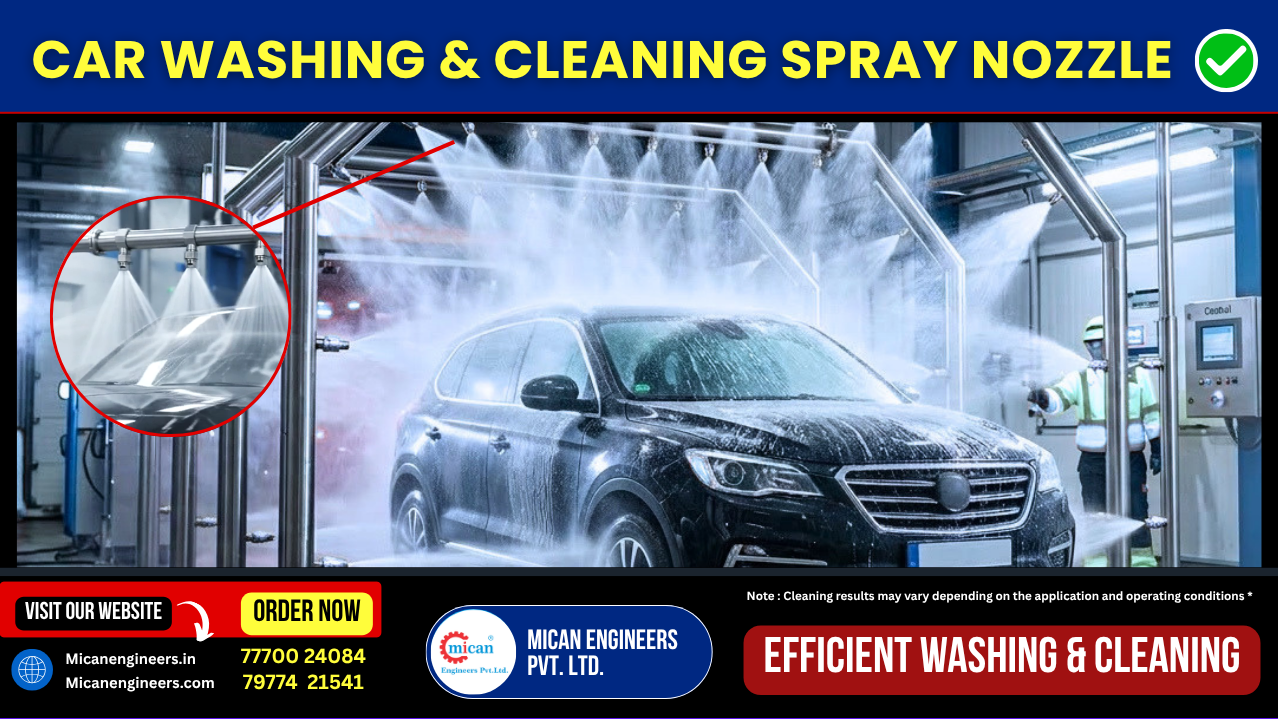
In automatic washing equipment, spray nozzles may be installed on overhead headers, side manifolds, rotating arms, or strategically positioned spray bars. Their arrangement helps cover the vehicle as it moves through the system or as the washing equipment moves around it.
Role of spray nozzles:
Flat fan nozzles provide broad, overlapping spray coverage.
Full cone nozzles distribute liquid over a defined area.
Multiple nozzle arrangements can improve coverage across the roof, sides, front, rear, and lower body of a vehicle.
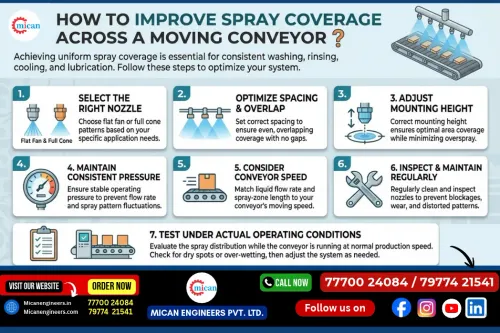
The spray angle and spacing between adjacent nozzles must be considered carefully. Proper overlap helps reduce untreated areas and improves the consistency of the washing process.
1.5 Wheel, Tyre and Underbody Cleaning
Wheels, tyres, wheel arches, and underbody surfaces often accumulate mud, road salt, brake dust, and other contaminants.
These areas may require dedicated spray arrangements because their geometry and contamination levels differ from those of the main vehicle body.
Role of spray nozzles:
Straight jet nozzles can be considered for targeted cleaning.
Flat fan nozzles can cover wider wheel or underbody sections.
Full cone nozzles can be used where distributed coverage is required.
For automated systems, nozzle positioning and spray direction are particularly important for reaching difficult areas while limiting unnecessary water consumption.
1.6 Final Rinsing
After the detergent and loosened contaminants have been removed, the vehicle is rinsed with clean water.
The objective is to remove residual cleaning chemicals and dirt while providing consistent coverage over the vehicle's exterior.
In automatic car wash machines, the final rinse may be performed using overhead and side spray headers or multiple nozzle assemblies.
Role of spray nozzles:
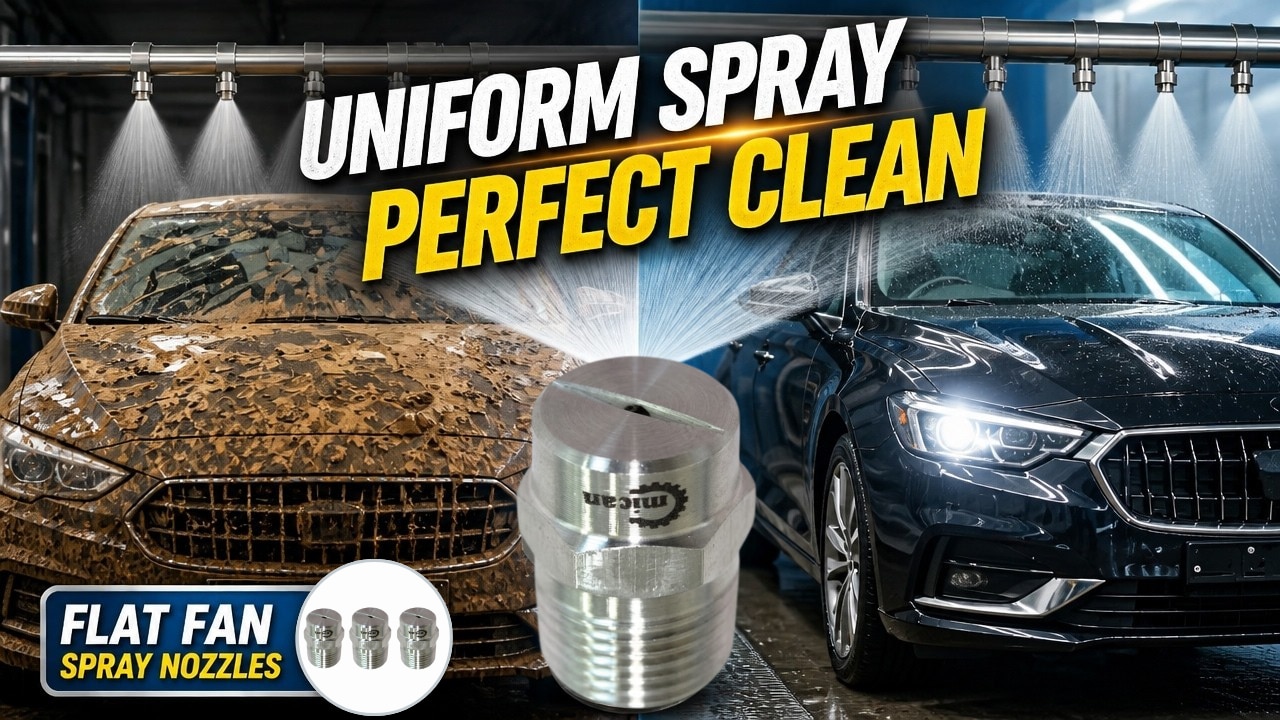
Flat fan spray nozzles can cover broad surfaces with a uniform fan-shaped pattern.
Full cone nozzles may be used for applications requiring distributed water coverage.
Multiple nozzle arrangements can help rinse the roof, side panels, windows, and other accessible surfaces.
The nozzle configuration should provide sufficient coverage without excessive overlap or unnecessary water discharge.
1.7 Drying and Finishing
The final stage may involve air drying, water removal, spot-free rinsing, or manual finishing.
Some systems use treated or demineralized water for the final rinse to reduce water spots. Drying is commonly achieved with air knives, blowers, or dedicated drying equipment rather than conventional liquid spray nozzles.
In integrated washing systems, air wiping equipment may be used to remove residual water from vehicle surfaces before the vehicle leaves the washing station.
The choice of equipment depends on the required finish, production speed, and overall car wash system design.
2. Which Spray Nozzles Are Used for Car Washing?
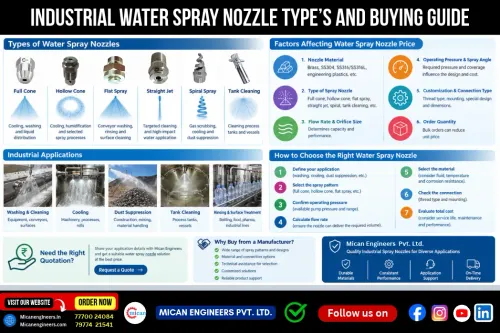
Different spray nozzle types produce different spray patterns. Understanding these patterns helps car wash equipment manufacturers select nozzles for each cleaning stage.
2.1 Flat Fan Spray Nozzles
Flat fan spray nozzles produce a fan-shaped liquid pattern that spreads across a relatively narrow, elongated area.
They are widely considered for applications that require coverage along a surface, strip, or moving vehicle.
Applications in car washing:
Pre-washing vehicle exteriors
Rinsing the roof, bonnet, and side panels
Washing vehicles in conveyor-based systems
Cleaning wheel and underbody sections
Installing on spray bars and washing headers
Flat fan nozzles are particularly useful when multiple nozzles can be arranged with suitable spacing to create overlapping spray patterns.
The F-series flat fan nozzles from Mican Engineers can be evaluated for suitable vehicle washing applications. The final model should be selected according to the required flow rate, pressure, spray angle, and mounting arrangement.
2.2 Full Cone Spray Nozzles
Full cone spray nozzles distribute liquid over a roughly circular area, producing a filled spray pattern.
They may be used where water needs to be distributed over a defined target area rather than concentrated into a narrow stream.
Applications in car washing:
General washing and rinsing
Cleaning selected vehicle sections
Water distribution in customized washing systems
Applications requiring distributed spray coverage
The suitability of a full cone nozzle depends on the required droplet distribution, impact, coverage, and installation geometry.
2.3 Straight Jet or Water Jet Nozzles
Straight jet nozzles produce a concentrated stream of liquid for targeted cleaning.
They may be suitable for applications where localized cleaning action is required rather than broad surface coverage.
Applications in car washing:
Targeted mud removal
Wheel and tyre cleaning
Selected underbody cleaning applications
Manual or automated pressure washing equipment
Operating pressure and nozzle distance must be selected carefully to avoid damaging paintwork and sensitive vehicle components.
2.4 High-Pressure Spray Nozzles
High-pressure spray nozzles are designed for systems operating under elevated liquid pressure. Depending on their design, they may produce a flat fan, straight jet, or another spray pattern.
They are used in applications where stronger cleaning action is required, such as removing stubborn dirt from selected vehicle surfaces.
The nozzle must be compatible with the pump capacity, operating pressure, fluid, and intended cleaning task. A high-pressure system should always be designed with suitable safety measures and pressure-rated components.
2.5 Air Atomizing Spray Nozzles
Air atomizing nozzles use compressed air to atomize liquid into finer droplets.
They are not generally the first choice for ordinary high-volume vehicle rinsing, but they may be considered for specialized coating, misting, or controlled liquid application processes associated with particular equipment.
For conventional car washing, flat fan, full cone, and suitable water jet nozzles are typically more relevant starting points.
3. Why Is Correct Spray Nozzle Selection Important?
Selecting a nozzle based only on its connection size or nominal spray angle may not deliver the desired washing performance. Several technical parameters should be evaluated.
3.1 Spray Pattern and Coverage
The spray pattern determines how water is distributed over the target surface.
Flat fan nozzles are suitable for elongated coverage, while full cone nozzles distribute liquid across a circular area. Straight jet nozzles concentrate the flow into a narrow stream.
The correct pattern depends on the vehicle surface, the cleaning stage, and the arrangement of the washing equipment.
3.2 Flow Rate and Operating Pressure
Flow rate determines how much water passes through the nozzle over a given period. Operating pressure influences the spray characteristics and, for many nozzle designs, the flow rate.
For a fixed nozzle geometry and liquid, flow rate commonly changes approximately with the square root of the pressure ratio:
Q₂ = Q₁ × √(P₂/P₁)
Where:
Q₁ = initial flow rate
Q₂ = flow rate at the new pressure
P₁ = initial pressure
P₂ = new pressure
This relationship is an approximation for comparable operating conditions. Actual performance depends on the nozzle design, fluid properties, and pressure losses in the system.
Selecting the correct flow rate helps balance cleaning performance, pump capacity, and water consumption.
3.3 Spray Angle and Nozzle Spacing
Spray angle affects the width of the spray pattern at a given distance from the nozzle.
For an idealized flat fan spray, the approximate spray width can be calculated as:
W = 2 × D × tan(θ/2)
Where:
W = theoretical spray width
D = distance from the nozzle to the target
θ = nominal spray angle
Actual coverage depends on the nozzle's spray characteristics, installation angle, and target geometry.
When several nozzles are mounted on a header, their spacing and orientation should be designed to provide the required coverage and overlap.
3.4 Material and Chemical Compatibility
Vehicle washing systems may use detergents, pre-soak chemicals, and other cleaning formulations.
The nozzle material must be compatible with the liquid, operating temperature, and environmental conditions. Stainless steel and suitable engineering plastics may be considered depending on the application.
The final material choice should be confirmed against the chemical manufacturer's compatibility guidance and the nozzle supplier's technical specifications.
3.5 Durability and Maintenance
Spray nozzles operate repeatedly in washing systems and may be exposed to suspended particles, chemical residues, and changing operating conditions.
Appropriate filtration, periodic inspection, and timely replacement of worn or clogged nozzles can help maintain consistent spray performance.
For equipment manufacturers, selecting nozzles that are easy to inspect, clean, and replace can also simplify maintenance.
4. Mican Engineers Spray Nozzles for Car Washing and Cleaning Systems
Mican Engineers Pvt. Ltd. offers industrial spray nozzle solutions for a range of liquid spraying, washing, rinsing, and cleaning applications.
For automobile washing equipment manufacturers, automatic car wash system integrators, manual washing equipment suppliers, and industrial cleaning system designers, Mican Engineers can help identify suitable spray nozzle
configurations based on the application requirements.
Potential areas of evaluation include flat fan spray nozzles, full cone spray nozzles, straight jet or water jet nozzles, and suitable high-pressure spray solutions.
Flat Fan Spray Nozzles for Vehicle Washing
Mican Engineers' flat fan nozzle range can be evaluated for applications requiring broad, fan-shaped spray coverage.
Potential uses include:
Pre-wash water spraying
Vehicle body washing
Rinsing operations
Spray headers and manifolds
Automated vehicle washing equipment
Customized washing and cleaning systems
For car washing applications, the F1 to F5 series can be evaluated against the required spray angle, flow rate, pressure, and coverage. The appropriate series and model should be confirmed using the current product specifications and the intended operating conditions.
Full Cone Spray Nozzles for Distributed Water Coverage
Mican Engineers' full cone spray nozzles may be considered for washing applications that require liquid distribution over a defined area.
Depending on the model and installation arrangement, these nozzles can be incorporated into customized washing manifolds and other liquid distribution systems.
Straight Jet and Water Jet Nozzles for Targeted Cleaning
For applications requiring a concentrated stream of water, suitable straight jet or water jet nozzles may be evaluated.
Potential applications include selected wheel cleaning, underbody washing, and targeted dirt removal. The operating pressure, nozzle distance, and stream impact must be matched to the surface being cleaned.
Customized Spray Arrangements for Car Wash Equipment
A car wash system may require different spray patterns at different stages. Rather than using the same nozzle throughout the entire system, equipment designers can select suitable nozzle types and arrange them according to the cleaning requirements.
Mican Engineers can work with customers to assess the required spray pattern, operating conditions, material, connection, and installation configuration for an application-specific solution.
The final nozzle selection should be based on verified technical data and, where appropriate, practical testing under representative operating conditions.
5. Applications of Spray Nozzles in the Automobile Industry
Industrial spray nozzles can be incorporated into various vehicle washing and cleaning systems, including:
Automatic car wash machines: For pre-washing, detergent application, rinsing, and vehicle surface cleaning.
Conveyor-based car wash tunnels: For continuous washing of vehicles moving through multiple cleaning stages.
Rollover car wash systems: For washing vehicles while spray arches or other equipment move around them.
Manual car washing stations: For water spraying, rinsing, and targeted cleaning.
Wheel and underbody washing systems: For cleaning areas exposed to mud and road contaminants.
Commercial vehicle washing systems: For cleaning cars, vans, buses, and selected fleet vehicles, subject to suitable system design.
Automotive equipment manufacturing: For integrating spray headers, manifolds, and nozzle assemblies into customized washing equipment.
The nozzle selection and arrangement should always be tailored to the vehicle type, cleaning process, available water supply, and required production capacity.
6. How to Select the Right Spray Nozzle for a Car Washing Machine
Before selecting a nozzle for an automatic or manual car washing system, equipment manufacturers should establish the following requirements:
Cleaning stage: Determine whether the nozzle is intended for pre-washing, detergent application, high-pressure cleaning, or final rinsing.
Required spray pattern: Select a flat fan, full cone, or straight jet pattern according to the target area and cleaning objective.
Operating pressure: Confirm the working pressure and available pump capacity.
Required flow rate: Determine the water consumption per nozzle and the total flow required by the system.
Spray angle and distance: Evaluate coverage at the actual nozzle-to-vehicle distance.
Nozzle spacing and orientation: Design the header or manifold to achieve suitable coverage across the target surfaces.
Material and connection: Verify chemical compatibility, durability, thread type, and mounting requirements.
Water quality and filtration: Consider suspended particles and the filtration required to reduce clogging.
Surface protection: Ensure that the spray impact is suitable for vehicle paint, glass, sensors, seals, and trim.
Testing and validation: Where possible, test the proposed nozzle arrangement under representative operating conditions before finalizing the design.
Providing these details to the nozzle supplier helps narrow the available options and supports a more reliable selection.
7. Why Consider Mican Engineers for Car Washing Spray Nozzles?
Choosing an industrial spray nozzle supplier involves more than identifying a nozzle with the correct thread size. The spray pattern, flow rate, pressure, material, and installation arrangement must work together to meet the requirements of the washing system.
Mican Engineers Pvt. Ltd. specializes in industrial spray nozzle solutions and can assist equipment manufacturers and system integrators in evaluating nozzle options for washing and cleaning applications.
When discussing your requirements, provide details of the washing process, target surface, operating pressure, required flow rate, preferred spray pattern, and mounting arrangement. These details help establish which nozzle configuration is most appropriate.
Whether you are developing an automatic car wash machine, a vehicle washing tunnel, or a customized industrial cleaning system, selecting the right spray nozzle is an important step towards achieving consistent and effective cleaning performance.
Conclusion :
Car washing and cleaning involve several stages, from removing loose dirt during pre-washing to applying cleaning solutions, performing the main wash, cleaning wheels and underbody areas, and completing the final rinse.
Each stage may require a different spray pattern and operating configuration. Flat fan spray nozzles are useful for broad surface coverage, full cone nozzles can distribute liquid over a defined area, and straight jet nozzles can provide concentrated cleaning action for selected applications.
For automobile equipment manufacturers and industrial cleaning system integrators, Mican Engineers Pvt. Ltd. offers spray nozzle solutions that can be evaluated for car washing, vehicle rinsing, and customized cleaning systems.
Contact Mican Engineers to discuss your application requirements and identify suitable spray nozzle options for your car washing or vehicle cleaning equipment.
Mican Engineers Pvt. Ltd. — Your Partner in Industrial Spray Solutions.
#MicanEngineers #CarWashing #SprayNozzles #AutomotiveIndustry #IndustrialCleaning #FlatFanNozzles #FullConeNozzles #AutomaticCarWash #VehicleCleaning #IndustrialSpraySolutions #carwashingnozzle #carwashingnozzle #carwashingspray #spraynozzlesforwashing #automobileindustry #automobilecleaning #carwashingservices #carcleaningservice #carwashingnozzle #automaticcarwashingnozzle #micanengineers