

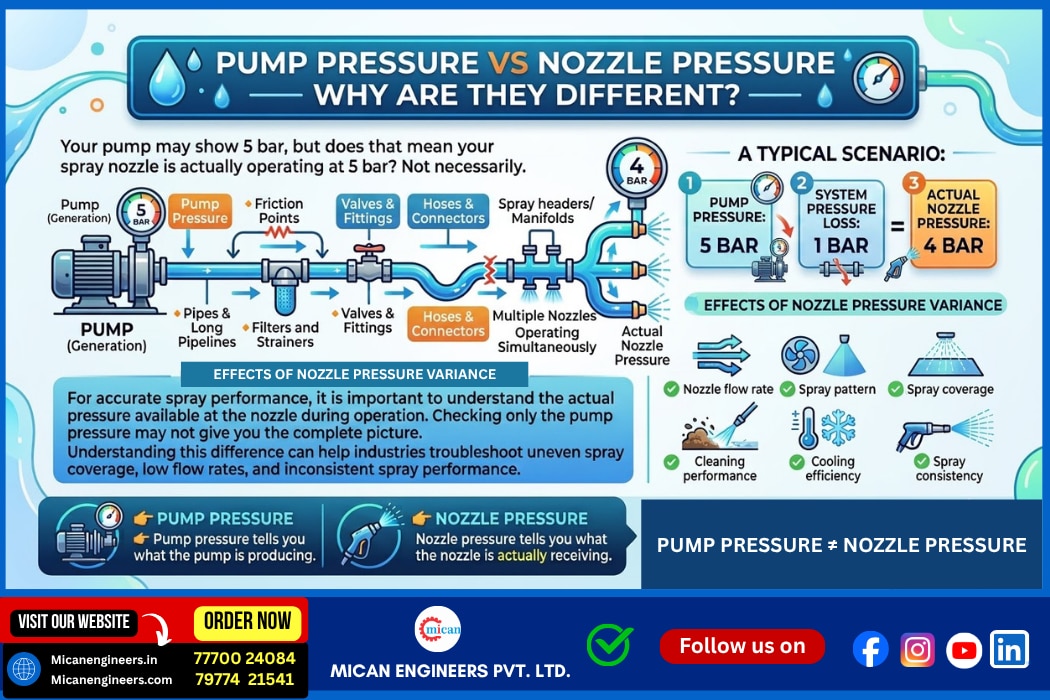
Pump Pressure vs Nozzle Pressure: Why Are They Different ?
Pump pressure and nozzle pressure are two important parameters in any industrial spray system. However, they are not always the same.
A pump may be rated or adjusted to deliver a certain pressure, while the pressure measured near the spray nozzle can be significantly lower.
This difference can affect spray pattern, flow rate, coverage, droplet size, cleaning performance, cooling efficiency, and overall process consistency.
Understanding why pump pressure and nozzle pressure differ is therefore essential when selecting spray nozzles and designing or troubleshooting an industrial spray system.
What Is Pump Pressure ?
Pump pressure is the pressure generated by the pump as it moves liquid through the spray system.
Depending on the system design, pressure may be measured:
- At the pump discharge
- Near the pump outlet
- At a pressure gauge installed on the discharge line
- At a manifold or header
For example, suppose a pump discharge pressure is:
5 bar
This does not necessarily mean that every spray nozzle in the system receives exactly 5 bar.
The liquid still has to travel through pipes, valves, filters, fittings, manifolds, hoses and other components before reaching the nozzle.
What Is Nozzle Pressure ?
Nozzle pressure is the pressure available at or immediately upstream of the spray nozzle during operation.
This is the pressure that directly influences the nozzle's hydraulic performance.
For a given nozzle, changing the pressure can affect:
- Flow rate
- Spray angle
- Spray distribution
- Droplet size
- Spray velocity
- Coverage
- Atomization
Therefore, when evaluating the performance of a spray nozzle, pressure at the nozzle is more relevant than pressure measured only at the pump.
Why Does Pressure Drop Between the Pump and Nozzle ?
The main reason is pressure loss in the piping and components between the pump and the nozzle.
A simplified spray system can be represented as:
Pump → Pipe → Filter → Valve → Manifold → Hose/Fittings → Nozzle
Every component can introduce some pressure loss.
For example:
Pump Pressure = 5 bar
After losses in the piping system:
Pressure at Nozzle = 4 bar
The difference is:
5 − 4 = 1 bar pressure loss
This 1 bar has not disappeared. It has been converted primarily into frictional losses and other hydraulic losses in the system.
1. Pipe Friction
Liquid flowing through a pipe experiences resistance against the pipe wall.
The longer the pipe and the higher the flow rate, the greater the potential pressure loss.
For example, a system with:
- Long piping
- Small pipe diameter
- High flow rate
can experience considerably more pressure loss than a short system using appropriately sized piping.
Why does pipe diameter matter ?
If the pipe diameter is too small for the required flow, liquid velocity increases and pressure loss can increase significantly.
Therefore, undersized piping can prevent the nozzle from receiving the pressure required for its intended operation.
2. Filters Can Cause Pressure Loss
Filters are commonly installed to protect spray nozzles from particles and contamination.
However, a filter creates resistance to flow.
A clean filter may have relatively low pressure loss, but as the filter becomes clogged, the pressure drop across it can increase.
For example :
Before filter: 4.8 bar
After filter: 4.2 bar
Pressure loss across filter:
0.6 bar
This is why a clogged filter can sometimes appear to be a nozzle-pressure problem even though the actual cause is upstream.
3. Valves and Fittings Also Create Losses
Valves, elbows, tees, reducers, unions, connectors and other fittings can contribute to pressure loss.
A system containing many fittings may have considerably more resistance than a simple, short pipeline.
This is particularly important in systems with :
- Multiple branches
- Large manifolds
- Long hoses
- Numerous valves
- Several spray headers
4. Long Hoses Can Reduce Nozzle Pressure
Flexible hoses are frequently used to connect spray headers, guns and nozzles.
If the hose is:
- Too long
- Too small in diameter
- Carrying a high flow rate
the pressure at the nozzle can be lower than expected.
For this reason, hose selection should consider flow rate, length and internal diameter, rather than only connection size.
5. Multiple Nozzles Change the System Requirement
When several nozzles operate simultaneously, the pump must supply the combined flow requirement.
For example, imagine a spray header containing:
10 nozzles
Each nozzle requires:
5 LPM
Total required flow:
10 × 5 = 50 LPM
If the pump cannot supply the required flow at the desired operating pressure, the actual pressure at the nozzles may fall below the target.
This is one of the most common reasons for poor spray performance in multi-nozzle systems.
6. Pressure Can Vary Across a Spray Header
Even if the pump is capable of maintaining the required pressure, the pressure may not be identical at every nozzle.
Consider a long spray header :
Pump → Nozzle 1 → Nozzle 2 → Nozzle 3 → Nozzle 4 → Nozzle 5
As liquid travels along the header, pressure can decrease because of friction and flow distribution.
If the header is not properly designed, the first nozzle may receive higher pressure than the last nozzle.
This can lead to :
- Uneven flow
- Uneven spray coverage
- Different spray patterns
- Inconsistent cooling
- Uneven washing
- Process variation
7. Pump Capacity Matters
A pump's maximum pressure rating does not mean that it will maintain that pressure under every operating condition.
Pump performance depends on the relationship between:
Pressure + Flow Rate
A pump may be capable of producing a certain pressure at low flow, but pressure can decrease as system flow demand increases.
Therefore, pump selection should consider the required total flow and required operating pressure simultaneously.
Pump Pressure vs Nozzle Pressure : Simple Example
Consider an industrial spray system with the following conditions :
| Parameter | Pressure |
|---|---|
| Pump discharge | 6 bar |
| Pipe losses | 0.5 bar |
| Filter loss | 0.3 bar |
| Valve/fitting losses | 0.2 bar |
| Header losses | 0.4 bar |
| Nozzle pressure | 4.6 bar |
Therefore :
6 bar pump pressure − 1.4 bar system losses = 4.6 bar nozzle pressure
The nozzle is therefore operating at approximately 4.6 bar, not 6 bar.
This distinction is important when referring to a nozzle's flow and spray characteristics.
Why Nozzle Pressure Is Important for Spray Nozzle Selection ?
Spray nozzle flow rate is commonly related to pressure approximately according to:
Q₂ = Q₁ × √(P₂/P₁)
Where :
- Q₁ = known flow rate
- P₁ = known pressure
- Q₂ = new flow rate
- P₂ = new pressure
This means that if pressure changes, the nozzle flow rate also changes.
For example, if a nozzle delivers 10 LPM at 4 bar, reducing the pressure to 2 bar will reduce the approximate flow to:
10 × √(2/4) ≈ 7.1 LPM
So a relatively small change in operating pressure can affect the liquid flow delivered by the nozzle.
Actual performance depends on nozzle design, liquid properties and manufacturer specifications.
What Happens When Nozzle Pressure Is Too Low ?
If nozzle pressure falls below the required operating range, several problems can occur.
1. Reduced Flow Rate
Lower pressure generally results in lower flow through a pressure-dependent hydraulic nozzle.
2. Poor Spray Coverage
The spray pattern may not provide the expected coverage.
3. Reduced Spray Velocity
Lower pressure can reduce the velocity of the liquid leaving the nozzle.
4. Poor Cleaning Performance
In applications such as equipment washing or surface cleaning, reduced pressure can decrease cleaning effectiveness.
5. Inconsistent Cooling
For cooling applications, insufficient flow or altered distribution can affect temperature control.
6. Uneven Spray Distribution
In multi-nozzle systems, pressure variation can result in different flow rates between nozzles.
What Happens When Nozzle Pressure Is Too High?
Increasing pressure is not always the solution.
Excessive pressure can :
- Increase flow rate
- Increase pump energy consumption
- Increase wear
- Change spray characteristics
- Increase unwanted mist or overspray in some applications
- Put additional stress on system components
- Potentially damage a nozzle if operated beyond its recommended limits
Therefore, the nozzle should always be operated within the manufacturer's recommended pressure range.
How to Measure Nozzle Pressure Correctly ?
If you want to know the actual pressure available to a nozzle, measuring only the pump discharge pressure is not enough.
A practical approach is to install a pressure gauge as close to the nozzle as possible, ideally at the nozzle inlet or immediately upstream.
For a multi-nozzle system, pressure can be checked at different locations :
Pump → Header Inlet → Header Middle → Header End
This can help identify where pressure is being lost.
Pump Pressure vs Nozzle Pressure: Troubleshooting Checklist
If the pump shows the expected pressure but the spray nozzle is not performing correctly, check :
✔ Pressure measurement location
Is the pressure gauge installed near the pump or near the nozzle ?
✔ Filter condition
Is the filter clogged or undersized ?
✔ Pipe diameter
Is the piping adequate for the required flow ?
✔ Pipe length
Is the pipeline excessively long?
✔ Hose size
Is the hose internal diameter suitable for the flow ?
✔ Valves and fittings
Are there excessive restrictions?
✔ Number of nozzles
Is the pump supplying enough total flow for all operating nozzles ?
✔ Header design
Is pressure distributed evenly across the spray header ?
✔ Pump performance
Can the pump maintain the required pressure at the required total flow ?
✔ Nozzle condition
Is the nozzle worn, partially clogged or damaged ?
How to Reduce Pressure Loss in a Spray System
Several design practices can help maintain adequate nozzle pressure.
1. Select appropriate pipe diameter
Avoid unnecessarily small pipes that create excessive flow resistance.
2. Minimize unnecessary bends and restrictions
Use an efficient piping layout wherever practical.
3. Maintain filters
Regular filter inspection and cleaning can help prevent unnecessary pressure loss.
4. Use suitable hoses
Select hose diameter according to flow rate and length.
5. Balance multi-nozzle systems
A properly designed header can help provide more consistent pressure across multiple nozzles.
6. Select the pump based on both flow and pressure
Do not select a pump based only on its maximum pressure rating.
7. Measure pressure at the nozzle
Actual nozzle pressure should be verified during operating conditions.
Does a Higher Pump Pressure Always Mean Better Spray ?
No.
The objective is not simply to maximize pump pressure.
The objective is to provide the required pressure and flow at the nozzle for the intended application.
For example, if a nozzle requires 3 bar for the desired spray performance, operating the pump at a much higher pressure may simply increase system losses, energy consumption and flow without providing a meaningful process benefit.
A properly designed system should deliver the required operating conditions at the nozzle efficiently.
Pump Pressure vs Nozzle Pressure: Key Difference
The simplest way to remember the difference is:
Pump pressure is the pressure generated by the pump, while nozzle pressure is the pressure actually available to the nozzle after system losses.
Between the pump and nozzle, pressure can be lost due to:
Pipes + Filters + Valves + Fittings + Hoses + Manifolds + Flow Restrictions
Therefore :
Pump Pressure ≠ Nozzle Pressure
in many real-world spray systems.
Conclusion :
Understanding the difference between pump pressure and nozzle pressure is essential for designing, selecting and troubleshooting industrial spray systems.
A pump may generate the required pressure, but if significant pressure is lost through piping, filters, valves, hoses and manifolds, the spray nozzle may not receive the pressure it needs.
For consistent spray performance, always consider:
Pump Capacity → System Pressure Loss → Actual Nozzle Pressure → Nozzle Flow & Spray Pattern
Instead of asking only "What pressure is my pump producing?",
ask:
"What pressure is actually reaching my spray nozzle while the system is operating?"
That measurement can provide a much clearer picture of actual spray-system performance.
Keywords:
industrial spray nozzle pressure, spray nozzle pressure drop, pump pressure for spray nozzles, nozzle operating pressure, spray system pressure loss, spray nozzle flow rate, industrial spray system, spray nozzle manufacturer
Hashtags:
#SprayNozzle #IndustrialSprayNozzles #PumpPressure #NozzlePressure #SpraySystems #PressureDrop #IndustrialSpraying #SprayTechnology #FluidSystems #MicanEngineers #pressuredifference #pumppressurevsnozzlepressure #pressurechange #pumppressure #nozzlepressure
@mumbai @pune @chennai @ahmedabad
