

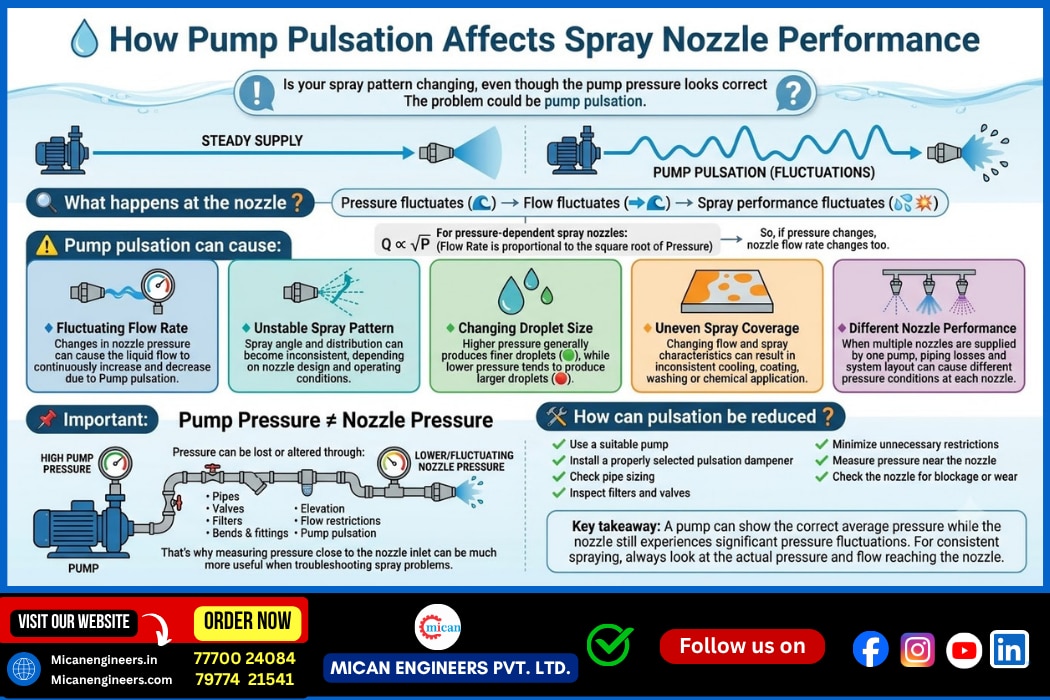
How Pump Pulsation Affects Spray Nozzle Performance ?
In many industrial spray systems, achieving consistent spray performance depends on more than simply selecting the right spray nozzle. The pump supplying the liquid also plays a critical role.
A pump may be rated to deliver a certain flow rate and pressure, but if its output fluctuates significantly, the pressure reaching the spray nozzle can continuously rise and fall. This phenomenon, known as pump pulsation, can directly affect spray pattern, flow rate, droplet size, coverage, and overall process consistency.
For applications such as spray drying, coating, cooling, washing, cleaning, humidification, chemical processing, and pharmaceutical spraying, understanding pump pulsation is important for maintaining stable spray performance.
What Is Pump Pulsation ?
Pump pulsation is the periodic fluctuation of pressure and flow produced by a pump.
Instead of supplying a perfectly steady flow, some pumps deliver liquid in pulses.
For example, imagine a system designed to operate at:
5 bar pressure
Ideally, the nozzle would continuously receive approximately 5 bar.
However, because of pump pulsation, the pressure might fluctuate between:
4 bar → 5 bar → 6 bar → 5 bar → 4 bar
The average pressure may still be around 5 bar, but the nozzle is not actually operating at a constant 5 bar.
This distinction is important because spray nozzles respond to the instantaneous pressure and flow conditions at the nozzle, not simply the average pressure shown by a gauge.
Why Does Pump Pulsation Occur ?
Pump pulsation is commonly associated with positive displacement pumps, particularly pumps that move liquid through reciprocating or cyclic mechanical action.
Common causes include :
1. Reciprocating Pumps
Piston, plunger, and diaphragm pumps can naturally produce pulsating flow because liquid is displaced during individual strokes or cycles.
The faster or more frequent the cycles, the more frequently the pressure fluctuations can occur.
2. Diaphragm Pumps
A diaphragm moves back and forth to transfer liquid. Each stroke can create a change in flow and pressure.
Without adequate pulsation control, these fluctuations can be transmitted directly into the spray line.
3. Multiple-Piston Pumps
Multiple-piston arrangements can reduce pulsation compared with a single-piston design, but they may still produce pressure fluctuations depending on the pump configuration and operating conditions.
4. Inadequate Pulsation Dampening
Even when a pump naturally produces some pulsation, a properly designed system can reduce its effect using devices such as:
- Pulsation dampeners
- Accumulators
- Air chambers
- Properly sized piping
- Appropriate control valves
How Pump Pulsation Affects Spray Nozzle Performance ?
The most important point is that nozzle performance depends on pressure at the nozzle.
If pump pulsation causes nozzle pressure to fluctuate, nozzle performance can also fluctuate.
1. Spray Nozzle Flow Rate Fluctuates
For many pressure-dependent spray nozzles, flow rate approximately follows the relationship:
Q ∝ √P
Where:
- Q = flow rate
- P = pressure
This means flow does not increase linearly with pressure.
For example, suppose a nozzle delivers:
10 LPM at 4 bar
If pressure increases to 9 bar:
Q₂ = 10 × √(9/4)
Q₂ = 15 LPM
Now imagine that pump pulsation causes the pressure to continuously move between 4 and 9 bar.
The nozzle's instantaneous flow will also change.
Therefore, even if the pump's average pressure appears acceptable, the nozzle may not deliver a stable flow.
2. Spray Pattern Can Become Unstable
Many spray nozzles are designed to produce a specific spray pattern at a particular pressure range.
When pressure fluctuates, the spray pattern can change.
Depending on the nozzle design, you may observe:
- Uneven spray distribution
- Fluctuating spray angle
- Intermittent spray
- Pattern distortion
- Irregular coverage
This can be particularly important in processes where uniform coverage is required.
3. Droplet Size Can Change
Pressure also influences the energy available for atomization.
When pressure increases, a pressure atomizing nozzle generally produces smaller droplets, while lower pressure tends to produce larger droplets.
Therefore, if the pump repeatedly moves between low and high pressure, the spray can alternate between different droplet-size conditions.
For example:
Low pressure → larger droplets
High pressure → finer droplets
This can be problematic in applications such as :
- Spray drying
- Humidification
- Cooling
- Chemical spraying
- Pharmaceutical coating
- Combustion-related atomization
4. Spray Coverage Becomes Non-Uniform
Consider a spray nozzle used to cool a moving product.
The nozzle is expected to provide consistent liquid distribution across the target surface.
If pump pressure fluctuates:
Pressure changes → flow changes → spray distribution changes
Some portions of the target may receive more liquid while others receive less.
In a production environment, this can result in :
- Uneven cooling
- Inconsistent coating
- Poor washing
- Incomplete cleaning
- Uneven chemical application
The problem can become even more noticeable when multiple nozzles are connected to the same pump.
5. Multiple Nozzles May Not Receive Stable Flow
Suppose one pump supplies 10 spray nozzles.
If the pump produces significant pulsation, all 10 nozzles may experience pressure fluctuations.
However, the effect may not be identical at every nozzle.
Differences in:
- Pipe length
- Pipe diameter
- Fittings
- Elevation
- Nozzle size
- Branch configuration
- Valve position
can cause different pressure conditions at different points in the system.
This is why pump pressure should not automatically be assumed to be the same as nozzle pressure.
Pump Pressure vs Nozzle Pressure
This is a critical concept when troubleshooting spray systems.
A pressure gauge installed near the pump may show:
6 bar
But the nozzle may receive a different pressure because of:
- Pipe friction losses
- Valves
- Filters
- Bends
- Elevation changes
- Flow restrictions
- Pulsation
- Other system components
For a pulsating system, the difference becomes even more important because the pressure near the pump and pressure at the nozzle can vary dynamically.
Therefore, if nozzle performance is inconsistent, measuring pressure close to the nozzle can provide much more useful information than relying only on the pump outlet gauge.
What Happens When Pressure Pulsates Too Much ?
The severity depends on the nozzle and application, but excessive pulsation can cause several symptoms.
Pump Condition | Possible Nozzle Effect |
|---|---|
| Stable pressure | Stable spray |
| Small pressure fluctuation | Small flow variation |
| Large pressure fluctuation | Significant flow variation |
| Rapid pressure fluctuation | Unstable spray |
| Pressure falls below nozzle operating range | Poor or distorted spray |
| Pressure repeatedly exceeds operating range | Excessive flow and potential equipment stress |
The important point is that average pressure alone does not tell the complete story.
Example: Why Average Pressure Can Be Misleading
Suppose a spray nozzle is designed to operate at:
5 bar
Now consider two systems.
System A
Pressure remains relatively stable:
4.9 → 5.0 → 5.1 → 5.0 bar
System B
Pressure fluctuates significantly:
3 → 5 → 7 → 5 → 3 bar
Both systems may show approximately 5 bar average pressure.
However, their spray performance can be very different.
System A provides relatively stable nozzle operation.
System B continuously changes the nozzle's flow and atomization conditions.
Therefore:
A correct average pressure does not necessarily mean stable spray performance.
How to Reduce Pump Pulsation ?
If pulsation is affecting spray performance, several approaches can be considered.
1. Install a Pulsation Dampener
A pulsation dampener can absorb pressure fluctuations and help create a more stable liquid supply.
It is particularly useful with pumps that naturally produce pulsating flow.
The dampener must be properly selected and installed according to the pump, pressure, liquid, flow rate, and operating conditions.
2. Use an Appropriate Pump
Pump selection should consider more than just the required flow rate and maximum pressure.
Important factors include:
- Pump type
- Required flow
- Operating pressure
- Number of nozzles
- Liquid properties
- Required spray stability
- Pulsation characteristics
For applications requiring extremely stable spray conditions, pump characteristics should be evaluated during system design.
3. Check Pipe Sizing
Incorrect pipe sizing can make pressure fluctuations more noticeable.
A pipe that is too small can create excessive pressure loss and velocity.
The piping system should be designed according to the required:
Flow rate + pressure + pipe length + fittings + liquid properties
4. Reduce Unnecessary Restrictions
Filters, valves, elbows, reducers, and other components can contribute to pressure loss.
A partially blocked filter, for example, can create additional restriction and worsen pressure instability.
Regular inspection of the complete liquid path is therefore important.
5. Measure Pressure Near the Nozzle
If the pump pressure looks stable but the spray remains inconsistent, measure pressure at or close to the nozzle inlet.
This can help identify whether the problem is occurring:
At the pump → in the piping → or near the nozzle.
For troubleshooting, recording pressure over time can be more informative than checking a single static gauge reading.
How to Troubleshoot Pump Pulsation-Related Spray Problems ?
If you notice unstable spray performance, follow a systematic approach.
Step 1: Check the Pump
Determine:
- Pump type
- Pump operating speed
- Rated flow
- Operating pressure
- Whether the pump naturally produces pulsating flow
Step 2: Check Pressure at the Pump
Record the minimum, maximum, and average pressure.
Step 3: Check Pressure Near the Nozzle
Install a suitable pressure gauge or pressure measurement device near the nozzle inlet.
Compare it with the pump-side measurement.
Step 4: Check the Piping System
Inspect :
- Filters
- Valves
- Pipe diameter
- Flexible hoses
- Fittings
- Blockages
- Leaks
Step 5: Inspect the Nozzle
Make sure the nozzle is not:
- Partially blocked
- Worn
- Damaged
- Incorrectly sized
- Operating outside its recommended pressure range
Step 6: Compare Spray Performance
Observe whether changes in pressure correspond with changes in:
- Flow rate
- Spray pattern
- Droplet characteristics
- Coverage
This can help confirm whether pulsation is actually responsible for the problem.
Does Every Spray System Need a Pulsation Dampener?
No.
Not every spray system requires pulsation control.
The need depends on :
- Pump type
- Pump pulsation level
- Nozzle type
- Operating pressure
- Flow requirement
- Application
- Required spray uniformity
- Number of nozzles
For some applications, small pressure fluctuations may have little practical effect.
For precision spraying or atomization applications, however, even relatively small fluctuations can become important.
Conclusion :
Pump pulsation can directly influence spray nozzle performance because changes in pump pressure can produce changes in nozzle flow, spray pattern, and droplet characteristics.
A spray nozzle does not operate based only on the pump's rated pressure. What matters is the actual pressure and flow reaching the nozzle during operation.
When troubleshooting an inconsistent spray system, don't look only at the pump.
Check the entire system :
Pump → Piping → Valves/Filters → Nozzle
Check this Most Common Problems and solutions Related to spray Nozzles :
Why One Nozzle Performs Differently From Another Identical Nozzle : Uneven Nozzle Performs
Why Does Spray Pattern Change During Production? 10 Common Causes & Solutions
Nozzle Vibration Problems : Causes, Effects & Solutions
#SprayNozzle #PumpPulsation #IndustrialSpraying #SprayTechnology #NozzlePerformance #PumpPressure #NozzlePressure #SpraySystem #IndustrialNozzles #ProcessEngineering #inconsistentpressure #inconsistentflow #unevenpressure #unevenflow #unstablespraypattern #changingspraydropletsize #lowpressurefluctuate #sprayfluctuate #nozzlefluctuateproblem #micanengineers
@mumbai @pune @ahmedabad @chennai
