

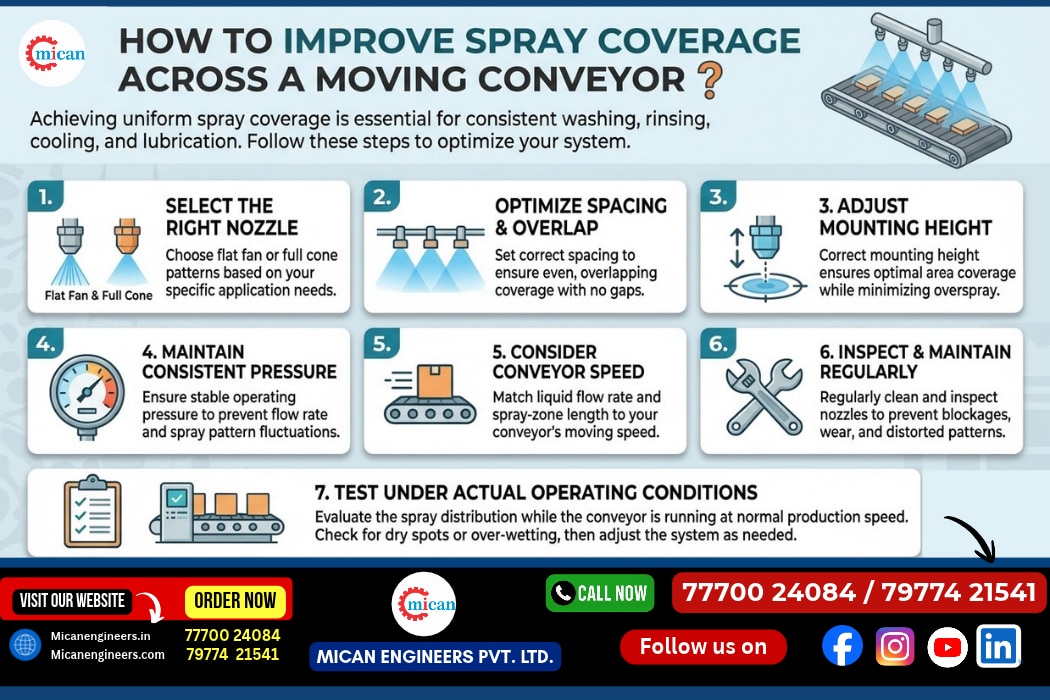
When products move continuously along a conveyor, spray nozzles must deliver the required amount of liquid across the entire target area while accommodating changes in product size, spacing, conveyor speed, and spray pressure.
In this blog, we will explore the common causes of uneven spray coverage and practical ways to improve spray distribution across a moving conveyor system.
1. Identify the Causes of Uneven Spray Coverage
Before making adjustments, it is important to identify why the existing spray system is not delivering consistent coverage.
Common causes include :
Incorrect nozzle selection: The selected spray pattern may not provide sufficient width or distribution for the application.
Improper nozzle spacing: Excessive spacing can create untreated gaps, while incorrect overlap can result in uneven liquid distribution.
Incorrect mounting height: Nozzles positioned too close to or too far from the target can affect spray width and coverage.
Inconsistent operating pressure: Pressure fluctuations can change spray flow rate, droplet characteristics, and spray pattern.
Blocked or worn nozzles: Deposits, contamination, or wear can distort the spray pattern and reduce performance.
Excessive conveyor speed: Products may pass through the spray zone before receiving the required amount of liquid.
Irregular product spacing: Gaps between products or overlapping items can create variations in spray exposure.
Identifying the actual cause helps prevent unnecessary changes to the entire spray system.
2. Select the Right Spray Nozzle
Nozzle selection is one of the most important factors in achieving uniform coverage across a moving conveyor. The appropriate nozzle depends on the required spray pattern, flow rate, pressure, liquid properties, target geometry, and application requirements.
Different spray patterns serve different purposes :
Flat Fan Spray Nozzles
Flat fan spray nozzles produce a narrow, fan-shaped spray pattern suitable for applications requiring controlled coverage across a defined width. They are commonly used for conveyor washing, rinsing, surface treatment, and liquid application.
When multiple flat fan nozzles are installed in a row, their spacing and overlap should be selected carefully to achieve the desired distribution.
Full Cone Spray Nozzles
Full cone spray nozzles distribute liquid over a circular impact area and are useful when a broader, more evenly distributed spray is required. They can be suitable for washing, cooling, and general-purpose liquid application, depending on the target and installation arrangement.
Hollow Cone Spray Nozzles
Hollow cone spray nozzles concentrate liquid around the outer region of a circular spray pattern. They may be appropriate for applications that require peripheral coverage or specific droplet characteristics rather than uniform coverage across a solid surface.
Selection tip: Choose the spray pattern based on the required coverage and application conditions, rather than selecting a nozzle solely by its nominal spray angle.
3. Optimize Nozzle Spacing and Spray Overlap
When several nozzles are mounted above a conveyor, the spacing between them directly affects coverage.
If the nozzles are positioned too far apart, untreated strips may appear between adjacent spray patterns. If the spacing and overlap are poorly matched, certain areas may receive more liquid than others.
For flat fan nozzles, overlapping adjacent spray patterns is often necessary to achieve uniform distribution. However, the correct overlap depends on the nozzle's distribution characteristics, spray angle, mounting height, and operating conditions.
A practical approach is to :
Determine the required conveyor coverage width.
Establish the nozzle mounting height.
Calculate the approximate spray width at the target surface.
Select nozzle spacing based on the manufacturer's spray distribution data.
Verify the actual distribution through a spray test.
Do not assume that overlapping the visible edges of two spray patterns will automatically produce uniform coverage. The liquid distribution across each pattern may vary, so actual performance should be verified.
4. Maintain the Correct Nozzle Mounting Height
The distance between the nozzle and the conveyor surface influences the width and distribution of the spray.
A greater mounting height generally increases the spray footprint, while a lower mounting height reduces it. However, the actual result depends on the nozzle geometry, spray angle, pressure, and surrounding airflow.
Incorrect mounting height can cause several problems:
Insufficient coverage across the conveyor width.
Excessive overlap between adjacent nozzles.
Spray escaping beyond the product area.
Increased overspray and liquid wastage.
Uneven application on products of different heights.
Adjust the nozzle mounting height according to the required coverage area and the manufacturer's recommendations. Where product heights vary significantly, evaluate whether the spray arrangement can accommodate those differences without compromising performance.
5. Match Spray Flow Rate With Conveyor Speed
A moving conveyor introduces an important variable: the time each product spends inside the spray zone.
If conveyor speed increases while the spray flow remains unchanged, each product generally receives less liquid during its passage through the spray zone. This can reduce cleaning effectiveness, coating consistency, cooling performance, or other application results.
For a steady process, match spray flow rate with conveyor speed.
6. Maintain Consistent Spray Pressure
Operating pressure affects nozzle flow rate and spray characteristics. Pressure that is too low may produce an unsuitable spray pattern, while excessive pressure can increase liquid consumption, alter droplet size, and create unwanted overspray.
To maintain stable performance :
Use a pressure regulator appropriate for the system.
Monitor pressure near the spray manifold where practical.
Check for pressure drops caused by undersized piping, clogged filters, or excessive flow demand.
Confirm that the pump can supply the combined flow requirements of all operating nozzles.
Operate within the nozzle manufacturer's recommended pressure range.
Remember that increasing pressure is not always the best way to correct poor coverage. Incorrect nozzle selection, spacing, mounting height, or flow distribution may be the underlying cause.
7. Position Nozzles According to Product Geometry
Uniform coverage across the conveyor does not necessarily mean uniform coverage on every product surface.
For example, flat products may require a different arrangement from cylindrical components, containers, trays, or irregularly shaped parts. Raised edges, recesses, overlapping products, and shadowed areas can prevent the spray from reaching certain surfaces.
Consider the following installation practices:
Position nozzles to cover the full usable conveyor width.
Adjust spray direction according to the surfaces that need treatment.
Use multiple spray directions when a single direction cannot reach the required areas.
Evaluate side-mounted nozzles for vertical surfaces where top-mounted nozzles are insufficient.
Consider separate spray zones for different process requirements.
For applications involving product rotation or complex geometries, additional spray directions or controlled product movement may be necessary.
8. Inspect and Maintain Spray Nozzles Regularly
Even a well-designed spray system can develop uneven coverage over time if nozzles become blocked, damaged, or worn.
Contamination can restrict flow or distort the spray pattern. Wear can enlarge an orifice and increase flow beyond its original specification. Damaged nozzle edges may also produce irregular spray distribution.
A preventive maintenance programme should include :
Inspecting nozzle tips and spray patterns.
Cleaning blocked nozzles using suitable procedures.
Checking filters and strainers for contamination.
Comparing individual nozzle flow rates where practical.
Replacing worn or damaged nozzles.
Checking manifold pressure and leakage.
Verifying nozzle alignment after maintenance.
Avoid cleaning nozzle orifices with tools that may damage precision spray surfaces. Use the manufacturer's recommended cleaning method.
9. Test Spray Coverage Under Actual Operating Conditions
A spray arrangement that looks uniform when the conveyor is empty may not perform the same way during production.
Products can interrupt the spray, create shadowed regions, or change the amount of liquid reaching adjacent surfaces. Conveyor speed and operating pressure can also fluctuate under normal production conditions.
For reliable verification:
Run the conveyor at its normal operating speed.
Set the spray pressure and flow rate to the intended production settings.
Check coverage across the full conveyor width.
Test representative products, including different sizes and shapes.
Identify dry areas, excessive wetting, and uneven distribution.
Adjust nozzle spacing, orientation, pressure, or flow as required.
Repeat the test after each significant adjustment.
Depending on the application, coverage can be assessed using water-sensitive test media, collection trays, flow measurements, fluorescent tracers, or application-specific quality tests. Select a test method compatible with the liquid and process requirements.
10. Consider a Multi-Zone Spray System
For applications requiring different treatment stages, a multi-zone spray arrangement can improve process control.
For example, a conveyor washing system may include separate zones for pre-rinsing, main washing, and final rinsing. Each zone can use an appropriate nozzle type, pressure, flow rate, and spray direction.
A multi-zone arrangement can help :
Match spray conditions to each process stage.
Control liquid consumption.
Reduce unnecessary spraying outside the required area.
Accommodate different product sizes or production conditions.
Simplify troubleshooting and maintenance.
The design should account for the required cleaning or treatment result, drainage, overspray control, and the compatibility of all wetted components with the process liquid.
Common Mistakes to Avoid :
When improving spray coverage across a moving conveyor, avoid these common mistakes :
Increasing pressure without first checking nozzle selection and spacing.
Choosing spray angles based only on catalogue values without checking actual coverage.
Ignoring conveyor speed when calculating liquid delivery.
Using worn nozzles alongside new nozzles without verifying their flow rates.
Overlooking product shadowing and variations in product height.
Assuming that uniform spray appearance guarantees uniform process results.
Making adjustments without documenting the original operating conditions.
A systematic approach is more effective than changing several parameters simultaneously.
Conclusion :
Improving spray coverage across a moving conveyor requires the correct combination of nozzle selection, spacing, mounting height, operating pressure, flow rate, conveyor speed, and maintenance.
By evaluating these parameters together and testing the spray system under actual production conditions, manufacturers can improve liquid distribution, reduce untreated areas, minimize overspray, and achieve more consistent process performance.
At Mican Engineers Pvt. Ltd., we manufacture industrial spray nozzles designed for a range of applications, including washing, rinsing, cooling, surface treatment, and industrial liquid distribution. The appropriate nozzle and arrangement depend on the specific application, operating conditions, and required coverage.
Looking to improve spray coverage on your conveyor system?
Contact Mican Engineers to discuss your application requirements and explore a suitable spray nozzle solution.
Q) Frequently Asked Questions :
1. Which spray nozzle is best for a moving conveyor?
The best nozzle depends on the application. Flat fan nozzles are commonly considered for controlled strip coverage, while full cone nozzles may be suitable for broader impact areas. The final selection should account for the target geometry, required distribution, flow rate, pressure, and conveyor speed.
2. How do I prevent dry spots between spray nozzles?
Check nozzle spacing, mounting height, spray angle, and the liquid distribution across adjacent patterns. For flat fan nozzles, appropriate overlap is often necessary. Confirm the result through a spray coverage test rather than relying only on the visible spray edges.
3. Does conveyor speed affect spray coverage?
Yes. Higher conveyor speed generally reduces the time a product spends in the spray zone. Depending on the process, this may require adjustments to flow rate, spray-zone length, nozzle arrangement, or the number of treatment stages.
4. Can increasing spray pressure improve coverage?
Increasing pressure may change spray width, flow rate, and droplet characteristics, but it does not always solve uneven coverage. First check nozzle selection, spacing, alignment, blockages, and pressure stability.
5. How often should conveyor spray nozzles be inspected?
Inspection frequency depends on liquid cleanliness, operating hours, nozzle material, and process conditions. Establish a preventive maintenance schedule based on actual wear and blockage risk, and inspect the spray pattern whenever process performance changes.
6. How can I reduce water consumption in a conveyor spray system?
Select suitable nozzles, optimize pressure and flow, direct the spray toward the required surfaces, control unnecessary spraying, and maintain consistent nozzle performance. Where appropriate, consider zoned spraying or flow control linked to conveyor operation.
Tags :
conveyor spray nozzles, uniform spray coverage, industrial spray nozzles, flat fan spray nozzle, conveyor washing system, spray nozzle spacing, conveyor spray system optimization.
@mumbai @pune @ahmedabad @chennai
