
Overspray in Industrial Spray Nozzles : Causes, Problems & Effective Solutions
Introduction :
Industrial spray nozzles are designed to deliver precise spray patterns for applications such as cooling, coating, cleaning, dust suppression, humidification, lubrication, and chemical spraying. However, one of the most common issues faced in industrial spray systems is overspray.
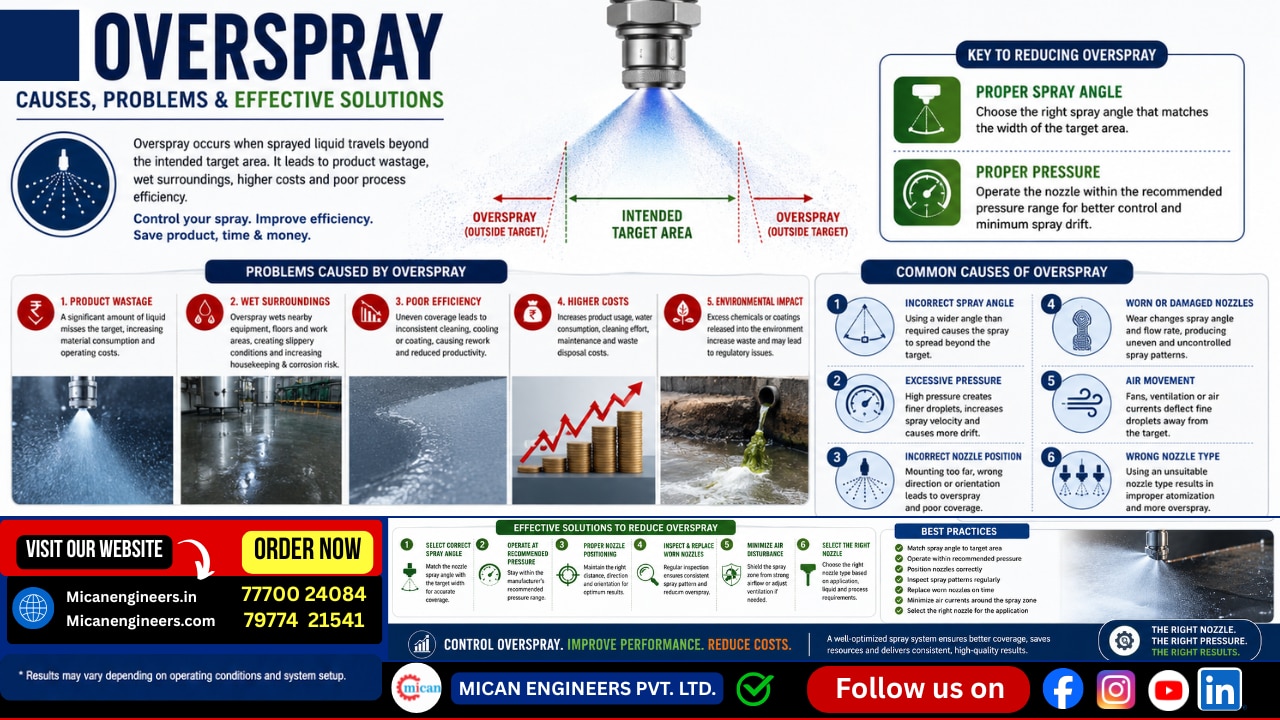
Overspray occurs when sprayed liquid travels beyond the intended target area. Instead of reaching only the desired surface, part of the spray drifts into the surrounding environment. This results in wasted product, increased operating costs, safety hazards, and inconsistent process performance.
Understanding the causes of overspray and implementing the right corrective measures can significantly improve process efficiency while reducing material consumption and maintenance costs.
What is Overspray ?
Overspray refers to the portion of the sprayed liquid that does not reach the intended target. It may settle on nearby equipment, walls, floors, conveyors, or simply remain suspended in the air as fine droplets.
Overspray is commonly observed in industries such as :
Pharmaceutical manufacturing
Food and beverage processing
Chemical processing
Automotive painting
Steel and metal processing
Paper and pulp
Textile manufacturing
Cement plants
Dust suppression systems
Regardless of the application, overspray represents unnecessary loss of material and reduced process efficiency.
Common Causes of Overspray :
1. Incorrect Spray Angle
Choosing a spray angle that is wider than the target surface is one of the primary causes of overspray.
For example, using a 120° spray nozzle when only a narrow spray width is required causes a significant amount of liquid to miss the target.
Selecting the proper spray angle ensures that the spray pattern matches the application area, minimizing waste and improving coverage.
2. Excessive Operating Pressure
Many operators assume that increasing pressure improves performance. In reality, operating above the recommended pressure often creates :
Finer droplets
Increased spray velocity
Greater spray drift
Reduced spray control
Smaller droplets are easily carried away by air currents, resulting in substantial overspray.
Always operate the nozzle within the manufacturer's recommended pressure range for optimal atomization and control.
3. Incorrect Nozzle Position
Even a correctly selected nozzle can produce overspray if it is installed improperly.
Common positioning mistakes include:
Mounting the nozzle too far from the target
Incorrect spray direction
Improper nozzle orientation
Excessive nozzle height
The farther the spray travels, the greater the opportunity for droplets to drift away from the intended surface.
4. Worn or Damaged Nozzles
Industrial nozzles gradually wear due to continuous exposure to abrasive liquids, chemicals, or high-pressure operation.
As wear increases:
Spray angle changes
Flow rate increases
Droplet size becomes inconsistent
Spray distribution becomes uneven
A worn nozzle often produces uncontrolled spray that extends beyond the intended coverage area.
Regular nozzle inspection is essential to maintain spray accuracy.
5. Air Movement Around the Spray Zone
Air movement from:
Exhaust fans
Cooling systems
Ventilation ducts
Compressed air equipment
Open doors
can deflect fine spray droplets away from the target.
This is especially noticeable when atomizing low-viscosity liquids at high pressure.
6. Using the Wrong Nozzle Type
Different industrial applications require different spray characteristics.
For example:
Flat fan nozzles provide uniform linear coverage.
Full cone nozzles provide complete circular coverage.
Hollow cone nozzles produce fine atomization.
Air atomizing nozzles create very fine droplets.
Using an unsuitable nozzle type increases the likelihood of overspray and inefficient liquid distribution.
Problems Caused by Overspray :
1. Product Wastage
Perhaps the biggest consequence of overspray is unnecessary product loss.
Whether spraying:
Water
Chemicals
Paint
Lubricants
Cleaning agents
Coating solutions
every litre that misses the target directly increases operating costs.
Even a small amount of overspray during continuous production can result in significant annual losses.
2. Wet Floors and Surrounding Equipment
Overspray settles on nearby machinery, piping, walls, electrical enclosures, and floors.
This creates several problems:
Slippery working conditions
Increased housekeeping requirements
Corrosion of equipment
Contamination of nearby processes
Electrical safety concerns
Maintaining a clean work environment becomes more difficult when overspray is not controlled.
3. Reduced Process Efficiency
When part of the spray misses the target, the intended surface receives insufficient liquid.
This can lead to:
Uneven cleaning
Poor coating quality
Inconsistent cooling
Inadequate lubrication
Inefficient dust suppression
As a result, production quality decreases and additional processing or rework may be required.
4. Higher Operating Costs
Overspray affects more than just product consumption.
It also increases:
Water usage
Chemical consumption
Pump operating costs
Cleaning labor
Equipment maintenance
Waste disposal expenses
Reducing overspray directly improves process economics.
5. Environmental Impact
Excess chemicals or coatings released into the surrounding environment increase waste generation and may require additional treatment before disposal.
Many industries must comply with environmental regulations that limit emissions and liquid waste.
Controlling overspray supports cleaner operations and regulatory compliance.
Effective Solutions to Reduce Overspray :
1. Select the Correct Spray Angle
Always choose a spray angle that closely matches the target width.
A properly selected spray angle ensures:
Better liquid utilization
Uniform coverage
Reduced product loss
Improved spray accuracy
2. Operate at the Recommended Pressure
Avoid unnecessarily high operating pressure.
Running within the recommended pressure range provides:
Controlled droplet size
Better spray stability
Lower spray drift
Improved process consistency
3. Position the Nozzle Correctly
Proper nozzle placement is equally important.
Ensure that:
Spray distance is appropriate
Spray direction is correctly aligned
Nozzle orientation matches the application
Target surface receives complete coverage without excessive overlap
4. Replace Worn Nozzles Regularly
Nozzles are wear components.
Periodic inspection should include checking:
Flow rate
Spray angle
Spray pattern
Uniformity of distribution
Replacing worn nozzles restores accurate spray performance and minimizes overspray.
5. Minimize Air Disturbance
Where possible:
Shield the spray zone from strong airflow.
Adjust ventilation systems if they interfere with spraying.
Reduce unnecessary air turbulence around the application area.
This helps maintain spray accuracy, especially when fine droplets are involved.
6. Select the Right Nozzle for the Application
Every application has unique spray requirements.
Consider:
Spray pattern
Flow rate
Operating pressure
Droplet size
Liquid properties
Target distance
Choosing the appropriate nozzle design is one of the most effective ways to improve efficiency and reduce overspray.
Best Practices for Preventing Overspray :
Match the nozzle spray angle to the target area.
Operate within the recommended pressure range.
Position nozzles correctly for optimal coverage.
Inspect spray patterns during routine maintenance.
Replace worn or damaged nozzles promptly.
Minimize airflow that can deflect the spray.
Select the correct nozzle type based on the application.
Conclusion :
Overspray may appear to be a minor issue, but over time it can significantly impact production costs, product quality, workplace safety, and operational efficiency. Product waste, wet surroundings, inconsistent coverage, and increased maintenance are all common consequences of poor spray system optimization.
By selecting the correct spray angle, operating at the proper pressure, positioning nozzles accurately, and maintaining them regularly, industries can dramatically reduce overspray and improve overall process performance.
A well-designed spray system not only conserves valuable resources but also delivers consistent, reliable, and cost-effective results across a wide range of industrial applications.
Tags :
#IndustrialSprayNozzles #Overspray #SprayNozzle #SprayEfficiency #IndustrialMaintenance #Manufacturing #ProcessOptimization #FluidHandling #NozzleSelection #MicanEngineers
@mumbai @pune @chennai
