
Applications of Spray Nozzles in the Cement Industry : Improving Efficiency, Dust Control & Equipment Reliability
The cement industry operates under some of the harshest industrial conditions, with high temperatures, abrasive materials, continuous production, and strict environmental regulations.
Every stage of cement manufacturing—from raw material handling to clinker production and cement grinding—requires precise control over dust, temperature, cleaning, and lubrication.
Industrial spray nozzles play a critical role in optimizing these processes. The right spray nozzle can reduce water consumption, improve process efficiency, extend equipment life, lower maintenance costs, and help cement plants comply with environmental standards.
In this blog, we'll explore the major applications of spray nozzles in cement manufacturing.
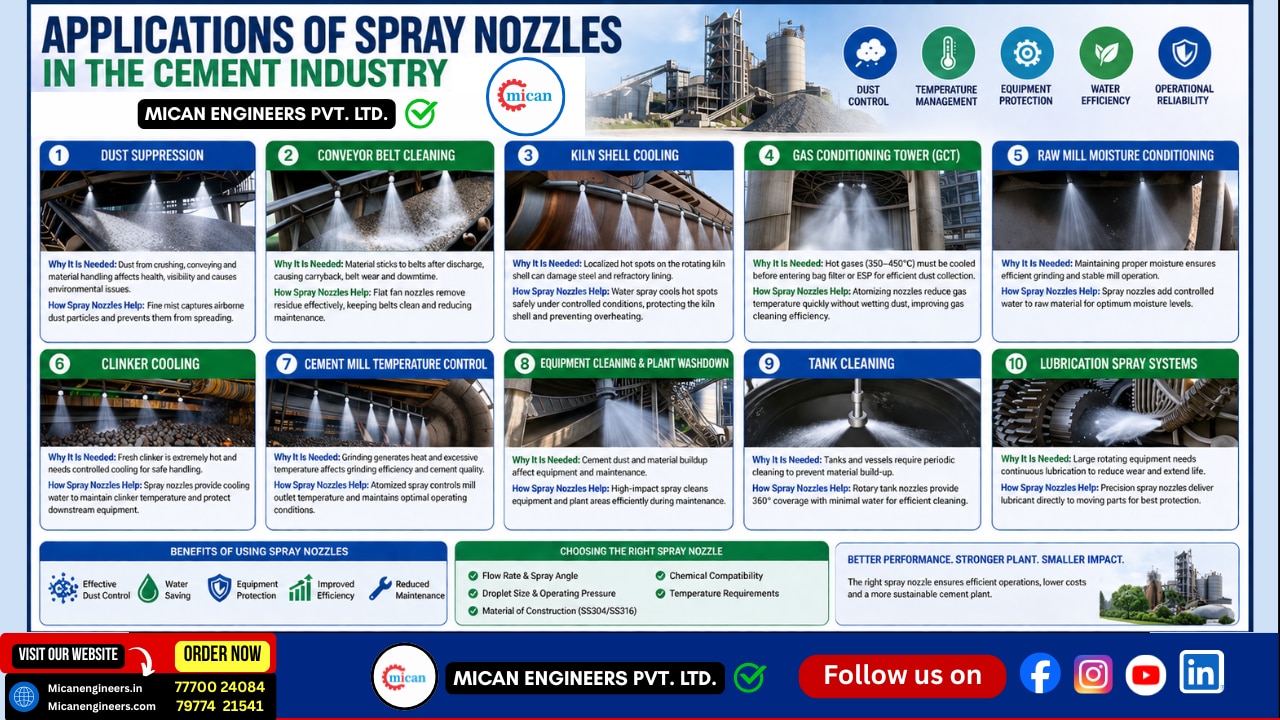
1. Dust Suppression
Why It Is Needed ?
Dust generation is one of the biggest challenges in cement manufacturing. Large quantities of dust are produced during crushing, conveying, screening, grinding, and material transfer.
Excessive dust can:
Affect worker health
Reduce plant visibility
Increase housekeeping costs
Cause premature equipment wear
Lead to environmental compliance issues
How Spray Nozzles Help
Fine mist or full cone spray nozzles atomize water into small droplets that capture airborne dust particles before they spread throughout the plant.
Common Applications
Limestone unloading
Crusher area
Conveyor transfer points
Raw material stockyards
Clinker handling
Cement packing plants
Truck loading stations
Benefits
Effective dust suppression
Improved worker safety
Reduced airborne particulate emissions
Better housekeeping
Lower water consumption with optimized nozzle selection
Recommended Spray Nozzles
Full Cone Spray Nozzle
Hollow Cone Spray Nozzle
Fine Mist Nozzle
2. Conveyor Belt Cleaning
Why It Is Needed ?
Material often sticks to conveyor belts after discharge, creating carryback that accumulates on rollers, pulleys, and floors.
This can result in:
Belt misalignment
Increased maintenance
Material wastage
Premature belt wear
How Spray Nozzles Help
Flat fan spray nozzles provide uniform, high-impact water coverage to clean conveyor belts efficiently.
Benefits
Removes cement residue
Prevents material buildup
Reduces maintenance downtime
Extends conveyor belt life
Recommended Spray Nozzle
Flat Fan Spray Nozzle
3. Kiln Shell Cooling
Why It Is Needed ?
The rotary kiln is the heart of the cement manufacturing process. Inside the kiln, raw materials are heated to approximately 1,450°C to produce clinker.
Although the kiln is protected by refractory bricks, localized damage to the lining can create hot spots on the steel shell.
How Spray Nozzles Help
Water spray nozzles are sometimes used to cool localized hot spots on the kiln shell under controlled conditions, helping prevent shell damage while maintenance can be planned.
Benefits
Protects the kiln shell
Prevents excessive overheating
Supports reliable kiln operation
Reduces the risk of unplanned shutdowns
Recommended Spray Nozzle
Full Cone Spray Nozzle
4. Gas Conditioning Tower (GCT)
Why It Is Needed ?
Hot gases leaving the rotary kiln can exceed 350–450°C before entering the bag filter or electrostatic precipitator (ESP).
These gases must be cooled to protect downstream equipment and improve dust collection efficiency.
How Spray Nozzles Help
High-pressure atomizing nozzles produce extremely fine droplets that evaporate rapidly, reducing gas temperature without wetting the dust.
Benefits
Rapid gas cooling
Improved bag filter performance
Increased ESP efficiency
Better emission control
Reduced thermal stress on equipment
Recommended Spray Nozzles
High-Pressure Atomizing Nozzle
Two-Fluid Atomizing Nozzle
5. Raw Mill Moisture Conditioning
Why It Is Needed ?
How Spray Nozzles Help
Benefits
Maintaining the correct moisture content in raw materials is essential for stable grinding and efficient mill performance.
Spray nozzles provide controlled water addition to maintain the desired moisture level during raw material processing.
Improved grinding efficiency
Stable mill operation
Better material flow
Reduced dust generation
Recommended Spray Nozzles
Hollow Cone Spray Nozzle
Full Cone Spray Nozzle
6. Clinker Cooling
Why It Is Needed ?
Fresh clinker exits the rotary kiln at extremely high temperatures.
Controlled cooling improves clinker quality and protects downstream handling equipment.
How Spray Nozzles Help
In certain clinker handling and cooling applications, spray nozzles provide controlled water application to assist temperature management where required.
Benefits
Better clinker handling
Protection of downstream equipment
Improved operational stability
Recommended Spray Nozzle
Full Cone Spray Nozzle
7. Cement Mill Temperature Control
Why It Is Needed ?
Grinding generates heat. Excessive temperatures inside the cement mill can:
Reduce grinding efficiency
Affect cement quality
Cause gypsum dehydration
Increase energy consumption
How Spray Nozzles Help
Benefits
Water spray systems control mill outlet temperatures by injecting a finely atomized spray.
Stable mill temperature
Improved cement quality
Better grinding performance
Reduced equipment stress
Recommended Spray Nozzles
Fine Atomizing Spray Nozzles
8. Equipment Cleaning & Plant Washdown
Why It Is Needed ?
Cement dust accumulates on machinery, structures, and production areas, affecting maintenance and operational efficiency.
How Spray Nozzles Help
High-impact spray nozzles provide efficient washing during scheduled maintenance.
Cleaning Applications
Crushers
Chutes
Hoppers
Mixers
Screens
Production floors
Benefits
Faster cleaning
Reduced manual labor
Improved maintenance efficiency
Longer equipment life
Recommended Spray Nozzles
Flat Fan Spray Nozzle
Solid Stream Nozzle
9. Tank Cleaning
Why It Is Needed
Storage tanks and process vessels require periodic cleaning to prevent material buildup.
How Spray Nozzles Help
Rotary tank cleaning nozzles provide complete internal coverage with minimal water usage.
Benefits
360° cleaning
Reduced cleaning time
Lower water consumption
Improved cleaning consistency
Recommended Spray Nozzle
Rotary Tank Cleaning Nozzle
10. Lubrication Spray Systems
Why It Is Needed ?
Large rotating equipment in cement plants requires continuous lubrication to minimize wear.
Typical equipment includes:
Kiln girth gears
Open gears
Bearings
Chains
How Spray Nozzles Help
Precision spray nozzles apply a controlled amount of lubricant directly to moving components.
Benefits
Uniform lubrication
Reduced friction
Extended equipment life
Lower lubricant consumption
Reduced maintenance costs
Recommended Spray Nozzles
Air Atomizing Nozzle
Precision Lubrication Spray Nozzle
Choosing the Right Spray Nozzle
Selecting the correct spray nozzle depends on several operating parameters:
Flow rate
Spray angle
Droplet size
Operating pressure
Material of construction (SS304, SS316, Brass, etc.)
Chemical compatibility
Temperature requirements
Proper nozzle selection ensures maximum performance while minimizing water and maintenance costs.
Benefits of Spray Nozzles in Cement Plants
Using the right industrial spray nozzle can help cement manufacturers achieve:
Effective dust suppression
Improved environmental compliance
Better cooling performance
Higher process efficiency
Reduced water consumption
Lower maintenance costs
Longer equipment life
Improved product quality
Increased plant reliability
Enhanced worker safety
Conclusion :
Spray nozzles are essential components in modern cement manufacturing. Whether controlling dust, cooling hot process gases, cleaning conveyor belts, managing mill temperatures, or lubricating critical equipment, they contribute significantly to plant efficiency and reliability.
Selecting the appropriate spray nozzle for each application not only improves process performance but also reduces operating costs, minimizes downtime, and supports sustainable plant operations.
If you're looking for high-performance industrial spray nozzles for cement plant applications, choosing the right nozzle design and operating parameters is the key to achieving consistent and efficient results.
#CementIndustry
#SprayNozzles
#IndustrialSprayNozzles
#CementManufacturing
#DustSuppression
#RotaryKiln
#ClinkerProduction
#GasConditioning
#ConveyorCleaning
#IndustrialAutomation
#ProcessEngineering
#PlantMaintenance
#ManufacturingIndustry
#IndustrialEquipment
#WaterSaving
#ProcessOptimization
#EngineeringSolutions
#IndustrialInnovation
#MicanEngineers
#IndustrialSolutions
