
Inline Homogenizer Machine : Working Principle, Applications, Benefits & Uses :
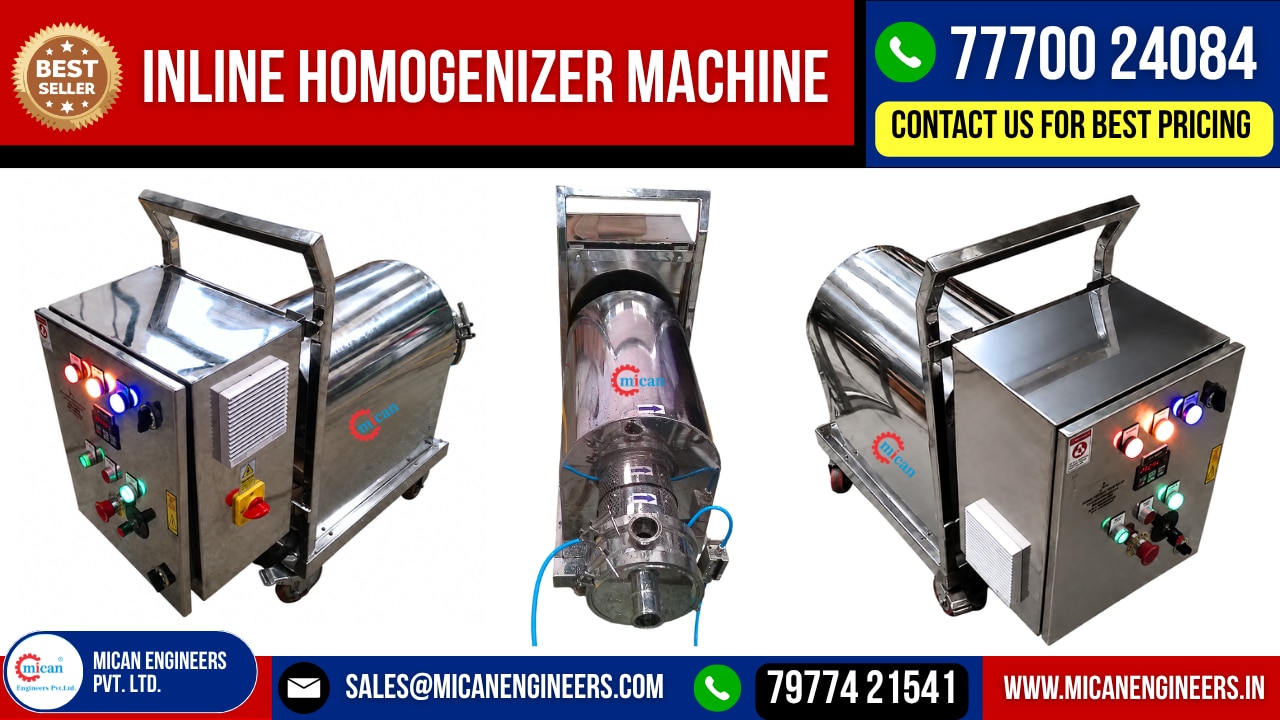
An Inline Homogenizer Machine is a high-shear processing machine used for continuous mixing, emulsification, dispersion, and homogenization of liquids and semi-liquid products. It is designed to process materials as they flow through the machine, helping achieve a more uniform and consistent product.
Inline homogenizers are widely used in industries such as pharmaceuticals, food processing, cosmetics, personal care, chemicals, and other process industries where consistent mixing and product uniformity are important.
What Is an Inline Homogenizer Machine ?
An inline homogenizer is a continuous processing machine that uses a high-speed rotor-stator system to generate intense shear forces within the product.
As the product passes through the rotor-stator assembly, the high-speed rotation creates turbulence and shear. This helps break down agglomerates, disperse one phase into another, and improve the uniformity of the final product.
Unlike a conventional batch mixer, an inline homogenizer can be installed directly into a process pipeline, allowing the product to be processed continuously.
How Does an Inline Homogenizer Work ?
The working principle of an inline homogenizer can be explained in a few steps :
- Product Entry
The liquid or semi-liquid product enters the homogenizer through the inlet connection. - High-Speed Rotor Rotation
A motor drives the rotor at high speed inside the stator assembly. - Shear Generation
As the product passes through the narrow rotor-stator gap, high shear forces and turbulence are generated. - Dispersion and Homogenization
Agglomerates can be broken down and different phases can be dispersed more uniformly. - Processed Product Discharge
The homogenized product exits through the outlet and can continue to the next stage of the process.
What Is the Difference Between Mixing and Homogenization ?
Conventional mixing primarily helps combine different materials throughout a vessel or process stream.
Homogenization, on the other hand, involves applying higher shear to improve dispersion, reduce agglomeration, and produce a more uniform product.
For example, an inline homogenizer can help disperse an oil phase into a water phase to produce a more stable and uniform emulsion.
The actual result depends on factors such as formulation, viscosity, flow rate, rotor speed, processing time, temperature, and machine configuration.
Applications of Inline Homogenizer Machines :
Inline homogenizers are used for a wide range of liquid and semi-liquid processing applications.
1. Pharmaceutical Industry
Inline homogenizers can be used for:
- Liquid formulations
- Emulsions
- Suspensions
- Creams and ointments
- Active ingredient dispersion
- Uniform mixing of pharmaceutical formulations
The machine configuration and material of construction can be selected according to the product and hygienic requirements.
2. Food Processing Industry
Food applications may include:
- Mayonnaise
- Salad dressings
- Sauces
- Emulsified food products
- Dairy-based formulations
- Liquid and semi-liquid food products
For products containing larger solid particles or requiring substantial grinding, additional equipment such as a colloid mill may be required.
3. Cosmetic and Personal Care Industry
Inline homogenizers are commonly considered for products such as:
- Creams
- Lotions
- Emulsions
- Shampoos
- Conditioners
- Cosmetic formulations
High-shear processing can help improve the dispersion and uniformity of these formulations.
4. Chemical Industries
Applications can include :
- Chemical emulsions
- Pigment dispersion
- Suspensions
- Adhesives
- Coatings
- Chemical formulations
The appropriate rotor-stator design and materials should be selected according to the chemical characteristics of the product.
Key Benefits of an Inline Homogenizer Machine :
1. Continuous Processing
The machine can be integrated into a pipeline, making it suitable for continuous production processes.
2. High-Shear Processing
The rotor-stator assembly generates high shear for effective dispersion, emulsification, and homogenization.
3. Improved Product Uniformity
It can help produce a more consistent distribution of ingredients throughout the product.
4. Compact Process Integration
Because the machine is installed inline, it can be integrated into existing processing systems without requiring a large separate mixing vessel for every application.
5. Reduced Processing Time
Continuous high-shear processing can reduce the time required to achieve the desired level of dispersion or homogenization compared with some conventional mixing methods.
6. Flexible Applications
The same basic technology can be used across pharmaceutical, food, cosmetic, personal care, and chemical processing applications, subject to suitable machine configuration.
Inline Homogenizer vs Conventional Mixer :
An inline homogenizer and a conventional mixer serve different processing requirements.
| Feature | Inline Homogenizer | Conventional Mixer |
|---|---|---|
| 1. Processing | Continuous inline | Usually batch |
| 2. Shear | High shear | Low to moderate/high depending on mixer |
| 3. Emulsification | Excellent for many applications | Depends on mixer design |
| 4. Dispersion | Effective for many formulations | Depends on impeller and process |
| 5. Pipeline Integration | Yes | Generally no |
| 6. Homogenization | Designed for this purpose | Not always suitable |
The best choice depends on the formulation, viscosity, required shear level, production capacity, and desired final product characteristics.
Inline Homogenizer vs Colloid Mill :
An inline homogenizer and colloid mill can sometimes be used in similar processing lines, but they are not identical machines.
An inline homogenizer is primarily used for high-shear mixing, emulsification, dispersion, and homogenization.
A colloid mill is generally more focused on intensive size reduction, wet grinding, and producing fine dispersions or pastes.
For example, when manufacturing a product that requires both fine grinding and subsequent homogenization, a process may use a colloid mill and an inline homogenizer depending on the formulation and desired result.
Factors to Consider When Selecting an Inline Homogenizer :
Choosing the correct inline homogenizer requires understanding the application and process conditions.
Important factors include :
- Product viscosity
- Required flow rate
- Processing capacity
- Rotor speed
- Rotor-stator configuration
- Required shear intensity
- Desired degree of homogenization
- Product temperature
- Operating pressure
- Material of construction
- Hygienic requirements
- CIP requirements
- Batch or continuous production requirements
A machine should be selected based on actual product trials and process requirements rather than simply selecting a homogenizer based on motor power or capacity.
Is an Inline Homogenizer Suitable for Every Product ?
No. An inline homogenizer is not a universal grinding or mixing solution.
It is particularly useful when the process requires high-shear mixing, emulsification, dispersion, or homogenization.
If the product contains large particles, requires heavy grinding, or needs significant particle-size reduction, another machine such as a colloid mill, high-shear mixer, or other specialized processing equipment may be more suitable.
In some production systems, multiple processing machines may be combined to achieve the required final product quality.
Conclusion :
An Inline Homogenizer Machine is a versatile high-shear processing solution for continuous mixing, emulsification, dispersion, and homogenization of liquid and semi-liquid products. Its inline configuration makes it suitable for integrating high-shear processing directly into production pipelines.
From pharmaceutical formulations and cosmetic creams to food emulsions and chemical dispersions, the correct homogenizer configuration can help achieve improved product uniformity and consistent processing.
However, machine selection should always be based on the product characteristics, required shear, flow rate, viscosity, particle size, production capacity, and desired final result.
Mican Engineers manufactures process equipment and can provide inline homogenizer solutions based on specific application and processing requirements.
📞 Contact Mican Engineers Private Limited for More Details on Inline Homogenizer Machine
77700 24084
79774 21541
📍 Official Company Address :
Plot No.E5, Mican Engineers Pvt Ltd,
Behind Sachin Hotel MIDC Anand Nagar,
Ambernath (E),
India 421 506
Watch this Company Introduction Video for Mican Engineers Pvt Ltd :
Keywords :
InlineHomogenizerMachine, InlineHomogenizer, HomogenizerMachine, HighShearMixer, InlineMixer, Homogenization, Emulsification, IndustrialMixing, ProcessEquipment, PharmaEquipment, FoodProcessingEquipment, ChemicalProcessing, CosmeticManufacturing, PharmaceuticalMachinery, MicanEngineers
Hastags :
#InlineHomogenizerMachine #InlineHomogenizer #HomogenizerMachine #HighShearMixer #InlineMixer #Homogenization #Emulsification #IndustrialMixing #ProcessEquipment #PharmaEquipment #FoodProcessingEquipment #ChemicalProcessing #CosmeticManufacturing #PharmaceuticalMachinery #MicanEngineers
