

Poor Atomization in Spray Nozzles : A Complete Troubleshooting Guide
Spray nozzles play a critical role in many industrial processes, including cooling, coating, humidification, cleaning, dust suppression, lubrication, chemical dosing, and pharmaceutical manufacturing. The effectiveness of these processes depends largely on the quality of atomization.
One of the most common spray-related problems faced by industries is poor atomization. Instead of producing fine, uniform droplets, the nozzle generates large droplets or an inconsistent spray pattern. This can lead to uneven product quality, increased chemical consumption, process inefficiencies, and higher operating costs.
Understanding the causes of poor atomization and implementing the correct solutions can significantly improve spray performance and extend nozzle life.
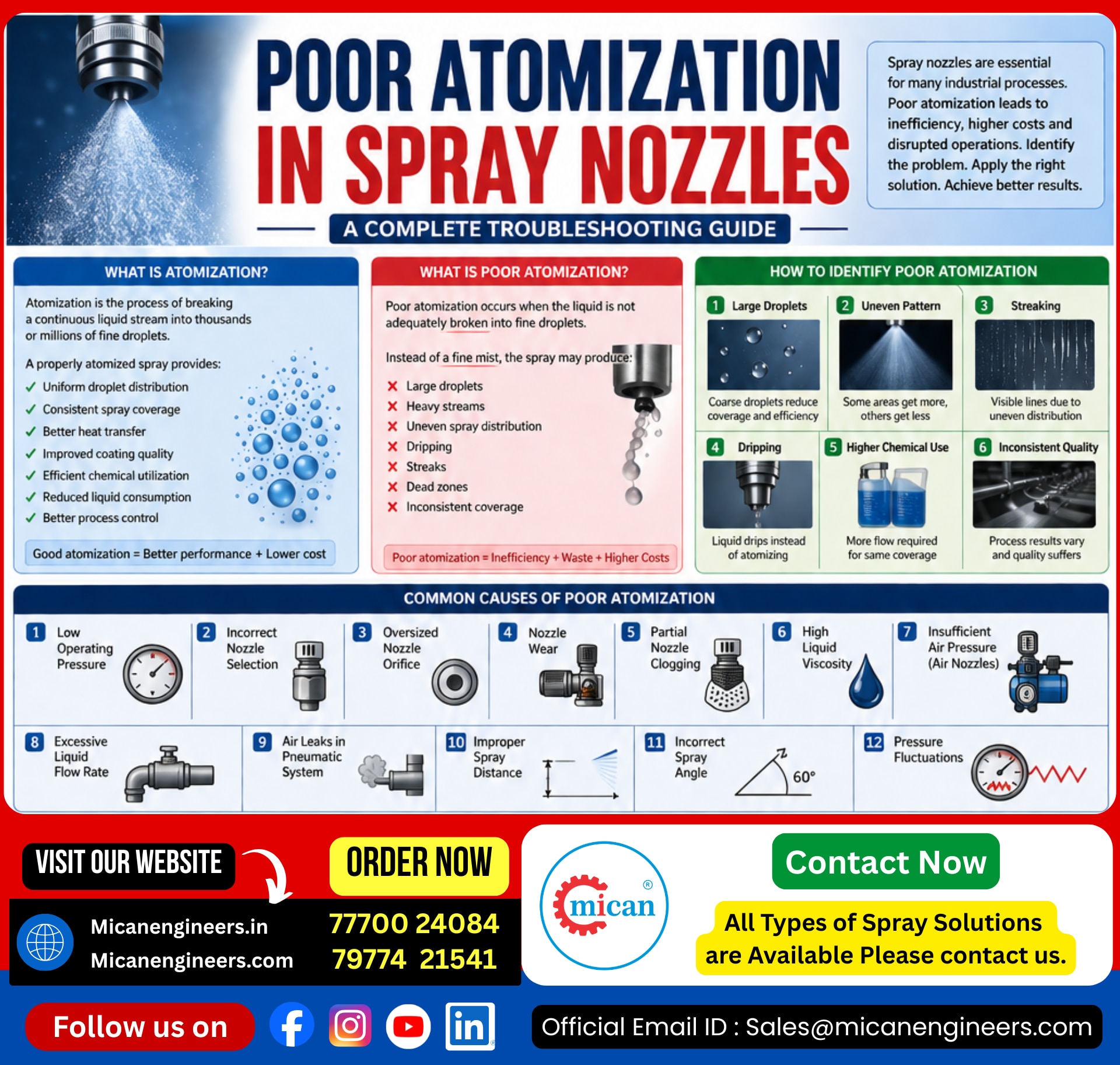
What is Atomization ?
Atomization is the process of breaking a continuous liquid stream into thousands or millions of fine droplets.
A properly atomized spray provides:
- Uniform droplet distribution
- Consistent spray coverage
- Better heat transfer
- Improved coating quality
- Efficient chemical utilization
- Reduced liquid consumption
- Better process control
The quality of atomization directly affects the overall efficiency of industrial spraying applications.
What is Poor Atomization ?
Poor atomization occurs when the liquid is not adequately broken into fine droplets.
Instead of a fine mist, the spray may produce:
- Large droplets
- Heavy streams
- Uneven spray distribution
- Dripping
- Streaks
- Dead zones
- Inconsistent coverage
Poor atomization is not always caused by the spray nozzle itself. In many cases, the root cause lies in pressure, liquid properties, nozzle selection, filtration, or system design.
How to Identify Poor Atomization :
Industries often observe the following symptoms:
1. Large Droplets
Instead of a fine spray, the nozzle releases coarse droplets that reduce coverage.
2. Uneven Spray Pattern
Some areas receive excessive liquid while others receive very little.
3. Streaking
Visible spray lines appear because the liquid is not evenly dispersed.
4. Dripping
Instead of atomizing properly, liquid drips from the nozzle.
5. Higher Chemical Consumption
Operators often increase flow rates to compensate for poor coverage, resulting in wasted chemicals.
6. Inconsistent Product Quality
Processes such as coating, cooling, humidification, and cleaning become inconsistent.
Common Causes of Poor Atomization :
1. Low Operating Pressure
2. Incorrect Nozzle Selection
3. Oversized Nozzle Orifice
4. Nozzle Wear
5. Partial Nozzle Clogging
6. High Liquid Viscosity
7. Insufficient Air Pressure (Air Atomizing Nozzles)
8. Excessive Liquid Flow Rate
9. Air Leaks in Pneumatic Systems
10. Improper Spray Distance
11. Incorrect Spray Angle
12. Pressure Fluctuations
Effects of Poor Atomization on Industrial Processes :
Poor atomization can negatively impact a wide range of industrial applications.
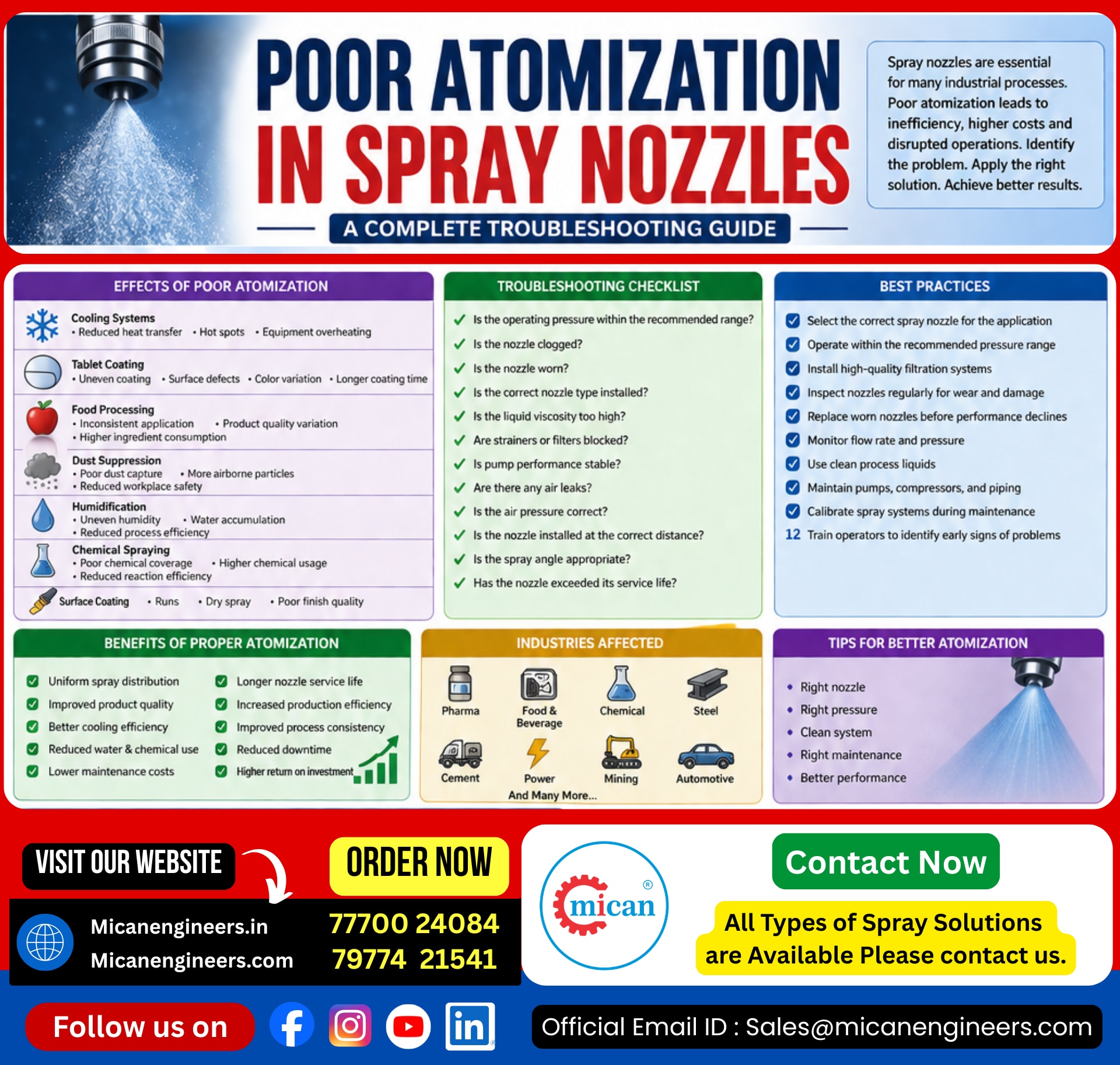
1. Cooling Systems
- Reduced heat transfer
- Hot spots
- Equipment overheating
2. Tablet Coating
- Uneven coating thickness
- Surface defects
- Color variation
- Longer coating times
3. Food Processing
- Inconsistent oil or flavor application
- Product quality variation
- Increased ingredient consumption
4. Dust Suppression
- Poor dust capture
- Increased airborne particles
- Reduced workplace safety
5. Humidification
- Uneven humidity distribution
- Water accumulation
- Reduced process efficiency
6. Chemical Spraying
- Poor chemical coverage
- Higher chemical usage
- Reduced reaction efficiency
7. Surface Coating
- Orange peel
- Runs
- Dry spray
- Poor finish quality
Troubleshooting Checklist :
Before replacing a spray nozzle, check the following :
- Is the operating pressure within the recommended range?
- Is the nozzle clogged?
- Is the nozzle worn?
- Is the correct nozzle type installed?
- Is the liquid viscosity too high?
- Are strainers or filters blocked?
- Is pump performance stable?
- Are there any air leaks?
- Is the air pressure correct?
- Is the nozzle installed at the correct distance?
- Is the spray angle appropriate?
- Has the nozzle exceeded its service life?
Best Practices to Prevent Poor Atomization :
- Select the correct spray nozzle for the application.
- Operate within the recommended pressure range.
- Install high-quality filtration systems.
- Inspect nozzles regularly for wear and damage.
- Replace worn nozzles before performance declines.
- Monitor flow rate and pressure.
- Use clean process liquids whenever possible.
- Maintain pumps, compressors, and piping systems.
- Calibrate spray systems during scheduled maintenance.
- Train operators to recognize early signs of atomization problems.
Benefits of Proper Atomization :
When spray nozzles are operating correctly, industries benefit from:
- Uniform spray distribution
- Improved product quality
- Better cooling efficiency
- Reduced water and chemical consumption
- Lower maintenance costs
- Longer nozzle service life
- Increased production efficiency
- Improved process consistency
- Reduced downtime
- Higher return on investment
Conclusion :
Poor atomization is one of the most common yet often overlooked causes of inefficient spraying. While symptoms such as large droplets, uneven coverage, and increased liquid consumption are easy to observe, the underlying causes may range from incorrect pressure and nozzle wear to improper nozzle selection or inadequate filtration.
A systematic troubleshooting approach—combined with routine inspection, preventive maintenance, and the right spray nozzle selection—can restore optimal atomization and significantly improve process efficiency. Investing in the correct spray technology not only enhances product quality but also reduces operating costs, minimizes waste, and extends equipment life.
Frequently Asked Questions (FAQs) :
1. What causes poor atomization in a spray nozzle?
The most common causes include low operating pressure, incorrect nozzle selection, nozzle wear, clogging, high liquid viscosity, unstable pressure, and insufficient air pressure in air atomizing systems.
2. How can I improve spray atomization?
Improve atomization by maintaining the correct operating pressure, selecting the right nozzle, cleaning or replacing worn nozzles, using proper filtration, and ensuring stable liquid and air supply.
3. Does higher pressure always improve atomization?
Generally, increasing pressure produces finer droplets, but pressure should always remain within the nozzle manufacturer's recommended operating range to avoid excessive wear and misting.
4. How often should spray nozzles be inspected?
Inspection frequency depends on the application and liquid being sprayed. For abrasive or high-use systems, regular inspections as part of preventive maintenance are recommended to detect wear or clogging before performance declines.
5. Which industries are most affected by poor atomization?
Industries such as pharmaceuticals, food processing, chemical manufacturing, steel, cement, power generation, mining, automotive, and paint & coating rely heavily on proper atomization for efficient and consistent spraying.
Need the right spray nozzle for your application ?
Mican Engineers Pvt. Ltd. offers a wide range of industrial spray nozzles and spray systems for cooling, cleaning, coating, humidification, dust suppression, and other industrial processes.
Choosing the correct nozzle and maintaining it properly can significantly improve spray performance, reduce waste, and enhance overall process efficiency.
Tags :
