
Introduction
Industrial spray nozzle systems play an important role in manufacturing, processing, cooling, cleaning, lubrication, surface treatment, dust suppression, and many other industrial applications. These systems are designed to deliver liquids in a controlled spray pattern, with the required flow rate, pressure, droplet size, and spray coverage.
However, an efficient spray system involves more than just selecting the right spray nozzle. It consists of several interconnected components, including pumps, filters, pipes, valves, pressure regulators, fittings, and control equipment. Each component contributes to the overall performance, reliability, and efficiency of the system.
Understanding the components of an industrial spray nozzle system helps engineers, maintenance teams, and plant operators select suitable equipment, troubleshoot problems, and maintain consistent spray performance.
In this guide, we will explore the major components of an industrial spray nozzle system, their functions, and the factors to consider when selecting them.
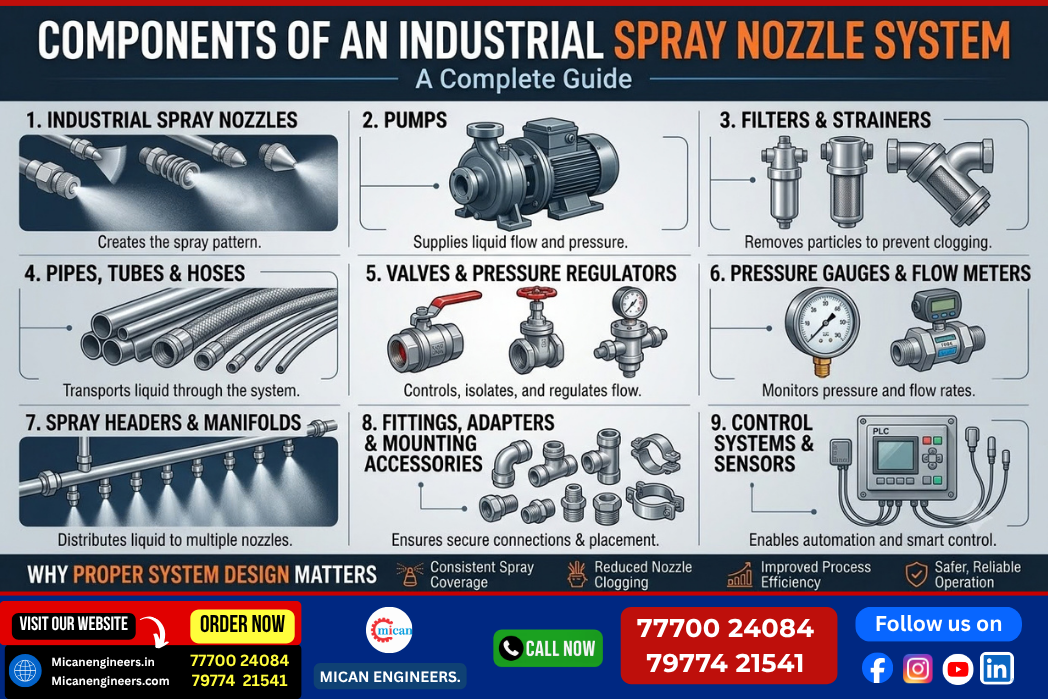
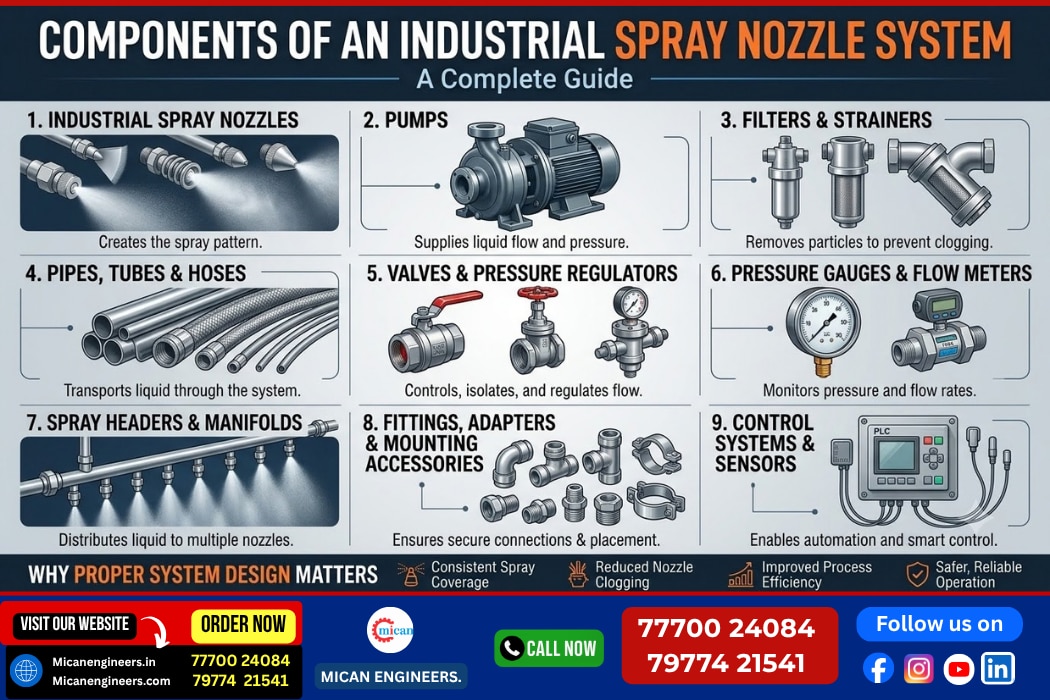
1. Industrial Spray Nozzle
The spray nozzle is the primary component responsible for converting the supplied liquid into a specific spray pattern. It controls how the liquid is distributed over a target surface or throughout a process area.
Different nozzle designs are available depending on the application, operating pressure, required flow rate, and spray characteristics.
Common types of industrial spray nozzles
Full Cone Spray Nozzles: Produce a filled, approximately circular spray pattern and are commonly used for cooling, washing, scrubbing, and general liquid distribution.
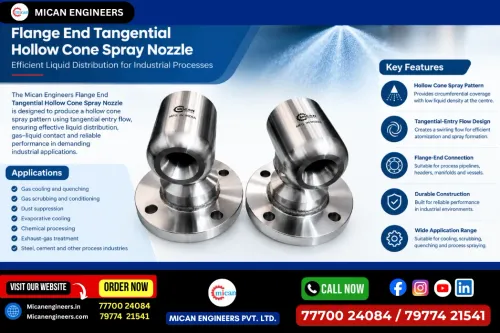
Hollow Cone Spray Nozzles: Concentrate most of the liquid near the outer region of a circular spray pattern. They are used in gas cooling, humidification, and certain dust-control applications.
Flat Fan Spray Nozzles: Produce a flat, fan-shaped spray pattern suitable for surface washing, coating, rinsing, and conveyor cleaning.
Straight Jet Spray Nozzles: Deliver a concentrated liquid stream for targeted washing, descaling, and high-impact cleaning applications.
Spiral Spray Nozzles: Produce a conical or other specified spray pattern, depending on their design, and are used in scrubbing, cooling, and gas treatment.
Air Atomizing Nozzles: Use compressed air or another gas to atomize liquid into fine droplets for coating, humidification, and specialized spraying processes.
Tank Cleaning Nozzles: Designed to distribute cleaning liquid inside tanks, vessels, and process equipment. These include static spray devices and rotating tank-cleaning nozzles.
What should be considered when selecting a nozzle ?
The selection process should account for :
Required flow rate
Operating pressure
Spray angle and pattern
Droplet size
Spray coverage and distribution
Liquid properties and temperature
Nozzle material and chemical compatibility
Risk of clogging and wear
Selecting a nozzle based on the complete set of operating requirements helps achieve the intended spray performance.
2. Pump
The pump supplies the liquid required by the spray nozzle system. It moves liquid from a storage tank, process vessel, or other source and provides the pressure and flow needed for operation.
The pump must be selected according to the total system demand rather than the nozzle flow rate alone. Pipe friction, elevation changes, filters, valves, and other restrictions can affect the pressure available at the nozzle.
Common pump types :
Centrifugal pumps
Positive displacement pumps
Diaphragm pumps
High-pressure pumps
Chemical transfer pumps
The appropriate pump depends on the liquid's viscosity, required flow rate, operating pressure, chemical properties, and process conditions.
Important consideration: The pump should deliver the required flow at the actual operating pressure of the system. A pump's maximum pressure or maximum flow rating alone is not sufficient for selection.
3. Liquid Supply Tank or Reservoir
The supply tank stores the liquid before it enters the spray system. Depending on the application, it may contain water, a cleaning solution, a chemical mixture, a coating liquid, or another process fluid.
The tank may also support liquid preparation, mixing, recirculation, and temperature control.
Key considerations
Tank capacity and required operating volume
Compatibility between the tank material and the liquid
Prevention of contamination
Suitable liquid inlet and outlet arrangements
Level monitoring and low-level protection
Agitation or recirculation requirements
Temperature control, where necessary
For applications involving suspended solids or mixtures that may settle, suitable agitation or recirculation may be necessary to maintain consistent liquid properties.
4. Piping, Tubing, and Hoses
Piping, tubing, and hoses transport liquid from the supply source to the spray nozzle. Their dimensions and materials directly affect system pressure losses, flow distribution, and reliability.
An undersized pipe can create excessive pressure losses, while poorly designed pipework may result in uneven flow between multiple nozzles.
Common materials
Stainless steel
Carbon steel
PVC and other compatible plastics
Chemical-resistant tubing
Pressure-rated industrial hoses
The material should be compatible with the liquid, temperature, and operating environment.
Selection factors
Required flow rate
Operating and surge pressure
Pipe diameter and total length
Liquid viscosity
Corrosion and abrasion resistance
Temperature rating
Connection type
Ease of maintenance
In multi-nozzle installations, the pipework should be designed to provide sufficient pressure and flow at each nozzle under actual operating conditions.
5. Filters and Strainers
Filters and strainers help remove unwanted particles from the liquid before it reaches the nozzle. Contamination can obstruct the nozzle orifice, alter the spray pattern, reduce flow, and cause inconsistent application.
Filtration is especially important for nozzles with small passages, fine atomization requirements, or demanding process conditions.
Common filtration options
Suction strainers
Inline strainers
Y-strainers
Cartridge filters
Bag filters
Automatic self-cleaning filters
The appropriate filter depends on the size and nature of the contaminants, nozzle passage dimensions, liquid properties, and acceptable pressure loss.
Important: Filter selection should be based on the nozzle manufacturer's filtration recommendations and the characteristics of the liquid. An excessively fine filter may create unnecessary pressure loss or clog frequently.
Regular inspection and cleaning are essential to maintain filtration efficiency.
6. Valves
Valves control, isolate, regulate, or redirect liquid flow within the spray system. They help operators start and stop spraying, perform maintenance, and manage flow through different sections of the installation.
Common valve types :
Ball Valves: Commonly used for manual isolation.
Gate Valves: Used for isolation in suitable piping applications.
Globe Valves: Can be used for flow regulation where appropriate.
Solenoid Valves: Enable electrically controlled opening and closing.
Check Valves: Help prevent reverse flow.
Control Valves: Regulate flow or pressure as part of an automated process.
The valve type must suit the liquid, pressure, temperature, required flow, and control requirements.
For automated spray systems, solenoid valves or other actuated valves can be integrated with timers, sensors, PLCs, and process control systems.
7. Pressure Regulator and Pressure Gauge
Pressure control is essential for achieving the required spray characteristics. Changes in nozzle inlet pressure can affect flow rate, spray angle, droplet size, and spray impact, depending on the nozzle design.
Pressure regulator
A pressure regulator helps maintain the desired downstream pressure within its operating range and under suitable flow conditions.
Pressure gauge
A pressure gauge allows operators to monitor pressure at a selected point in the system. Gauges can be installed near the pump, filter, distribution header, or nozzle supply line to help identify pressure losses.
Why pressure monitoring matters ?
Helps maintain consistent spray performance
Identifies excessive pressure loss across filters
Supports troubleshooting of reduced flow
Helps prevent operation outside equipment limits
Improves process repeatability
Technical note: The pressure measured at the pump discharge may differ from the pressure available at the nozzle inlet because of losses through pipes, fittings, filters, and valves. For accurate nozzle selection and troubleshooting, nozzle inlet pressure is particularly important.
8. Fittings, Adapters, and Couplings
Fittings connect the various components of the spray system. They provide the necessary mechanical interfaces between pipes, hoses, valves, filters, headers, and nozzles.
Common connection components include :
Threaded adapters
Pipe elbows and tees
Reducers and expanders
Flanges
Quick-release couplings
Nozzle holders
Mounting adapters
Clamps and unions
Thread standards must be checked carefully. BSPP, BSPT, and NPT connections are not interchangeable in every application. The correct sealing method and compatible thread geometry are essential to prevent leakage.
In applications requiring frequent nozzle inspection or replacement, suitable quick-release couplings or removable nozzle holders can simplify maintenance and reduce downtime.
9. Spray Headers and Manifolds
Spray headers and manifolds distribute liquid from a common supply line to multiple nozzles. They are widely used in steel manufacturing, paper production, conveyor washing, cooling lines, chemical processing, and other industrial applications.
A header may contain several nozzles arranged to cover a particular width, surface, or process zone.
Benefits of spray headers
Distribute liquid across a larger area
Support multiple-nozzle installations
Allow consistent nozzle positioning
Simplify piping and mounting arrangements
Support repeatable spray coverage
Design considerations
The header diameter, inlet location, nozzle spacing, and flow demand must be considered together. Pressure variations along a long header can cause differences in nozzle discharge, especially when many nozzles operate simultaneously.
For uniform coverage, engineers should evaluate the pressure available at each nozzle and account for overlap between adjacent spray patterns where required.
10. Flow Meters and Flow Control Devices
Flow meters measure the quantity of liquid passing through a pipe. They help operators verify whether the spray system is delivering the intended flow rate.
Flow control devices can also be used to adjust liquid delivery to individual nozzles or branches.
Common flow measurement technologies
Rotameters
Electromagnetic flow meters
Turbine flow meters
Ultrasonic flow meters
Other application-specific flow meters
The suitable instrument depends on the liquid's conductivity, viscosity, cleanliness, operating pressure, temperature, and required measurement accuracy.
Flow monitoring is useful in applications such as chemical dosing, coating, cooling, washing, and process lubrication, where an incorrect liquid delivery rate can affect product quality or operating costs.
11. Control Panel, Sensors, and Automation
Modern industrial spray systems may use electrical and electronic controls to manage spraying automatically. These components can improve process consistency and reduce unnecessary liquid consumption.
Typical control components
Programmable logic controllers (PLCs)
Human-machine interfaces (HMIs)
Pressure and flow sensors
Liquid-level sensors
Temperature sensors
Solenoid valve controls
Timers and interlocks
Variable frequency drives for compatible pumps
For example, a spray system may be configured to activate when a product reaches a conveyor station and stop when the product moves away. In another installation, pressure or flow feedback may be used to identify an abnormal operating condition.
The level of automation should match the application, production requirements, and safety needs.
12. Nozzle Mounting Systems and Positioning Equipment
Correct nozzle positioning is important for achieving the intended spray coverage, impact, and distribution. Mounting equipment holds the nozzle at the required location and orientation.
Common arrangements include:
Fixed nozzle holders
Adjustable mounting brackets
Spray arms
Spray lances
Spray bars
Flanged mounting assemblies
Custom nozzle manifolds
In industrial washing or surface treatment, the nozzle angle and distance from the target can affect cleaning effectiveness and coverage. In cooling and lubrication applications, positioning also determines where the liquid reaches the equipment.
Mounting arrangements should provide adequate mechanical support and allow inspection, cleaning, and replacement without unnecessary dismantling.
13. Safety and Protective Components
Safety equipment is an important part of an industrial spray installation, particularly when the system operates at high pressure or handles hazardous, hot, or corrosive liquids.
Depending on the design, safety-related components may include:
Pressure relief valves
Emergency-stop circuits
Pump dry-run protection
Low-level switches
Overpressure protection
Suitable hose restraints
Guards and protective enclosures
Chemical-compatible seals and containment arrangements
Pressure relief devices must be correctly sized, installed, and rated for the system. They should not be isolated or bypassed in a way that compromises protection.
Additional safety measures may be necessary for atomized chemicals, hot liquids, high-pressure water jets, or applications that produce airborne droplets.
How Do These Components Work Together?
An industrial spray nozzle system operates through the coordinated action of its components. A typical liquid supply arrangement follows this sequence:
Liquid storage: The liquid is stored in a tank or reservoir.
Liquid pumping: The pump supplies the required flow and pressure.
Filtration: The liquid passes through a suitable filter or strainer.
Pressure and flow control: Regulators, valves, and monitoring instruments help control operating conditions.
Liquid distribution: Pipes, hoses, headers, and manifolds transport liquid to the nozzle locations.
Spray formation: The nozzles convert the supplied liquid into the required spray pattern.
Monitoring and control: Sensors and automation equipment monitor or adjust system operation where required.
The precise order of some components varies by design. For example, a filter may be installed on the pump suction or discharge side, and pressure measurement points may be provided at multiple locations.
Example: Industrial Spray System for Surface Cooling
Consider a system designed to cool a moving metal surface using several flat spray nozzles.
The pump supplies water through a filtration unit and a distribution header. Pressure gauges monitor the operating conditions, while valves control the supply to the spray line. Multiple nozzles are mounted at carefully selected positions to distribute water across the required surface.
To achieve the intended cooling performance, the system designer must consider nozzle flow rates, spray angles, spacing, header pressure losses, water temperature, and surface movement.
If one nozzle becomes partially clogged, the resulting uneven spray distribution may create a localized cooling difference. Inspecting the filter, checking nozzle condition, and measuring pressure and flow can help identify the cause.
This example demonstrates why nozzle selection and supporting system design must be considered together.
Common Industrial Spray System Problems and Their Possible Causes
| Problem | Possible causes | Recommended checks |
|---|---|---|
| Low spray flow | Insufficient pressure, clogged nozzle, restricted filter | Check nozzle inlet pressure, filter condition, and nozzle passage |
| Uneven spray coverage | Incorrect nozzle spacing, damaged nozzle, pressure variation | Inspect the spray pattern and header distribution |
| Frequent nozzle clogging | Contaminated liquid, unsuitable filtration, deposits | Review filtration and liquid cleanliness |
| Excessive leakage | Incorrect fittings, damaged seals, incompatible threads | Check connection type, sealing method, and seal condition |
| Inconsistent spray performance | Pressure fluctuations, unstable flow, changing liquid properties | Monitor operating pressure and flow |
| Rapid nozzle wear | Abrasive particles, corrosive liquid, unsuitable material | Review fluid properties and nozzle material selection |
| Excessive liquid consumption | Incorrect nozzle sizing, excessive pressure, leakage | Verify flow requirements, pressure, and system condition |
These are possible causes rather than definitive diagnoses. Actual troubleshooting should consider the complete operating conditions and equipment manufacturer's guidance.
Factors to Consider When Designing an Industrial Spray Nozzle System
Before selecting or installing a spray system, evaluate the following parameters :
1. Application requirements: Determine whether the objective is cooling, cleaning, coating, lubrication, humidification, dust suppression, or another process.
2. Required flow rate: Calculate the liquid quantity needed to achieve the process objective.
3. Operating pressure: Determine the required nozzle inlet pressure and account for pressure losses throughout the system.
4. Spray pattern and coverage: Select the appropriate pattern, angle, nozzle spacing, and mounting arrangement.
5. Liquid properties: Consider viscosity, density, temperature, chemical compatibility, and suspended particles.
6. Material selection: Choose suitable materials for the nozzle, piping, valves, fittings, and seals.
7. Filtration requirements: Select filtration that protects the nozzle without introducing excessive pressure loss.
8. Maintenance access: Make provisions for inspection, cleaning, replacement, and servicing.
9. Automation requirements: Decide whether manual operation, timed spraying, sensor-based control, or PLC integration is necessary.
10. Operating cost: Consider pump energy consumption, water or chemical use, maintenance frequency, and component service life.
A well-designed system balances these factors to achieve reliable performance without unnecessary complexity or operating costs.
Conclusion :
An industrial spray nozzle system consists of several components that work together to deliver liquid at the required flow rate, pressure, and spray pattern. While the nozzle determines the spray characteristics, supporting components such as pumps, filters, piping, valves, pressure regulators, fittings, manifolds, and control equipment influence the overall system performance.
Selecting the right components and integrating them correctly can help improve spray uniformity, reduce clogging, simplify maintenance, and support consistent industrial processes.
For engineers and plant operators, understanding the complete spray system is essential to diagnosing problems and achieving the intended application results.
Looking for industrial spray nozzles for your application?
Mican Engineers Pvt. Ltd. offers industrial spray nozzle solutions for applications such as cooling, cleaning, washing, lubrication, dust suppression, and liquid distribution. The suitable nozzle depends on the process requirements, liquid properties, operating pressure, required flow rate, and spray coverage.
Contact Mican Engineers to discuss your application and identify a suitable spray nozzle solution for your industrial process.
#industrialspray #spraynozzle #spraysytem #MicanEngineers #IndustrialSprayNozzles #SprayNozzleSystem #SprayTechnology #IndustrialEngineering #ProcessEngineering #IndustrialCooling #IndustrialCleaning #Manufacturing #spraycomponents
@mumbai @pune @ahmedabad @chennai