

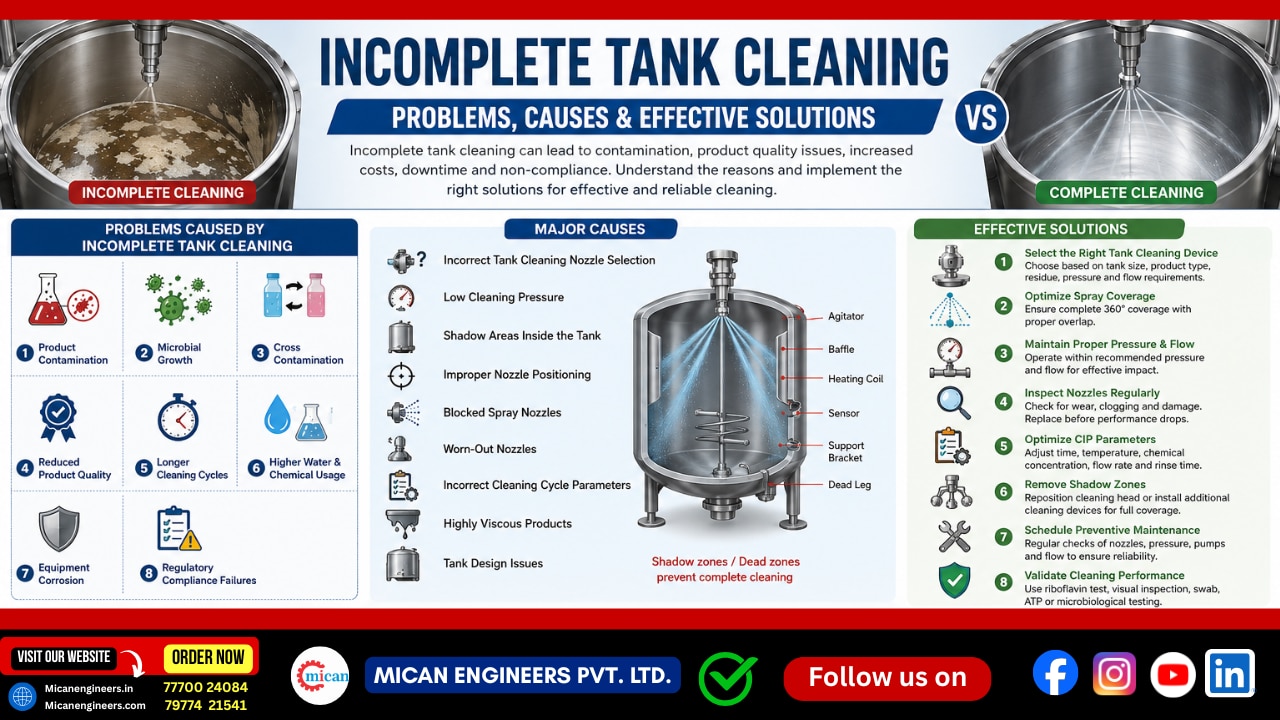
Incomplete Tank Cleaning : Problems, Causes, and Effective Solutions
Industrial tanks play a vital role in industries such as pharmaceuticals, food & beverage, chemicals, cosmetics, dairy, breweries, and personal care manufacturing. Proper tank cleaning is essential to maintain product quality, prevent contamination, comply with industry regulations, and maximize production efficiency.
However, incomplete tank cleaning remains one of the most common challenges in industrial cleaning systems. Residual product, biofilm, chemicals, or contaminants left inside the tank can lead to quality issues, increased downtime, and costly production losses.
This guide explains the problems, causes, and solutions for incomplete tank cleaning and how selecting the right spray nozzles and tank cleaning devices can significantly improve cleaning performance.
Meta Description :
What is Incomplete Tank Cleaning ?
Incomplete tank cleaning occurs when certain areas inside a vessel are not cleaned thoroughly after a cleaning cycle.
These untreated areas are commonly known as shadow zones or dead zones, where cleaning solution fails to reach with sufficient impact or coverage.
These residues may include:
- Product deposits
- Powder accumulation
- Sticky syrup
- Oils and fats
- Chemical residues
- Biofilm
- Burnt deposits
- Sludge
Even a small amount of remaining residue can contaminate the next production batch.
Common Problems Caused by Incomplete Tank Cleaning :
1. Product Contamination
Residues from previous batches contaminate new products, affecting quality and safety.
Impact
- Batch rejection
- Product recalls
- Customer complaints
- Regulatory issues
2. Microbial Growth
Moist residues create an ideal environment for bacteria, fungi, and mold.
Common in:
- Pharmaceutical manufacturing
- Dairy plants
- Beverage industries
- Food processing
3. Cross Contamination
Different formulations or chemicals may mix with subsequent batches.
Especially critical for:
- Pharmaceuticals
- Cosmetics
- Food products
- Specialty chemicals
4. Reduced Product Quality
Remaining residues may alter:
- Color
- Taste
- Odor
- Viscosity
- Chemical composition
5. Longer Cleaning Cycles
Operators often repeat cleaning cycles because tanks are not cleaned properly the first time.
This results in:
- Increased downtime
- Lower productivity
- Higher operating costs
6. Higher Water and Chemical Consumption
Poor cleaning efficiency requires:
- More rinse cycles
- Additional detergent
- Increased water usage
7. Equipment Corrosion
Chemical residues left inside tanks can gradually damage stainless steel surfaces and shorten equipment life.
8. Regulatory Compliance Failures
Industries following:
- GMP
- FDA
- EHEDG
- 3-A Sanitary Standards
must demonstrate effective cleaning. Poor cleaning can result in failed inspections and non-compliance.
Major Causes of Incomplete Tank Cleaning :
1. Incorrect Tank Cleaning Nozzle Selection
Using the wrong spray pattern is one of the most common reasons for poor cleaning.
Examples:
- Low-impact spray balls for heavy residues
- Incorrect spray angle
- Insufficient flow rate
2. Low Cleaning Pressure
Insufficient pressure reduces the impact energy needed to remove stubborn deposits.
Symptoms include:
- Product sticking to walls
- Poor residue removal
- Longer cleaning time
3. Shadow Areas Inside the Tank
Internal structures may block spray coverage.
Examples:
- Agitators
- Baffles
- Heating coils
- Support brackets
- Sensors
- Pipes
These create hidden areas where cleaning solution cannot reach effectively.
4. Improper Nozzle Positioning
If the cleaning device is mounted too high, too low, or off-center, some tank surfaces may not receive adequate spray coverage.
5. Blocked Spray Nozzles
Over time, spray openings may become clogged due to:
- Hard water scale
- Chemical deposits
- Product particles
- Dirt
This reduces flow and cleaning performance.
6. Worn-Out Nozzles
Continuous operation gradually enlarges nozzle orifices, altering:
- Spray angle
- Flow rate
- Impact force
- Spray pattern
7. Incorrect Cleaning Cycle Parameters
Problems include:
- Cleaning too quickly
- Low detergent concentration
- Incorrect temperature
- Short rinse time
- Inadequate contact time
8. Highly Viscous Products
Products such as:
- Syrups
- Creams
- Chocolate
- Adhesives
- Heavy chemicals
require higher-impact cleaning devices than standard spray balls.
9. Tank Design Issues
Poor tank design can create:
- Dead legs
- Sharp corners
- Hidden pockets
- Uneven surfaces
These areas are difficult to clean.
Effective Solutions for Incomplete Tank Cleaning :
1. Select the Right Tank Cleaning Device
Choose a cleaning device based on:
- Tank diameter
- Product type
- Residue characteristics
- Required cleaning impact
- Operating pressure
Options include :
- Static Spray Balls
- Rotary Spray Heads
- Rotary Jet Heads
- High-Impact Tank Cleaning Machines
2. Optimize Spray Coverage
Ensure complete 360° coverage with proper overlap so every internal surface receives sufficient cleaning action.
3. Maintain Proper Pressure and Flow
Verify that the cleaning system operates within the manufacturer's recommended pressure and flow range to achieve the required cleaning performance.
4. Inspect Nozzles Regularly
Routine inspection helps identify:
- Wear
- Clogging
- Damage
- Misalignment
Replace worn nozzles before cleaning efficiency declines.
5. Optimize CIP Parameters
Adjust:
- Cleaning time
- Temperature
- Chemical concentration
- Flow rate
- Rinse duration
to suit the product and tank design.
6. Remove Shadow Zones
If internal obstructions prevent adequate spray coverage:
- Reposition the cleaning head
- Install additional cleaning devices
- Use rotary jet cleaners for complex tanks
7. Schedule Preventive Maintenance
A preventive maintenance program should include:
- Nozzle inspection
- Pressure verification
- Pump performance checks
- Flow measurement
- Cleaning validation
8. Validate Cleaning Performance
Use appropriate validation methods such as:
- Riboflavin testing (spray coverage verification)
- Visual inspection
- Swab testing
- ATP testing (where applicable)
- Microbiological testing (where applicable)
to confirm cleaning effectiveness based on your process and industry requirements.
Best Industries for Advanced Tank Cleaning Systems :
Effective tank cleaning solutions are widely used in :
- Pharmaceutical Manufacturing
- Food Processing
- Beverage Plants
- Dairy Industry
- Chemical Processing
- Cosmetics Manufacturing
- Paint & Coatings
- Biotechnology
- Brewing
- Personal Care Products
Best Practices to Prevent Incomplete Tank Cleaning :
- Select the correct tank cleaning device for the application.
- Ensure complete 360° spray coverage.
- Monitor cleaning pressure and flow rate regularly.
- Inspect and replace worn or clogged nozzles.
- Optimize CIP cycle parameters.
- Eliminate shadow areas during tank design or retrofit.
- Validate cleaning performance periodically.
- Implement preventive maintenance to reduce downtime and improve reliability.
Conclusion :
Incomplete tank cleaning can result in contamination, microbial growth, increased operating costs, equipment damage, and production downtime.
Most cleaning issues stem from improper nozzle selection, insufficient spray coverage, low operating pressure, clogged or worn nozzles, or poorly optimized cleaning cycles.
By selecting the appropriate tank cleaning device, maintaining optimal operating conditions, and regularly validating cleaning performance, manufacturers can achieve consistent cleaning results, improve product quality, reduce water and chemical consumption, and enhance overall process efficiency.
Tank Cleaning Problems,
CIP Tank Cleaning,
Tank Cleaning Nozzles,
Rotary Tank Cleaning Nozzle,
Rotary Spray Head,
Static Spray Ball,
CIP Spray Nozzle,
Industrial Tank Cleaning,
Tank Cleaning Solutions,
Shadow Areas in Tank Cleaning,
Dead Zones in Tanks,
Stainless Steel Tank Cleaning,
Pharmaceutical Tank Cleaning,
Food Processing Tank Cleaning,
