

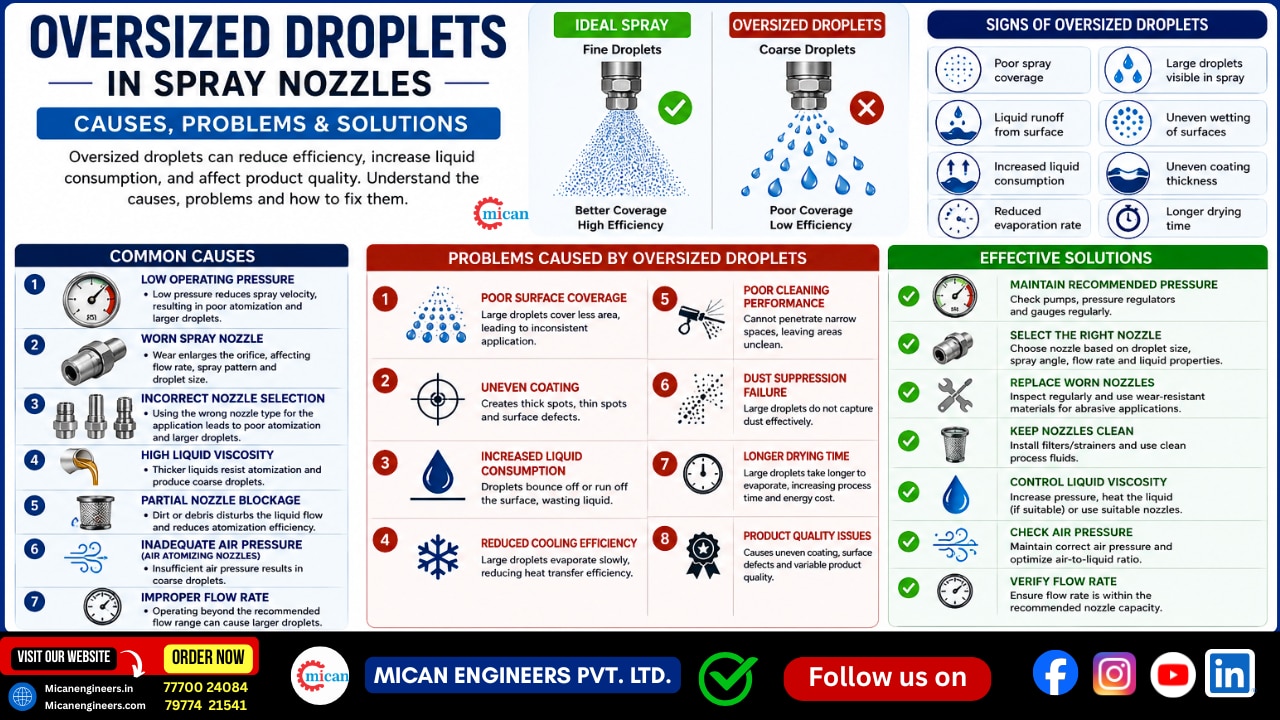
Oversized Droplets in Spray Nozzles : Causes, Problems & Solutions
Spray nozzles are designed to produce droplets of a specific size to ensure efficient coverage, uniform application, and optimal process performance.
When the spray produces oversized droplets, the process becomes less efficient, resulting in poor coverage, excessive liquid consumption, uneven application, and reduced product quality.
Whether your application is cooling, coating, cleaning, humidification, dust suppression, or chemical dosing, understanding the causes of oversized droplets can help improve productivity and reduce operational costs.
What Are Oversized Droplets ?
Oversized droplets are liquid particles that are significantly larger than the desired droplet size for a particular application. Instead of producing a fine, uniform spray, the nozzle generates coarse droplets that do not atomize properly.
Signs of Oversized Droplets
- Poor spray coverage
- Uneven wetting of surfaces
- Large water droplets visible in the spray
- Liquid runoff from the target surface
- Increased liquid consumption
- Uneven coating thickness
- Reduced evaporation rate
Common Causes of Oversized Droplets
1. Low Operating Pressure
Pressure is the most important factor affecting atomization.
When operating pressure decreases:
- Spray velocity reduces
- Atomization becomes poor
- Droplets become larger
Solution
- Maintain recommended operating pressure.
- Check pumps and pressure regulators.
- Inspect pressure gauges regularly.
2. Worn Spray Nozzle
Over time, nozzle orifices wear due to abrasive liquids.
This changes:
- Flow rate
- Spray pattern
- Droplet size
Solution
- Inspect nozzles periodically.
- Replace worn nozzles.
- Use wear-resistant materials such as SS316, Tungsten Carbide, or Ceramic for abrasive applications.
3. Incorrect Nozzle Selection
Not every nozzle is designed for fine atomization.
For example:
- Full Cone Nozzles generally produce larger droplets.
- Hollow Cone Nozzles produce finer droplets.
- Air Atomizing Nozzles create very fine droplets.
Solution
Choose the nozzle based on:
- Required droplet size
- Spray angle
- Flow rate
- Liquid properties
- Application
4. High Liquid Viscosity
Thicker liquids resist atomization.
Examples include:
- Syrups
- Oils
- Polymer solutions
- Adhesives
Solution
- Increase operating pressure (within limits).
- Heat the liquid if suitable.
- Use atomizing nozzles designed for high-viscosity fluids.
5. Partial Nozzle Blockage
Debris or contamination may partially block the nozzle, disrupting liquid flow and reducing atomization efficiency.
Solution
- Clean nozzles regularly.
- Install suitable strainers or filters.
- Use clean process fluids.
6. Inadequate Air Pressure (Air Atomizing Nozzles)
For air atomizing nozzles, insufficient compressed air results in coarse droplets.
Solution
- Check compressed air pressure.
- Inspect air lines for leaks.
- Maintain the correct air-to-liquid ratio.
7. Improper Flow Rate
A nozzle operating beyond its intended flow range may produce larger droplets.
Solution
- Verify flow rate calculations.
- Select the correct nozzle capacity.
- Avoid oversized pumps.
Problems Caused by Oversized Droplets
1. Poor Surface Coverage
Large droplets cover less surface area, leading to inconsistent application.
2. Uneven Coating
In coating applications, oversized droplets create:
- Thick spots
- Thin spots
- Surface defects
3. Increased Liquid Consumption
Large droplets often bounce off or run off the target surface, wasting liquid.
4. Reduced Cooling Efficiency
Fine droplets evaporate quickly and provide better cooling.
Oversized droplets reduce heat transfer efficiency.
5. Poor Cleaning Performance
Large droplets cannot penetrate narrow spaces effectively, resulting in incomplete cleaning.
6. Dust Suppression Failure
Fine droplets capture airborne dust more effectively.
Large droplets simply fall to the ground without binding dust particles.
7. Longer Drying Time
Oversized droplets take longer to evaporate, increasing process time and energy consumption.
8. Product Quality Issues
Industries such as pharmaceutical, food, and chemical manufacturing require precise droplet sizes.
Large droplets can cause:
- Uneven tablet coating
- Surface defects
- Variable product quality
How to Prevent Oversized Droplets :
- Maintain recommended spray pressure.
- Select the correct nozzle type.
- Replace worn nozzles periodically.
- Install filters or strainers.
- Monitor flow rate regularly.
- Inspect spray patterns during maintenance.
- Use wear-resistant nozzle materials for abrasive fluids.
- Verify compressed air pressure for air atomizing nozzles.
- Follow a preventive maintenance schedule.
Industries Affected :
Oversized droplets can impact :
- Pharmaceutical Manufacturing
- Food & Beverage Processing
- Chemical Processing
- Steel Plants
- Cement Plants
- Paper Industry
- Textile Industry
- Dust Suppression Systems
- Cooling Systems
- Humidification Systems
- Agricultural Spraying
- Surface Coating Operations
Best Practices :
- Perform routine spray pattern inspections.
- Measure operating pressure regularly.
- Replace nozzles before excessive wear occurs.
- Match nozzle design to process requirements.
- Train operators to identify changes in spray quality.
- Maintain pumps, filters, and air supply systems.
- Document nozzle maintenance history.
Conclusion :
Oversized droplets may seem like a minor spray issue, but they can significantly affect process efficiency, product quality, and operating costs. By identifying the root causes—such as low pressure, worn nozzles, incorrect nozzle selection, or high liquid viscosity—and implementing proper maintenance and nozzle selection practices, industries can achieve consistent atomization, improved coverage, and reliable performance.
For applications requiring precise droplet control, routine inspection, correct operating conditions, and selecting the right spray nozzle are essential for maximizing productivity and minimizing waste.
#SprayNozzles #IndustrialSprayNozzles #Atomization #SprayTechnology #NozzleMaintenance #ProcessEngineering #IndustrialMaintenance #Manufacturing #FluidHandling #IndustrialSolutions #ChemicalProcessing #PharmaceuticalManufacturing #CoolingSystems #DustSuppression #MicanEngineers #oversizedspraydroplets #bigspraydroplets #spraynozzlesproblems
@mumbai @pune @chennai @ahmedabad
