
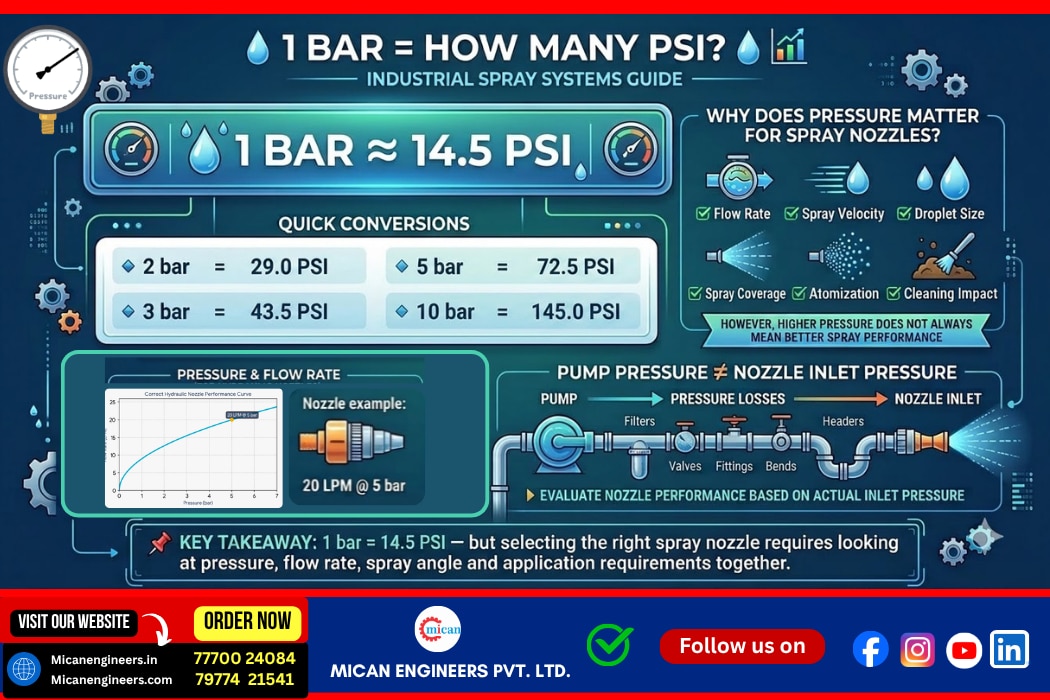
1 Bar = How Many PSI ? ( Understanding Pressure Conversion for Spray Systems )
Pressure is one of the most important parameters in any industrial spray system.
Whether you are using spray nozzles for cooling, washing, coating, cleaning, chemical processing, or dust suppression, understanding
Pressure helps you select the correct nozzle and achieve the desired spray performance.
One of the most common pressure conversions engineers come across is bar to PSI.
1 Bar = How Many PSI ? ( Complete Guide )
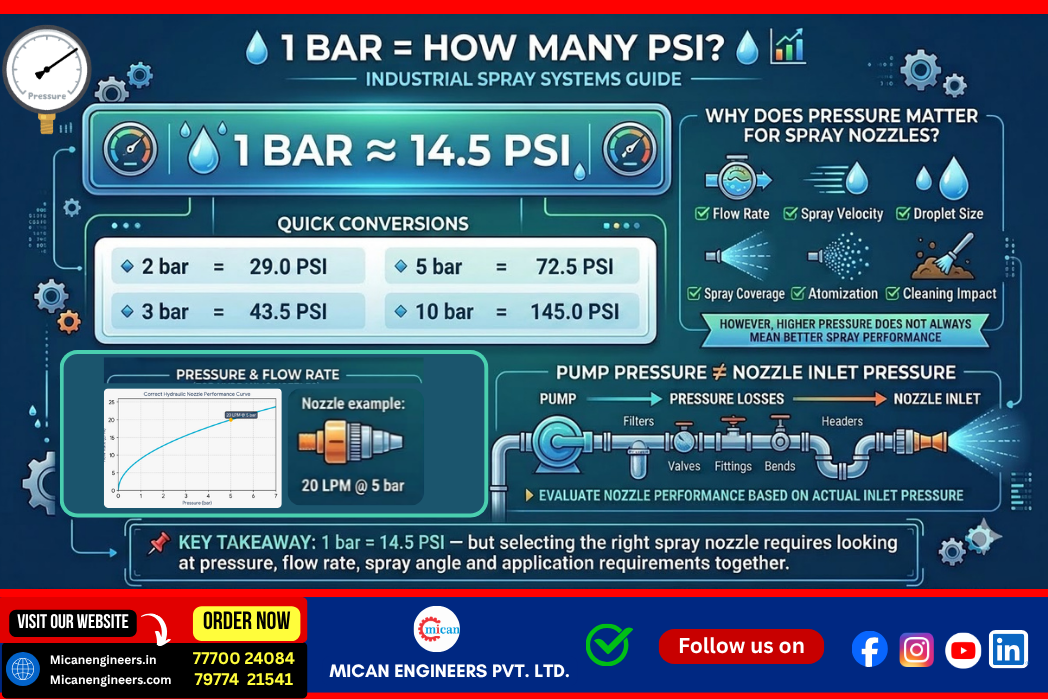
1 bar is approximately equal to 14.5 PSI (pounds per square inch).
The exact conversion is:
1 bar = 14.5038 PSI
For practical industrial calculations, 1 bar ≈ 14.5 PSI is normally sufficient.
Common Bar to PSI Conversion
Pressure (bar) | Pressure (PSI) |
|---|---|
| 0.5 bar | 7.25 PSI |
| 1 bar | 14.5 PSI |
| 2 bar | 29 PSI |
| 3 bar | 43.5 PSI |
| 4 bar | 58 PSI |
| 5 bar | 72.5 PSI |
| 6 bar | 87 PSI |
| 7 bar | 101.5 PSI |
| 8 bar | 116 PSI |
| 10 bar | 145 PSI |
| 15 bar | 217.5 PSI |
| 20 bar | 290 PSI |
| 30 bar | 435 PSI |
| 40 bar | 580 PSI |
| 50 bar | 725 PSI |
| 100 bar | 1,450 PSI |
What Does "Bar" Mean ?
Pressure describes the force exerted by a fluid or gas over a particular area.
In simple terms :
Pressure = ( Force ÷ Area )
Therefore, pressure is not simply the amount of fluid present. It describes how much force the fluid exerts over a given area.
For spray systems, pressure is generally measured at a specific point in the system, such as the pump discharge, nozzle inlet, or spray header.
What Does PSI Mean ?
PSI stands for pounds per square inch.
It represents pressure based on pounds-force acting over an area of one square inch.
For example:
14.5 PSI ≈ 1 bar
This does not mean that 1 bar is simply "14.5 pounds of weight." PSI is a pressure unit, meaning the force is expressed relative to an area of one square inch.
The area matters when understanding pressure.
Bar to PSI Conversion Formula :
To convert bar into PSI, use:
PSI = bar × 14.5038
For practical calculations :
PSI ≈ bar × 14.5
Example 1: 5 Bar
If a spray nozzle operates at 5 bar:
5 × 14.5 = 72.5 PSI
Therefore:
5 bar ≈ 72.5 PSI
Example 2: 10 Bar
10 × 14.5 = 145 PSI
Therefore:
10 bar ≈ 145 PSI
Example 3: 20 Bar
20 × 14.5 = 290 PSI
Therefore:
20 bar ≈ 290 PSI
PSI to Bar Conversion :
The reverse conversion can also be useful.
Bar = PSI ÷ 14.5038
For practical calculations :
Bar ≈ PSI ÷ 14.5
For example, if a spray system operates at 145 PSI:
145 ÷ 14.5 = 10 bar
Therefore:
145 PSI ≈ 10 bar
Why Is Pressure Important in Spray Nozzles ?
Pressure plays a major role in spray nozzle performance.
A nozzle converts liquid pressure into a controlled spray pattern. Depending on the nozzle design, increasing pressure can affect :
- Flow rate
- Spray velocity
- Droplet size
- Spray angle
- Coverage
- Atomization
- Impact force
- Cleaning performance
However, higher pressure does not automatically mean better spraying performance.
The nozzle must be selected according to the required flow rate, spray angle, pressure, liquid properties, and application.
Does Higher Pressure Mean Higher Flow Rate ?
Generally, for a given nozzle and fluid, increasing the pressure difference across the nozzle increases the flow rate.
For many conventional spray nozzles, flow approximately follows :
Q₂ = Q₁ × √(P₂/P₁)
Where :
- Q₁ = flow rate at the original pressure
- Q₂ = flow rate at the new pressure
- P₁ = original pressure
- P₂ = new pressure
Example
Suppose a nozzle delivers 10 LPM at 2 bar.
If the pressure is increased to 8 bar:
Q₂ = 10 × √(8/2)
Q₂ = 10 × √4
Q₂ = 20 LPM
So, under the same conditions, increasing pressure from 2 bar to 8 bar would approximately double the flow rate.
This is important because flow does not increase in direct proportion to pressure.
In other words :
4× pressure ≠ 4× flow
For a typical nozzle, approximately:
4× pressure → 2× flow
Actual performance depends on nozzle geometry, fluid properties, and operating conditions.
Does Higher Pressure Always Produce Better Spray ?
No.
Operating a nozzle above its recommended pressure can create several problems.
1. Excessive Flow
Higher pressure can increase liquid consumption and operating costs.
2. Smaller Droplets
For many atomizing applications, increasing pressure can produce finer droplets. This may be beneficial for certain applications but undesirable for others.
3. Overspray
Very fine droplets can be carried away by air movement, creating overspray and product loss.
4. Spray Pattern Changes
The spray pattern and effective coverage can change when operating outside the nozzle's recommended pressure range.
5. Nozzle Wear
Higher velocity through the nozzle can accelerate wear, particularly when spraying abrasive fluids.
6. Higher Pump Energy Consumption
Maintaining higher pressure generally requires more pumping energy.
Therefore, the goal should not simply be maximum pressure. The objective is to operate the nozzle at the correct pressure for the application.
Pressure vs Flow Rate in Spray Systems
Pressure and flow rate are related, but they are not the same thing.
Pressure describes the force available to push the liquid through the system.
Flow rate describes how much liquid passes through the system over a specific period.
For example :
- Pressure: 5 bar
- Flow rate: 20 LPM
Here, 5 bar describes the operating pressure, while 20 LPM describes the quantity of liquid flowing per minute.
A spray nozzle specification may therefore state :
Why Pressure Drop Matters ?
The pressure available at the pump may not be the same as the pressure available at the nozzle.
Pressure can be lost because of :
- Long pipelines
- Small pipe diameters
- Pipe fittings
- Valves
- Filters
- Strainers
- Bends
- Spray headers
- Elevation changes
- Excessive flow through the piping
For example, a pump may generate 10 bar, but the nozzle may receive significantly less pressure because of pressure losses throughout the system.
This is why nozzle selection should consider actual nozzle inlet pressure, not just pump discharge pressure.
( Pump Pressure vs Nozzle Pressure )
This distinction is particularly important in industrial spray systems.
Consider a system where :
Pump pressure = 10 bar
But due to piping and component losses:
Pressure at nozzle = 7 bar
The nozzle's performance should be evaluated at approximately 7 bar, not 10 bar.
For Example :
Flow: 20 LPM @ 5 bar
This means the nozzle delivers approximately 20 LPM when operated at a 5-bar pressure at its inlet.
If the inlet pressure changes, the actual flow rate will also change.
For example, the nozzle will generally deliver less flow at 3 bar and more flow at 7 bar, provided those pressures are within the nozzle's recommended operating range.
Pressure Conversion in Industrial Spray Applications :
Pressure conversion between bar and PSI is commonly required in many industries.
1. Pharmaceutical Industry
Pressure is important for :
- Tablet coating
- Fluid-bed processing
- Washing systems
- CIP systems
- Spray guns
- Process liquid spraying
2. Chemical Industry
Spray nozzles may be used for :
- Cooling
- Scrubbing
- Chemical spraying
- Gas treatment
- Dust suppression
- Process washing
3. Food Processing
Applications include :
- Equipment cleaning
- Conveyor washing
- Product spraying
- Cooling
- Sanitization
- CIP systems
4. Steel Industry
Spray systems are commonly used for:
- Cooling
- Descaling
- Scale removal
- Roll cooling
- Process water distribution
5. Cement Industry
Applications can include:
- Gas cooling
- Dust suppression
- Material conditioning
- Process cooling
Bar, PSI and Other Pressure Units :
Industrial equipment may use several different pressure units.
Common units include :
- bar
- PSI
- kPa
- MPa
- Pa
Useful approximate conversions include :
1 bar = 14.5 PSI
1 bar = 100 kPa
1 bar = 0.1 MPa
1 MPa = 10 bar
1 PSI ≈ 0.06895 bar
These conversions are useful when comparing equipment specifications from manufacturers using different measurement systems.
Quick Pressure Conversion Chart
For quick reference:
1 bar → 14.5 PSI
2 bar → 29 PSI
3 bar → 43.5 PSI
5 bar → 72.5 PSI
10 bar → 145 PSI
15 bar → 217.5 PSI
20 bar → 290 PSI
30 bar → 435 PSI
40 bar → 580 PSI
50 bar → 725 PSI
100 bar → 1,450 PSI
What Pressure Should a Spray Nozzle Operate At ?
There is no single pressure that is suitable for every spray nozzle.
The correct pressure depends on :
- Nozzle type
- Nozzle orifice size
- Required flow rate
- Spray angle
- Liquid viscosity
- Liquid density
- Required droplet size
- Application requirements
- Pump capacity
- Piping configuration
For example, a full cone nozzle, flat fan nozzle, hollow cone nozzle, and air atomizing nozzle can have very different operating pressure requirements.
Always refer to the manufacturer's pressure-flow performance data when selecting or replacing a nozzle.
Common Mistakes When Understanding Spray Pressure :
Mistake 1 : Assuming Higher Pressure Is Always Better
Higher pressure may increase flow and velocity, but it can also increase consumption, wear and overspray.
Mistake 2 : Confusing Pressure With Flow
A system can have high pressure but insufficient flow if the pump, piping, filter, valve, or nozzle configuration restricts the required flow.
Mistake 3 : Using Pump Pressure as Nozzle Pressure
Pressure losses between the pump and nozzle can be significant.
Mistake 4 : Ignoring the Nozzle's Rated Pressure
Every nozzle has a recommended operating range. Operating outside that range can affect performance and service life.
Mistake 5 : Comparing Nozzles Without Checking Pressure
A nozzle's flow rate should always be considered together with its operating pressure.
Conclusion :
Understanding the relationship between bar and PSI is essential when working with industrial spray systems.
The most important conversion to remember is :
1 bar ≈ 14.5 PSI
However, pressure conversion is only the starting point. Effective spray performance also depends on flow rate, nozzle design, spray angle, liquid properties, piping losses and the actual pressure available at the nozzle.
For industrial applications, selecting the correct nozzle based on both pressure and flow requirements can help achieve consistent spray coverage, efficient liquid consumption and reliable system performance.
Need help selecting the right spray nozzle for your operating pressure and flow rate ?
Mican Engineers provides industrial spray nozzle solutions for pharmaceutical, chemical, food processing, steel, cement and other industrial applications.
Contact Mican Engineers Private Limited for expert guidance.
77700 24084
79774 21541
sales@micanengineers.com
sales1@micanengineers.com
Official Company Address :
Plot No.E5, Mican Engineers Pvt Ltd,
Behind Sachin Hotel MIDC Anand Nagar,
Ambernath (E),
India 421 506
@mumbai @pune @amhedabad @chennai