

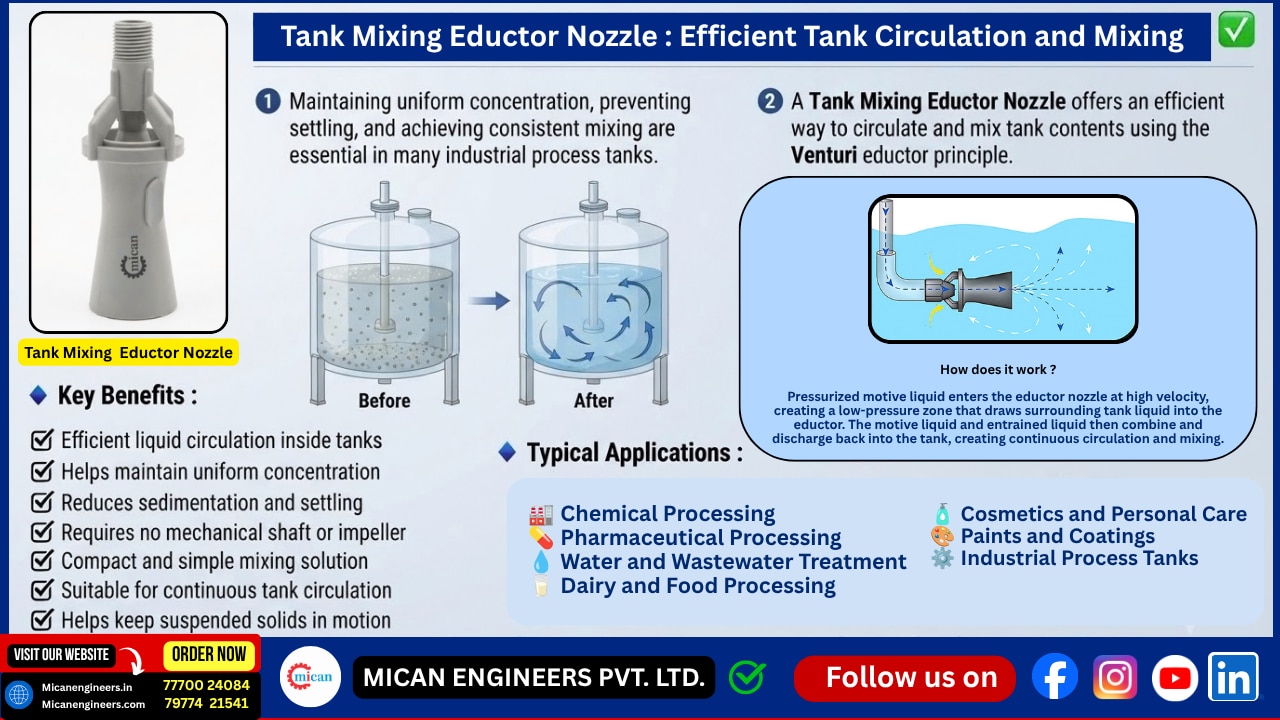
Tank Mixing Eductor Nozzle : Working, Benefits & Applications
Efficient tank mixing is essential for maintaining uniform concentration, preventing sedimentation, and improving process consistency.
A Tank Mixing Eductor Nozzle provides an effective way to circulate and mix tank contents using the Venturi eductor principle, without requiring a conventional mechanical agitator.
What is a Tank Mixing Eductor Nozzle ?
A Tank Mixing Eductor Nozzle is a liquid-driven mixing device installed inside a process tank.
A high-velocity motive liquid passes through the nozzle, creating a low-pressure zone that draws surrounding tank liquid into the eductor.
The motive liquid and entrained tank liquid are then discharged as a combined flow, creating continuous circulation and mixing throughout the tank.
How Does a Tank Mixing Eductor Work?
The basic working principle involves three steps:
1. Motive Liquid Entry
A pressurized liquid enters the eductor nozzle.
2. Entrainment
The high-velocity jet creates a low-pressure region, drawing additional liquid from the surrounding tank.
3. Mixing & Circulation
The motive liquid and entrained liquid combine and are discharged into the tank, generating circulation and promoting uniform mixing.
Key Benefits
- Efficient tank circulation and mixing
- Helps maintain uniform concentration
- Reduces sedimentation and settling
- No mechanical shaft or impeller required
- Suitable for continuous mixing applications
- Can be used in tanks of different sizes and configurations
- Compact design with relatively low maintenance requirements
- Useful for blending and keeping solids suspended
Applications of Tank Mixing Eductor Nozzles
Tank mixing eductors can be used across several process industries, including:
- Chemical Processing – chemical dilution and solution mixing
- Water & Wastewater Treatment – tank circulation and solids suspension
- Pharmaceutical Processing – liquid preparation and blending
- Food & Beverage – ingredient mixing and product circulation
- Dairy Processing – liquid circulation and uniformity
- Cosmetics – formulation and blending
- Paints & Coatings – maintaining uniform suspension
- Industrial Process Tanks – continuous liquid circulation
Tank Mixing Eductor vs. Conventional Agitator
Unlike a conventional mechanical agitator, which uses an impeller to move the liquid, an eductor uses pressurized motive liquid to generate circulation.
This makes eductor systems particularly useful where mechanical agitation is undesirable, difficult to install, or where tank circulation is the primary requirement.
Factors to Consider When Selecting an Eductor
Proper selection depends on the process and tank conditions. Important parameters include:
- Tank capacity and geometry
- Motive liquid flow rate
- Motive pressure
- Required circulation rate
- Liquid viscosity and specific gravity
- Presence and concentration of suspended solids
- Material of construction
- Installation location and orientation
Conclusion :
A Tank Mixing Eductor Nozzle is a practical solution for creating continuous liquid circulation and mixing inside process tanks. By using the Venturi eductor principle, it can help maintain product uniformity, minimize settling, and simplify tank-mixing systems.
For applications involving chemical solutions, wastewater, pharmaceutical liquids, food products, or industrial process fluids, the correct eductor design and operating conditions are important for achieving the desired mixing performance.
#TankMixing #EductorNozzle #MixingNozzle #TankMixingNozzle #IndustrialNozzles #ProcessEquipment #ChemicalIndustry #PharmaceuticalIndustry #WaterTreatment #FoodProcessing #MicanEngineers
@mumbai @pune @chennai @ahmedabad
