
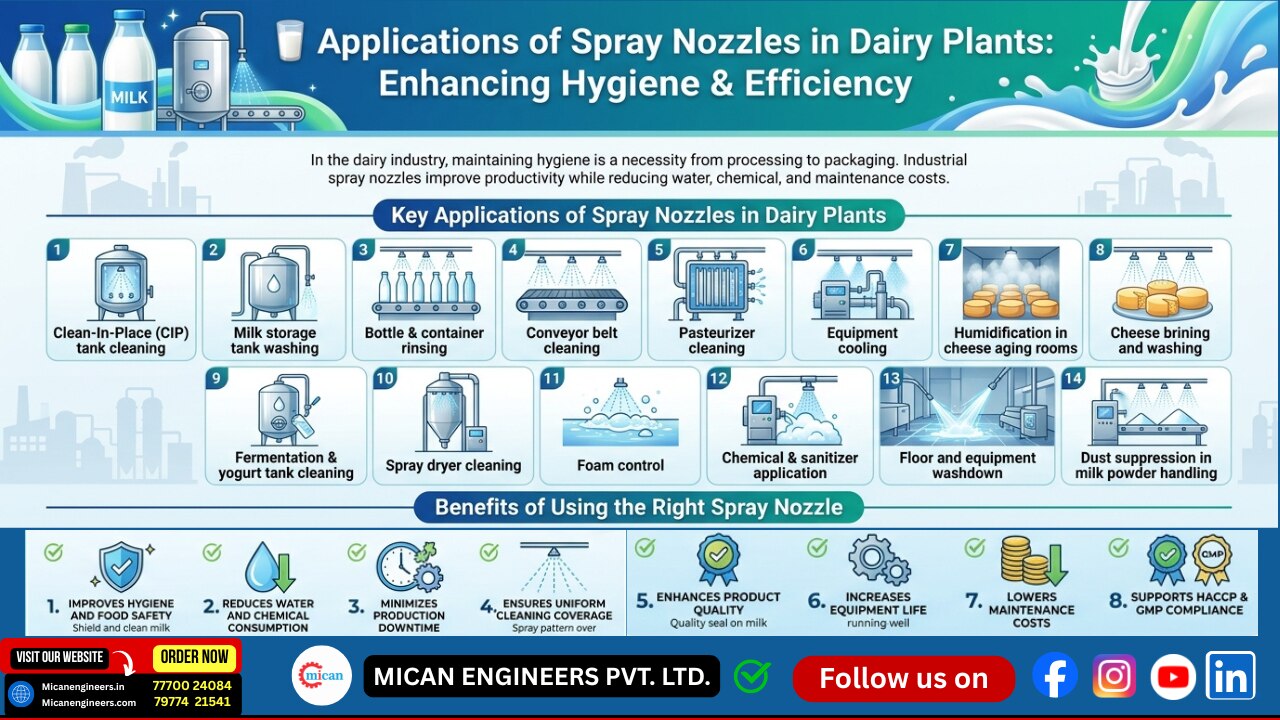
Applications of Spray Nozzles in Dairy Plants : Improving Hygiene, Product Quality, and Production Efficiency
The dairy industry operates under some of the strictest hygiene and quality standards in the food processing sector.
From milk reception to packaging, every stage requires precise cleaning, controlled liquid application, temperature management, and sanitization. Even minor inconsistencies in these processes can lead to product contamination, increased downtime, reduced equipment life, and higher operating costs.
Industrial spray nozzles play a critical role in ensuring that dairy plants maintain cleanliness, improve processing efficiency, reduce water and chemical consumption, and comply with food safety regulations. Selecting the right spray nozzle for each application can significantly improve production performance while lowering operational costs.
In this blog, we'll explore the major applications of spray nozzles in dairy processing plants and how they contribute to efficient, hygienic, and reliable operations.
Why Spray Nozzles Are Essential in Dairy Processing ?
Dairy products such as milk, butter, cheese, yogurt, ice cream, and milk powders require controlled processing environments where cleanliness and consistency are paramount.
Spray nozzles help by :
- Maintaining hygienic production conditions
- Improving cleaning efficiency
- Reducing water and chemical consumption
- Ensuring uniform product processing
- Controlling temperature during production
- Minimizing production downtime
- Extending equipment life
- Meeting food safety and sanitation standards
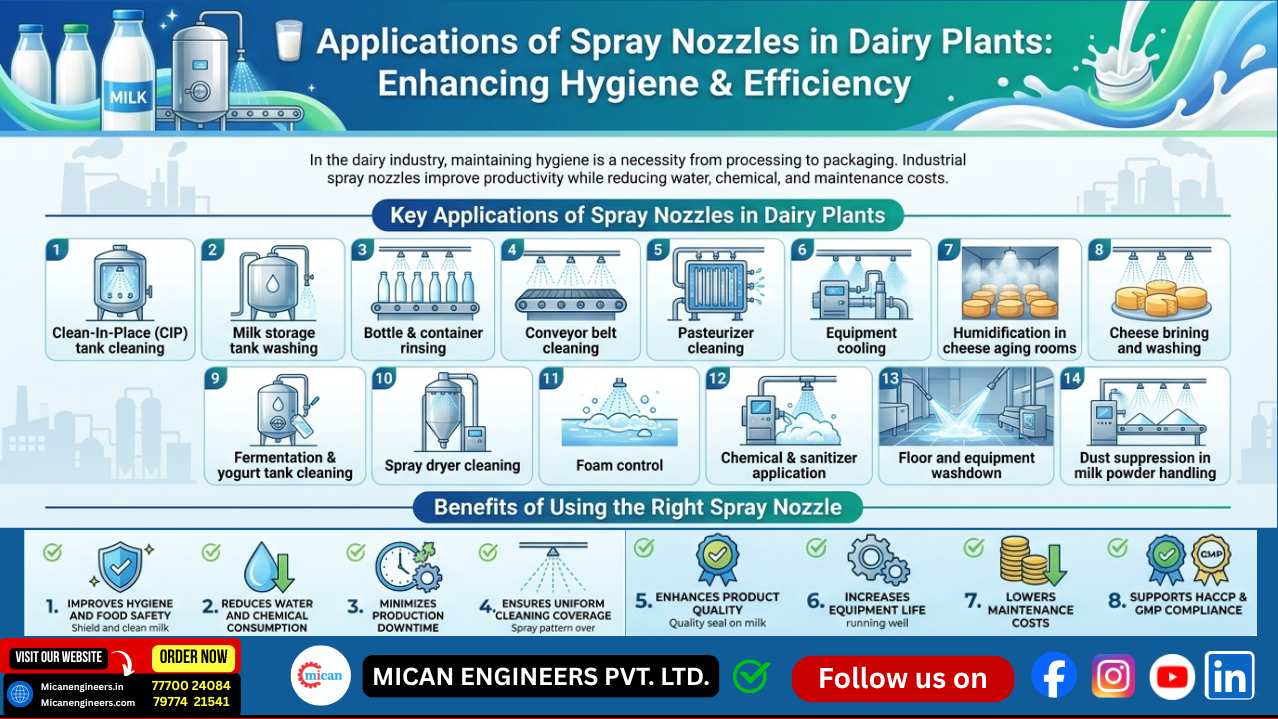
Major Applications of Spray Nozzles in Dairy Plants :
1. Clean-In-Place (CIP) System Cleaning
One of the most important applications is CIP cleaning.
Spray nozzles and rotary tank cleaning nozzles clean the inside surfaces of :
- Milk storage tanks
- Mixing vessels
- Pasteurizers
- Pipelines
- Homogenizers
- Cream separators
- Cheese vats
- Fermentation tanks
Benefits include :
- Complete internal cleaning
- Reduced manual cleaning
- Faster cleaning cycles
- Lower water usage
- Improved sanitation
- Consistent cleaning results
Common Nozzles :
- Rotary Tank Cleaning Nozzles
- Static Spray Balls
- Full Cone Nozzles
2. Tank Washing
Milk residues, fats, proteins, and sugar deposits accumulate inside tanks over time.
High-performance spray nozzles generate controlled impact to remove:
- Milk stone
- Fat deposits
- Protein buildup
- Product residues
- Cleaning chemical residues
Benefits:
- Reduced contamination risk
- Better product quality
- Lower maintenance
- Longer equipment life
3. Conveyor Belt Cleaning
Conveyor systems transport:
- Milk bottles
- Cheese blocks
- Yogurt cups
- Butter packs
- Ice cream containers
Spray nozzles continuously wash conveyor belts to remove:
- Milk spills
- Food particles
- Sugar residues
- Packaging debris
Benefits:
- Improved hygiene
- Continuous production
- Reduced bacterial growth
- Lower manual cleaning effort
Common Nozzle:
- Flat Fan Spray Nozzle
4. Bottle and Container Washing
Before filling, bottles and containers must be free from dust and contaminants.
Spray nozzles provide:
- High-pressure rinsing
- Sterile water spraying
- Air blow-off
- Internal bottle cleaning
Applications:
- Glass bottles
- Plastic bottles
- Milk pouches
- Cups
- Dairy containers
Benefits:
- Improved packaging hygiene
- Reduced contamination
- Better shelf life
5. Pasteurizer Cleaning
Pasteurizers develop deposits of:
- Milk proteins
- Minerals
- Fats
Spray nozzles ensure complete cleaning of:
- Heat exchanger plates
- Internal chambers
- Process pipelines
Benefits:
- Improved heat transfer
- Reduced energy consumption
- Longer operating life
- Consistent pasteurization
6. Cooling Applications
Milk and dairy products require rapid cooling after processing.
Spray nozzles are used for:
- Equipment cooling
- Surface cooling
- Cooling towers
- Condenser cooling
Benefits:
- Faster cooling
- Lower equipment temperature
- Improved process stability
- Increased equipment life
Common Nozzles:
- Full Cone Nozzles
- Hollow Cone Nozzles
7. Humidification
Many dairy processing areas require controlled humidity.
Spray nozzles create fine mist for:
- Cheese aging rooms
- Cold storage
- Packaging rooms
- Ingredient storage
Benefits:
- Reduced product drying
- Better product quality
- Controlled moisture
- Improved storage conditions
8. Cheese Production
Cheese manufacturing uses spray nozzles for:
- Brine spraying
- Mold cleaning
- Equipment washing
- Cheese surface washing
Benefits:
- Uniform brining
- Better product consistency
- Improved hygiene
- Reduced manual work
9. Yogurt and Fermentation Tank Cleaning
Fermentation vessels require thorough cleaning after every production batch.
Spray nozzles remove:
- Yogurt residues
- Milk solids
- Fermentation deposits
- Protein films
Benefits:
- Prevents cross-contamination
- Consistent product quality
- Reduced cleaning time
10. Powder Drying Systems
Milk powder production involves spray drying.
Spray nozzles help in:
- Dryer chamber cleaning
- Equipment washing
- Cooling systems
- Dust suppression
Benefits:
- Reduced product contamination
- Better powder quality
- Improved equipment efficiency
11. Foam Control
Certain dairy processes generate excessive foam.
Spray nozzles apply:
- Water
- Food-grade defoaming agents
Applications:
- Milk processing
- Mixing tanks
- CIP systems
Benefits:
- Stable production
- Reduced overflow
- Better process control
12. Chemical Application
Cleaning chemicals and sanitizers must be evenly distributed.
Spray nozzles ensure uniform application of:
- Caustic solutions
- Acid cleaners
- Sanitizers
- Disinfectants
Benefits:
- Better cleaning
- Reduced chemical usage
- Uniform coverage
- Improved sanitation
13. Floor and Equipment Cleaning
Production areas require frequent washdowns.
Spray nozzles clean:
- Floors
- Walls
- Drains
- Processing equipment
- Workstations
Benefits:
- Improved hygiene
- Safer workplace
- Reduced bacterial growth
14. Dust Suppression
Milk powder and dry ingredients generate airborne dust during handling.
Spray nozzles create fine droplets to suppress dust in:
- Powder handling systems
- Ingredient transfer points
- Packaging lines
- Storage areas
Benefits:
- Cleaner working environment
- Reduced product loss
- Improved worker safety
- Lower housekeeping requirements
Common Spray Nozzle Types Used in Dairy Plants :
Spray Nozzle | Typical Applications |
|---|---|
| Full Cone Nozzle | Equipment cooling, washing, chemical spraying |
| Flat Fan Nozzle | Conveyor cleaning, bottle washing, surface cleaning |
| Hollow Cone Nozzle | Cooling, humidification, fine spraying |
| Rotary Tank Cleaning Nozzle | CIP tank cleaning, vessel washing |
| Static Spray Ball | Storage tank cleaning |
| Air Blow Nozzle | Drying bottles, removing excess water, packaging lines |
Benefits of Using the Right Spray Nozzle :
Choosing the correct spray nozzle offers several operational advantages:
1. Improved Hygiene
Consistent spray coverage removes residues effectively, supporting food safety standards.
2. Water Savings
Optimized spray patterns reduce unnecessary water consumption.
3. Lower Chemical Consumption
Efficient distribution minimizes chemical usage while maintaining cleaning performance.
4. Reduced Downtime
Faster cleaning cycles allow equipment to return to production more quickly.
5. Better Product Quality
Uniform cleaning and controlled spraying help prevent contamination and maintain consistent product quality.
6. Lower Maintenance Costs
Proper nozzle selection reduces wear on equipment and helps prevent scaling and buildup.
7. Higher Production Efficiency
Reliable spray performance contributes to smoother operations and increased productivity.
8. Regulatory Compliance
Effective cleaning supports compliance with food safety standards such as HACCP, GMP, and other dairy hygiene requirements.
Factors to Consider When Selecting Spray Nozzles :
Selecting the appropriate nozzle depends on several process requirements:
- Spray pattern (Full Cone, Flat Fan, Hollow Cone)
- Spray angle
- Flow rate
- Operating pressure
- Droplet size
- Impact force
- Material of construction (typically SS 304 or SS 316 for food applications)
- Temperature compatibility
- Chemical resistance
- Ease of maintenance and cleaning
Common Problems Caused by Incorrect Nozzle Selection :
Using an unsuitable or worn spray nozzle can result in :
- Incomplete tank cleaning
- Higher water consumption
- Excessive chemical usage
- Product contamination
- Uneven cooling
- Poor sanitization
- Increased maintenance costs
- Longer production downtime
- Reduced equipment lifespan
Regular nozzle inspection and timely replacement help maintain consistent spray performance and process reliability.
Conclusion :
Spray nozzles are essential components in modern dairy plants, supporting everything from CIP cleaning and tank washing to cooling, bottle rinsing, humidification, foam control, and dust suppression. Although small in size, they have a significant impact on hygiene, operational efficiency, product quality, and resource utilization.
By selecting the right spray nozzle for each application and maintaining it properly, dairy manufacturers can reduce water and chemical consumption, improve cleaning effectiveness, minimize downtime, and ensure compliance with stringent food safety standards.
At Mican Engineers, we provide a wide range of industrial spray nozzles and tank cleaning solutions designed for demanding dairy processing applications. Whether you need high-efficiency CIP nozzles, flat fan nozzles, full cone nozzles, or rotary tank cleaning systems, our solutions are engineered to deliver reliable performance, improved sanitation, and long service life.
#DairyIndustry
#MilkProcessing
#FoodProcessing
#SprayNozzles
#IndustrialSprayNozzles
#CIPCleaning
#TankCleaning
#FoodSafety
#IndustrialCleaning
#ProcessEngineering
#ManufacturingIndustry
#ProductionEfficiency
#CleaningSolutions
#NozzleTechnology
#MicanEngineers