
Excessive Mist in Spray Systems : Why It Happens and How to Prevent It ?
In many industrial spray applications, achieving the correct droplet size is essential for process efficiency. While fine droplets are beneficial in some applications, excessive mist is often a sign that the spray system is not operating optimally.
When spray nozzles produce too much mist instead of controlled droplets, the result can be product loss, poor coverage, contamination, increased operating costs, and unsafe working conditions.
Understanding the causes of excessive mist and implementing the right solutions can significantly improve spray performance and overall process reliability.
What is Excessive Mist ?
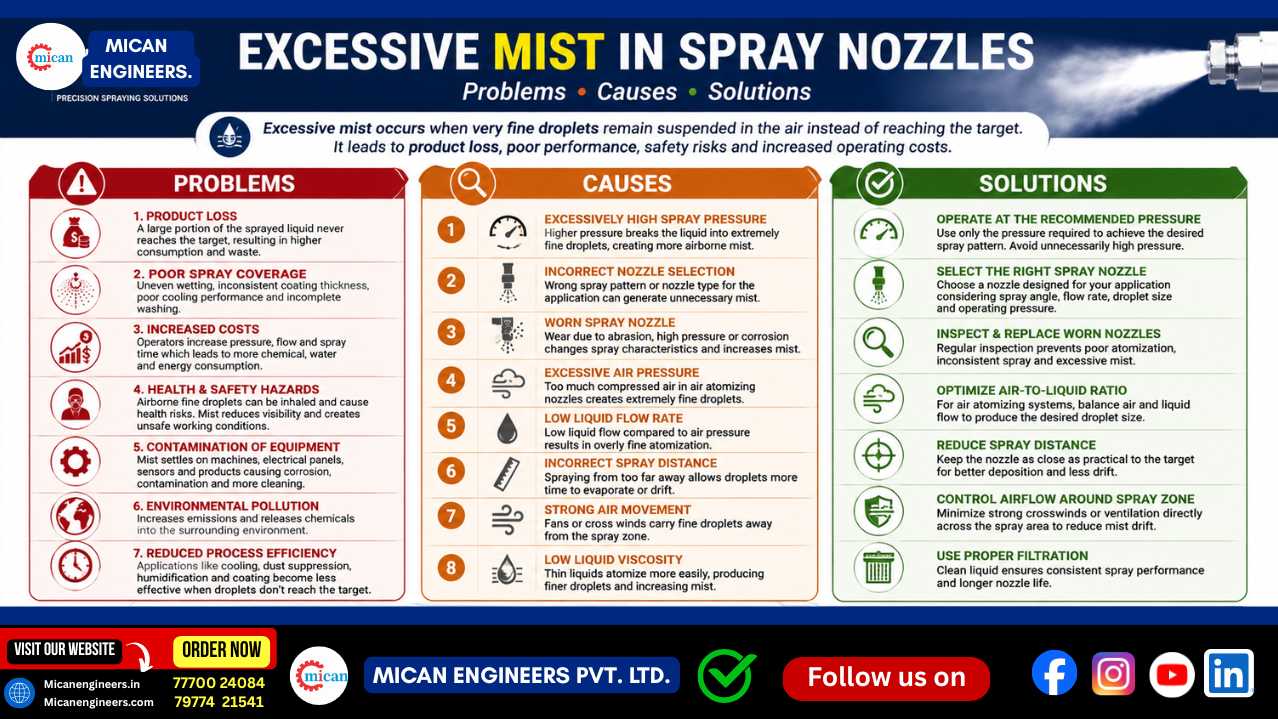
Excessive mist occurs when a spray nozzle generates extremely fine droplets that remain suspended in the air instead of reaching the intended target surface.
Rather than depositing efficiently, these tiny droplets drift away due to surrounding air currents, reducing the effectiveness of the spraying process.
Common Problems Caused by Excessive Mist :
1. Product Loss
A significant portion of the sprayed liquid never reaches the target.
This results in :
- Higher chemical consumption
- Increased coating material usage
- Wasted cleaning fluids
- Increased operating costs
2. Poor Spray Coverage
Because droplets drift away, the target surface receives an uneven amount of liquid.
This can lead to :
- Inconsistent coating thickness
- Uneven wetting
- Poor cooling performance
- Incomplete washing
3. Increased Chemical Consumption
To compensate for poor coverage, operators often increase :
- Spray time
- Pressure
- Flow rate
This further increases chemical and water usage without improving efficiency.
4. Health & Safety Hazards
Fine airborne droplets can become inhalation hazards, especially when spraying:
- Chemicals
- Acids
- Solvents
- Disinfectants
- Coating materials
Mist can also reduce visibility and create unsafe working conditions.
5. Contamination of Surrounding Equipment
Drifting mist can settle on:
- Machines
- Electrical panels
- Sensors
- Conveyors
- Finished products
This may lead to corrosion, contamination, or unnecessary cleaning.
6. Environmental Pollution
Excessive airborne spray increases emissions and releases chemicals into the surrounding environment.
Many industries must comply with environmental regulations regarding airborne mist.
7. Reduced Process Efficiency
Applications such as:
- Cooling
- Dust suppression
- Humidification
- Surface treatment
- Coating
Become less effective when the majority of droplets fail to reach the intended surface.
Common Causes of Excessive Mist :
1. Excessively High Spray Pressure
This is the most common cause.
Higher pressure breaks the liquid into extremely fine droplets, creating more airborne mist.
Signs
- Very fine fog-like spray
- Large spray cloud
- Significant overspray
2. Incorrect Nozzle Selection
Some nozzles naturally produce finer droplets than others.
Using the wrong spray pattern or nozzle type for an application can generate unnecessary mist.
3. Worn Spray Nozzle
Over time, nozzle orifices wear due to:
- Abrasive particles
- High-pressure operation
- Corrosion
Wear changes the spray characteristics and may create irregular atomization.
4. Excessive Air Pressure (Air Atomizing Nozzles)
For air atomizing systems, too much compressed air creates extremely fine droplets.
The result is excessive airborne mist instead of efficient deposition.
5. Low Liquid Flow Rate
When liquid flow is too low compared to air pressure, atomization becomes excessively fine.
6. Incorrect Spray Distance
Spraying from too far away allows droplets more time to evaporate or drift before reaching the target.
7. Strong Air Movement
Industrial ventilation systems or fans may carry fine droplets away from the spray zone.
8. Low Liquid Viscosity
Thin liquids naturally atomize more easily than viscous liquids, producing finer droplets and increasing mist formation.
How to Reduce Excessive Mist :
✔ Operate at the Recommended Pressure
Use only the pressure required to achieve the desired spray pattern.
Avoid unnecessarily high operating pressures.
✔ Select the Right Spray Nozzle
Choose a nozzle designed for your application.
Consider:
- Spray angle
- Flow rate
- Droplet size
- Spray pattern
- Operating pressure
✔ Inspect and Replace Worn Nozzles
Regular nozzle inspection prevents:
- Poor atomization
- Flow inconsistencies
- Excessive mist
- Product waste
Replacing worn nozzles at the right time improves process consistency.
✔ Optimize Air-to-Liquid Ratio
For air atomizing systems:
- Reduce unnecessary air pressure.
- Balance air and liquid flow to produce the desired droplet size.
✔ Reduce Spray Distance
Position the nozzle as close as practical to the target surface while maintaining complete coverage.
✔ Control Airflow Around the Spray Zone
Minimize strong crosswinds or ventilation directly across the spray area to reduce drift.
✔ Use Proper Filtration
Contaminants can alter spray characteristics and accelerate nozzle wear.
Installing suitable filters helps maintain consistent spray performance and extends nozzle life.
Preventive Maintenance Tips :
To avoid excessive mist and maintain consistent spraying performance:
- Inspect spray nozzles regularly.
- Monitor operating pressure.
- Check spray pattern for changes.
- Replace worn nozzles before performance deteriorates.
- Maintain clean filters and pipelines.
- Verify air and liquid pressure settings.
- Review nozzle alignment periodically.
Industries Commonly Affected :
Excessive mist can impact a wide range of industries, including:
- Pharmaceutical
- Chemical Processing
- Food & Beverage
- Steel
- Cement
- Power Plants
- Paper & Pulp
- Textile
- Automotive
- Surface Coating
- Dust Suppression
- Gas Scrubbing
- Tank Cleaning
Why Choosing the Right Spray Nozzle Matters ?
The correct spray nozzle is not just about achieving the desired spray pattern—it directly affects product quality, operational efficiency, safety, and operating costs.
Selecting the right nozzle, maintaining proper operating pressure, and performing routine maintenance can greatly reduce excessive mist while improving spray accuracy and reducing waste.
Conclusion :
Excessive mist is a common but preventable issue in industrial spraying systems. It often results from high operating pressure, incorrect nozzle selection, worn nozzles, or improper system settings.
By identifying the root cause and implementing the right corrective measures, industries can reduce chemical waste, improve spray efficiency, lower operating costs, and create a safer working environment.
At Mican Engineers Pvt. Ltd., we manufacture precision-engineered industrial spray nozzles designed to deliver controlled droplet sizes, uniform spray distribution, and reliable performance across a wide range of industrial applications. Our team can help you select the right nozzle solution to minimize excessive mist and optimize your spraying process.
( Visit Our Youtube Channel : https://www.youtube.com/@MicanEngineers )
#SprayNozzles #IndustrialSpray #SprayTechnology #IndustrialNozzles #SprayNozzleMaintenance #NozzleProblems #ProcessOptimization #Manufacturing #IndustrialMaintenance #EngineeringSolutions #IndustrialAutomation #ChemicalProcessing #PharmaceuticalIndustry #FoodProcessing #DustSuppression #TankCleaning #SurfaceCoating #IndustrialEquipment #MicanEngineers #PrecisionEngineering
@mumbai @pune @chennai @ahmedabad
73 more words to run Humanize