
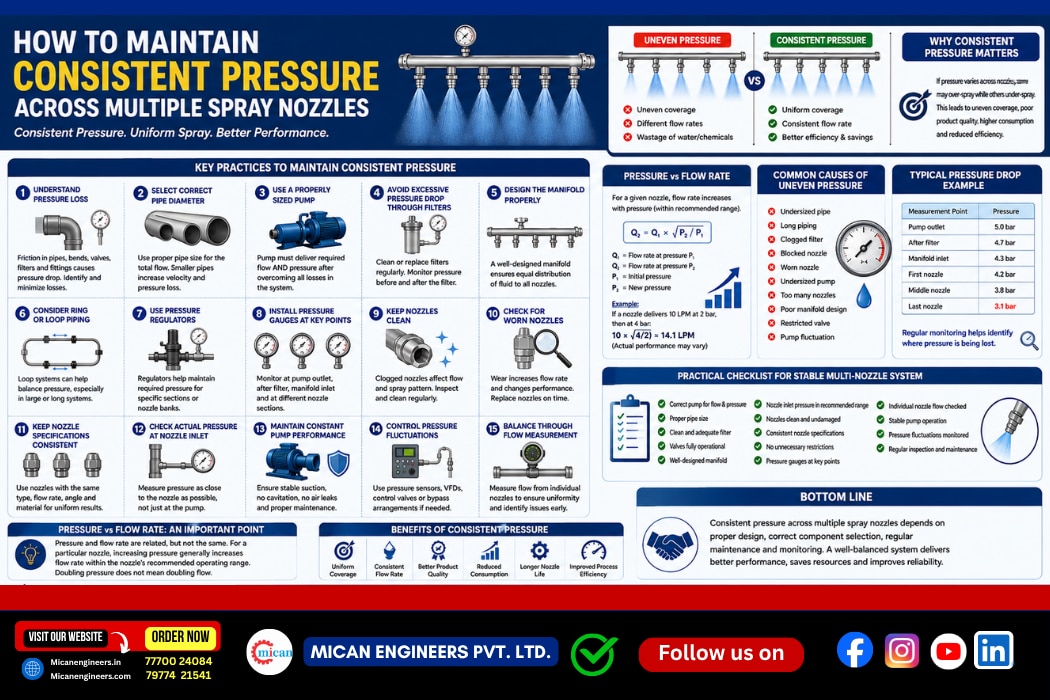
How to Maintain Consistent Pressure Across Multiple Spray Nozzles ?
In industrial spray systems, using multiple spray nozzles is common for cooling, washing, coating, cleaning, dust suppression, lubrication, and chemical spraying.
However, when several nozzles operate from the same supply line, maintaining consistent pressure at every nozzle can become a challenge.
If pressure is not properly balanced, some nozzles may produce excessive flow while others deliver insufficient spray.
This can result in uneven coverage, inconsistent droplet size, reduced cleaning performance, product quality issues, and unnecessary water or chemical consumption.
In this blog, we will discuss the main causes of pressure variation across multiple spray nozzles and practical methods to maintain more consistent spray performance.
Why Is Consistent Pressure Important in a Multi-Nozzle System ?
Spray nozzle performance depends significantly on the pressure available at the nozzle inlet.
For a given nozzle, increasing pressure generally increases flow rate and can also affect the spray characteristics.
Therefore, if one nozzle receives substantially higher pressure than another, the two nozzles may not produce the same spray output.
For example, consider a system with six identical flat spray nozzles.
" If the first nozzle receives 4 bar while the last nozzle receives only 2.5 bar, the spray pattern and flow rate may differ between the nozzles."
This can create :
- Uneven spray coverage
- Different flow rates between nozzles
- Variations in spray angle or pattern
- Inconsistent cooling or washing
- Poor coating uniformity
- Higher consumption of water or chemicals
- Increased wear on some nozzles
- Reduced process efficiency
For applications requiring uniform coverage, pressure distribution should therefore be considered during system design, not only after installation.
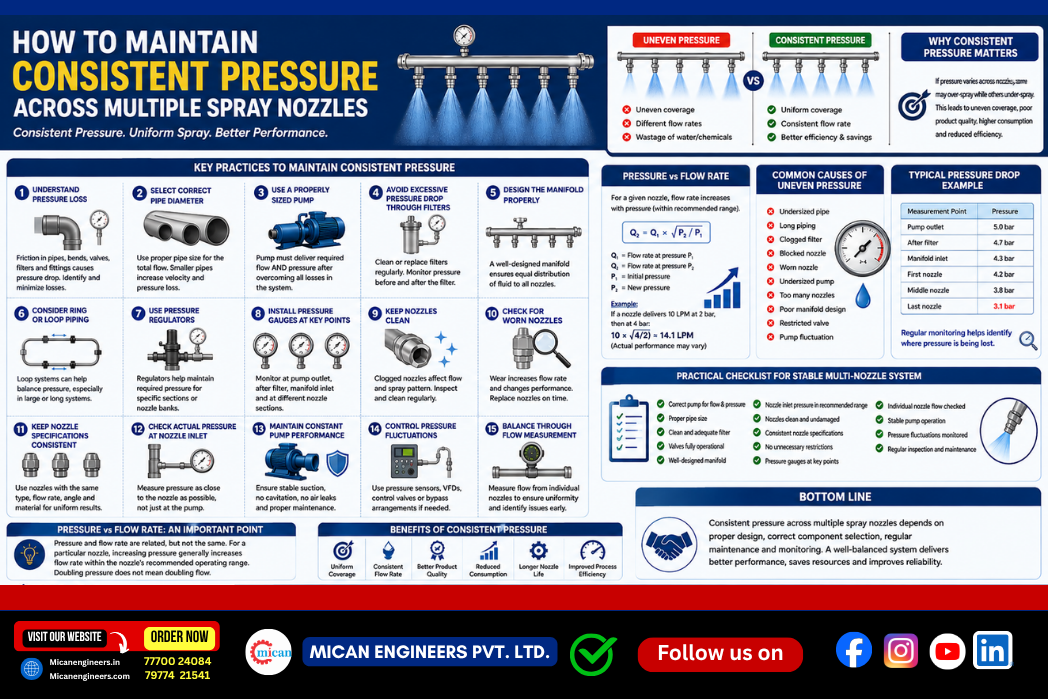
1. Understand Pressure Loss in the Piping System
One of the most common reasons for inconsistent pressure is pressure loss through the piping system.
As fluid travels through pipes, hoses, bends, valves, filters, fittings, and other components, some pressure is lost because of friction and flow resistance.
In a multi-nozzle system, this can become particularly important when the pipe is long or the flow rate is high.
What causes pressure loss ?
Common factors include :
- Long pipe lengths
- Small pipe diameters
- Excessive bends and elbows
- Undersized valves
- Clogged filters
- Restricted fittings
- Long flexible hoses
- High flow velocity
If the piping is not properly sized, the pressure at the end of the manifold can be considerably lower than the pressure near the pump.
2. Select the Correct Pipe Diameter
Pipe diameter has a major influence on pressure loss.
A pipe that is too small can create high flow velocity and increased friction losses. As more nozzles are added, the total flow requirement increases, making the problem more significant.
For example, if ten nozzles each require 5 LPM, the supply system needs to provide approximately :
10 × 5 = 50 LPM
The piping, pump, valves, and other components should be capable of handling the required flow without excessive pressure drop.
Practical consideration :
Instead of selecting the smallest possible pipe to reduce material cost, consider :
( Required flow → pipe diameter → pressure loss → nozzle inlet pressure )
Proper hydraulic sizing can help ensure that adequate pressure reaches all nozzles.
3. Use a Properly Sized Pump
The pump must be capable of supplying both the required flow rate and pressure.
A common mistake is selecting a pump based only on flow rate.
For example, a system may require :
- 60 LPM total flow
- 4 bar pressure at the nozzles
But the pump must provide sufficient pressure to overcome :
Static pressure requirement + piping pressure losses + component losses + nozzle pressure requirement
If the pump cannot maintain the required operating point, pressure at the nozzles will fluctuate or fall below the desired level.
4. Avoid Excessive Pressure Drop Through Filters
Filters are essential for protecting spray nozzles from clogging, particularly when using small-orifice nozzles.
However, a dirty or undersized filter can create significant pressure loss.
As contaminants accumulate, the filter becomes more restrictive, causing the pressure downstream to decrease.
Recommended practice :
- Monitor the pressure before and after the filter.
- A noticeable increase in differential pressure can indicate that the filter needs cleaning or replacement.
- This is especially important in systems operating continuously or with contaminated fluids.
5. Design the Manifold Properly
The manifold distributes fluid to multiple spray nozzles.
Poor manifold design can cause some nozzles to receive more pressure than others.
For example, in a simple linear arrangement, the first nozzle may receive fluid at a higher pressure while pressure gradually decreases toward the end of the manifold.
A properly designed manifold should consider :
- Total flow requirement
- Number of nozzles
- Nozzle flow rate
- Pipe diameter
- Manifold length
- Nozzle spacing
- Pressure loss
- Fluid properties
For larger systems, hydraulic calculations or flow simulation can help optimize the manifold design.
6. Consider a Ring or Loop Piping Arrangement
For systems with many spray nozzles, a loop or ring arrangement can sometimes provide better pressure distribution than a simple dead-end line.
In a loop system, fluid can approach different sections from multiple directions.
This can help reduce pressure variation across the system, especially when the nozzle arrangement is large or the piping run is long.
However, the appropriate arrangement depends on the application, flow requirement, available pump capacity, and piping layout.
7. Use Pressure Regulators Where Appropriate
A pressure regulator can help control the pressure supplied to a particular section of the spray system.
For example, if different nozzle banks require different operating pressures, separate pressure regulation can be used.
However, a regulator cannot compensate for an incorrectly, sized pump or severely undersized piping.
It should be considered as part of the overall system design rather than a solution to every pressure problem.
8. Install Pressure Gauges at Important Locations
One pressure gauge near the pump is often not enough to understand what is happening throughout a multi-nozzle system.
Consider measuring pressure at :
Pump outlet → filter inlet/outlet → manifold inlet → selected nozzle sections
This helps identify where pressure is being lost.
For example :
| Measurement Point | Pressure |
|---|---|
| Pump outlet | 5 bar |
| After filter | 4.7 bar |
| Manifold inlet | 4.3 bar |
| First nozzle | 4.2 bar |
| Middle nozzle | 3.8 bar |
| Last nozzle | 3.1 bar |
This type of measurement can immediately indicate that the system has a significant pressure drop toward the end of the line.
9. Keep Nozzles Clean and Free From Blockages
A partially blocked nozzle can behave differently from other nozzles even when the supply pressure is identical.
Contamination can affect :
- Flow rate
- Spray pattern
- Spray angle
- Droplet distribution
- Coverage
If one nozzle produces a noticeably different spray pattern, don't immediately assume that the system pressure is the problem.
Check the nozzle for :
- Dirt
- Scale
- Chemical deposits
- Foreign particles
- Mechanical damage
- Orifice wear
Regular nozzle inspection is an important part of maintaining spray consistency.
10. Check for Worn Nozzles
Nozzle wear can gradually change flow performance.
This is particularly important when spraying abrasive liquids or fluids containing suspended particles.
As the orifice wears, the nozzle may deliver more flow than a new nozzle at the same pressure.
For example, a system may contain ten identical nozzles, but if two nozzles have significantly worn orifices, their flow rates may differ from the remaining nozzles.
Therefore, nozzle replacement should be based not only on physical appearance but also on flow rate and spray pattern performance where practical.
11. Keep Nozzle Specifications Consistent
If uniform spraying is required, the nozzles should generally be selected with compatible specifications.
Pay attention to :
- Nozzle type
- Flow rate
- Spray angle
- Orifice size
- Connection size
- Material
- Operating pressure
Using different nozzle capacities in the same manifold can intentionally or unintentionally create different flow rates.
For applications requiring uniform coverage, selecting nozzles with matching flow characteristics can simplify system balancing.
12. Check the Actual Pressure at the Nozzle Inlet
Pressure shown on a pump discharge gauge does not necessarily represent the pressure available at every nozzle.
The actual nozzle inlet pressure can be affected by :
Pump → pipe → filter → valve → manifold → fittings → nozzle
Therefore, when troubleshooting, measure pressure as close to the nozzle inlet as practical.
This provides a much better understanding of actual nozzle operating conditions.
13. Maintain Constant Pump Performance
Pressure fluctuations can also originate from the pump.
Possible causes include :
- Pump wear
- Incorrect pump selection
- Variable pump speed
- Air entering the system
- Cavitation
- Inconsistent fluid supply
- Damaged pump components
- Improper suction conditions
If pressure continuously rises and falls across all nozzles simultaneously, investigate the pump and supply system before replacing individual nozzles.
14. Control Pressure Fluctuations
In some systems, pressure may fluctuate because demand changes during operation.
For example, automatic valves may open and close different nozzle sections.
When the number of operating nozzles changes, the system flow requirement also changes.
A suitable control system may include :
- Pressure sensors
- Flow meters
- Variable-frequency drives
- Automatic control valves
- Pressure regulators
- Bypass arrangements
These components can help maintain more stable operating conditions when the process requires variable spray demand.
15. Balance the Nozzle System Through Flow Measurement
Pressure alone does not always tell the complete story.
If uniform spray performance is important, measuring the flow from individual nozzles can be useful.
For example, suppose six identical nozzles are expected to deliver approximately the same flow :
| Nozzle | Measured Flow |
|---|---|
| Nozzle 1 | 5.1 LPM |
| Nozzle 2 | 5.0 LPM |
| Nozzle 3 | 5.0 LPM |
| Nozzle 4 | 4.9 LPM |
| Nozzle 5 | 4.8 LPM |
| Nozzle 6 | 3.9 LPM |
The last nozzle may require further inspection for blockage, pressure loss, piping restriction, or nozzle damage.
Flow measurement can therefore be a valuable troubleshooting tool.
Common Causes of Uneven Pressure Across Multiple Spray Nozzles :
| Cause | Possible Effect | Recommended Action |
|---|---|---|
| Undersized pipe | High pressure loss | Review pipe diameter |
| Long piping | Pressure reduction | Optimize piping layout |
| Clogged filter | Reduced downstream pressure | Clean/replace filter |
| Blocked nozzle | Reduced flow | Inspect and clean nozzle |
| Worn nozzle | Excessive flow | Replace nozzle |
| Undersized pump | Low system pressure | Recheck pump selection |
| Too many nozzles | Insufficient flow per nozzle | Check total flow requirement |
| Poor manifold design | Uneven pressure | Redesign distribution |
| Restricted valve | Pressure loss | Inspect valve |
| Pump fluctuation | Unstable spray | Check pump and controls |
( Pressure vs Flow Rate ) : An Important Point*
It is important to understand that pressure and flow rate are related, but they are not the same thing.
For a particular spray nozzle, increasing pressure generally increases flow rate. within the nozzle's recommended operating range.
A simplified relationship commonly used for many pressure-fed nozzles is :
Q₂ = Q₁ × √(P₂/P₁)
Where :
- Q₁ = flow rate at pressure P₁
- Q₂ = flow rate at pressure P₂
- P₁ = initial pressure
- P₂ = new pressure
This means that doubling pressure does not normally mean doubling nozzle flow.
For example, if a nozzle delivers 10 LPM at 2 bar, its theoretical flow at 4 bar would be approximately:
10 × √(4/2) ≈ 14.1 LPM
Actual performance can vary depending on the nozzle design and fluid properties.
Practical Checklist for Multi-Nozzle Pressure Stability
Before operating a multiple-nozzle spray system, check :
- Pump capacity is suitable for total flow and pressure requirement
- Pipe diameter is properly sized
- Filter capacity is adequate
- Filters are clean
- Valves are fully operational
- Manifold is correctly designed
- Nozzle inlet pressure is within the recommended range
- Nozzles are clean and undamaged
- Nozzle specifications are compatible
- Piping has no unnecessary restrictions
- Pressure gauges are installed at useful measurement points
- Individual nozzle flow is checked where uniformity is critical
- Pump operation is stable
- Pressure fluctuations are monitored during operation
Conclusion :
Maintaining consistent pressure across multiple spray nozzles requires more than simply selecting the correct nozzle.
The pump, piping, filters, valves, manifold, nozzle arrangement, and overall hydraulic design all influence the pressure available at each nozzle.
For best results, start with the required total flow and nozzle operating pressure, then size the pump and piping accordingly.
During operation, monitor pressure at strategic points and periodically inspect nozzle flow and spray patterns.
A well-designed and properly maintained spray system can provide more uniform coverage, predictable flow rates, better process performance, and improved nozzle life.
If you are designing a multi-nozzle spray system, selecting the right nozzle type and flow capacity is an important first step.
Mican Engineers can help with industrial spray nozzle selection based on application, pressure, flow rate, spray angle, material, and installation requirements.
Contact Mican Engineers Private Limited for expert guidance.
77700 24084
79774 21541
Official Company Address :
Plot No.E5, Mican Engineers Pvt Ltd,
Behind Sachin Hotel MIDC Anand Nagar,
Ambernath (E), India 421 506
Related Posts :
Check this Most Common Problems and solutions Related to spray Nozzles :
Why One Nozzle Performs Differently From Another Identical Nozzle : Uneven Nozzle Performs
Why Does Spray Pattern Change During Production? 10 Common Causes & Solutions
Nozzle Vibration Problems : Causes, Effects & Solutions
@mumbai @pune @chennai @ahmedabad