
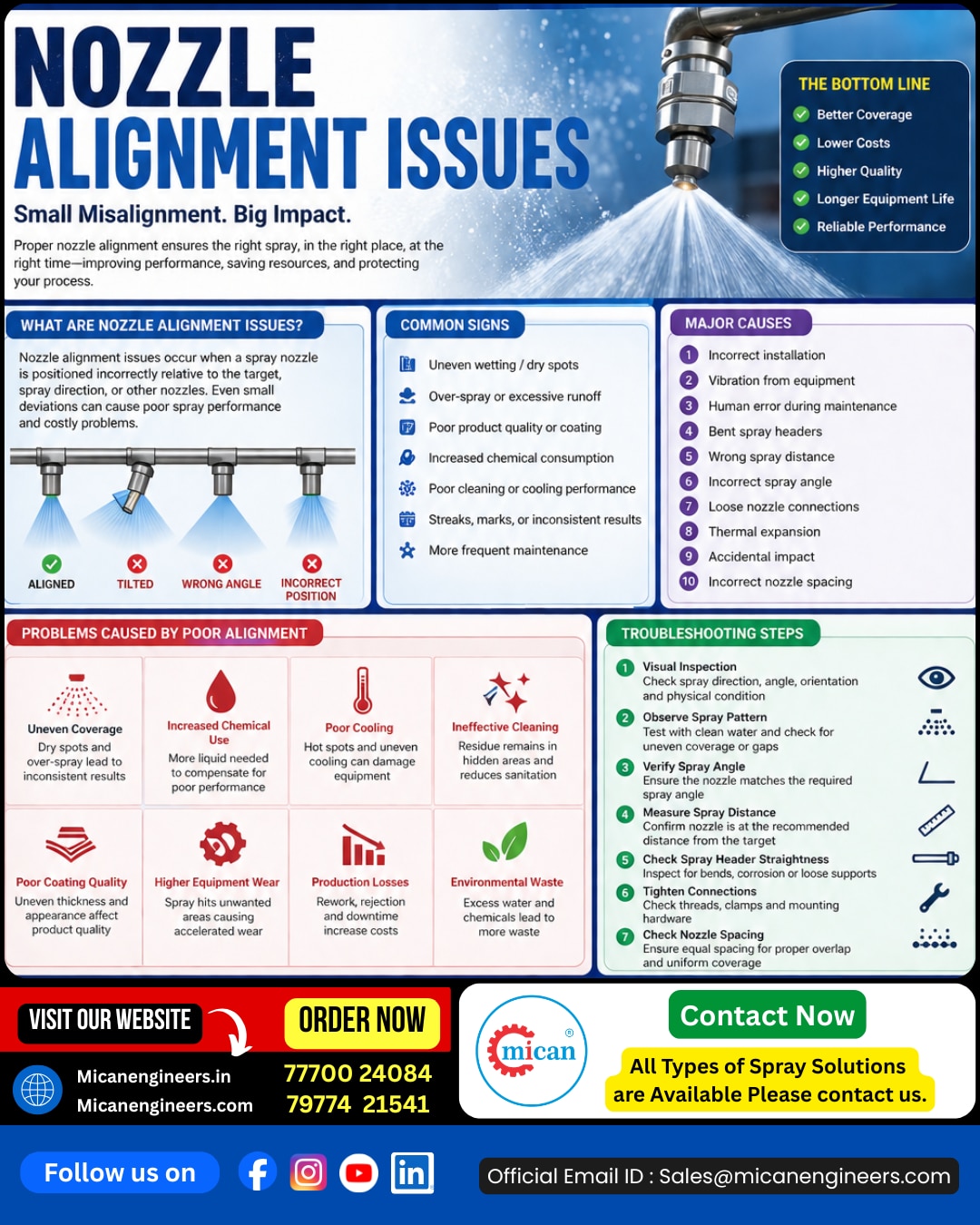
Nozzle Alignment Issues : Causes, Problems, Solutions & Best Practices
Industrial spray nozzles are designed to deliver precise spray patterns, accurate flow rates, and uniform liquid distribution.
However, even the highest-quality spray nozzle cannot perform efficiently. If it is not properly aligned. Nozzle alignment issues are among the most overlooked causes of poor spray performance, leading to inconsistent coverage, increased chemical consumption, product quality defects, equipment wear, and higher operating costs.
Whether your application involves cooling, coating, cleaning, humidification, lubrication, dust suppression, tank washing, gas scrubbing, or chemical dosing, proper nozzle alignment is critical for achieving optimal results.
In this comprehensive guide, we'll explore the causes, symptoms, consequences, troubleshooting methods, and preventive measures for nozzle alignment issues.
What Are Nozzle Alignment Issues ?
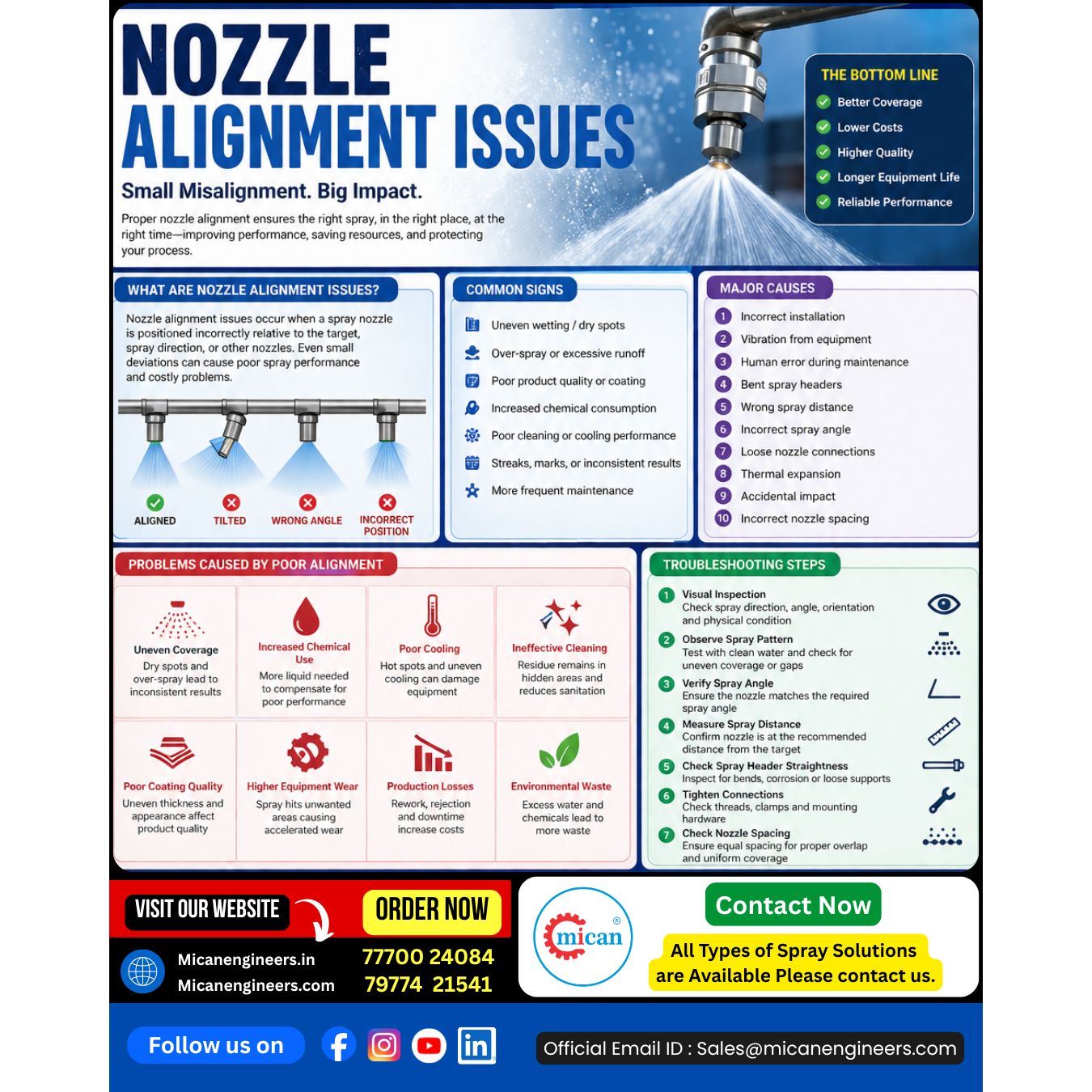
Nozzle alignment issues occur when a spray nozzle is not positioned correctly relative to the target surface, conveyor, product, or spray direction.
Misalignment may involve :
- Incorrect spray angle
- Wrong nozzle orientation
- Tilted installation
- Offset positioning
- Uneven spacing between multiple nozzles
- Incorrect spray distance
- Rotated spray pattern
- Incorrect overlap between adjacent nozzles
Even a few degrees of misalignment can significantly reduce spray efficiency.
Why Proper Nozzle Alignment Is Important ?
Correct nozzle alignment ensures :
- Uniform spray coverage
- Maximum process efficiency
- Consistent product quality
- Reduced liquid consumption
- Proper droplet distribution
- Complete surface coverage
- Improved cooling efficiency
- Better cleaning performance
- Longer equipment life
- Lower operating costs
Common Signs of Nozzle Alignment Problems
Operators may notice :
- Uneven wetting
- Dry spots
- Over-sprayed areas
- Excessive liquid runoff
- Product quality variation
- Irregular coating thickness
- Poor cooling performance
- Uneven cleaning
- Streak marks
- Increased chemical usage
- Inconsistent spray overlap
- Random process failures
Major Causes of Nozzle Alignment Issues
1. Incorrect Installation
One of the most common reasons is improper installation during maintenance or replacement.
Examples include:
- Nozzle not tightened correctly
- Incorrect spray direction
- Wrong mounting position
- Improper nozzle rotation
2. Vibration from Equipment
Continuous machine vibration can gradually shift nozzle positions.
Common in:
- Rolling mills
- Conveyors
- Crushers
- Packaging lines
- Cooling systems
Over time, vibration loosens fittings and changes the spray direction.
3. Human Error During Maintenance
Maintenance personnel may accidentally rotate or reposition nozzles after cleaning or replacement.
Without alignment checks, spray performance deteriorates.
4. Bent Spray Headers
Spray manifolds or headers may bend due to:
- Mechanical impact
- Corrosion
- Heavy loads
- Improper support
Even if every nozzle is installed correctly, a bent header causes poor alignment.
5. Wrong Spray Distance
Installing the nozzle too close or too far from the target affects:
- Spray overlap
- Coverage area
- Impact force
- Droplet distribution
6. Incorrect Spray Angle Selection
A nozzle with an unsuitable spray angle may create:
- Excessive overlap
- Gaps between sprays
- Concentrated spraying
- Incomplete coverage
7. Loose Nozzle Connections
Loose threaded or quick-connect nozzles may rotate during operation.
This changes the spray direction continuously.
8. Thermal Expansion
High-temperature processes can cause:
- Header expansion
- Nozzle movement
- Alignment shifts
Common in:
- Steel plants
- Boilers
- Furnaces
- Hot rolling applications
9. Accidental Impact
Nozzles may be struck by:
- Maintenance tools
- Moving equipment
- Cleaning devices
- Forklifts
- Product handling systems
Even minor impacts may change spray direction.
10. Incorrect Nozzle Spacing
When multiple nozzles are installed too close or too far apart:
- Coverage becomes uneven
- Spray patterns overlap incorrectly
- Some areas remain dry
Problems Caused by Poor Nozzle Alignment :
1. Uneven Spray Coverage
The most immediate consequence is inconsistent liquid distribution.
Results include:
- Dry areas
- Wet patches
- Streak formation
- Product inconsistency
2. Increased Chemical Consumption
Misaligned nozzles often require operators to increase flow rates or spraying time to compensate, leading to:
- Higher chemical usage
- Increased water consumption
- Greater wastewater generation
- Increased operating costs
3. Poor Cooling Performance
Cooling applications depend on uniform water distribution.
Misalignment causes:
- Hot spots
- Uneven cooling
- Thermal stress
- Equipment damage
4. Ineffective Cleaning
In tank cleaning, CIP systems, and conveyor washing :
- Hidden areas remain dirty
- Residue accumulates
- Cleaning cycles become longer
- Sanitation quality decreases
5. Poor Coating Quality
In coating applications, nozzle alignment directly affects:
- Film thickness
- Surface finish
- Uniformity
- Product appearance
Misalignment may result in:
- Uneven coating
- Overcoating
- Missed sections
- Product rejection
6. Higher Wear on Equipment
Improper spray direction may continuously hit:
- Bearings
- Motors
- Belts
- Rollers
- Structural components
This accelerates wear and maintenance requirements.
7. Production Losses
Misaligned nozzles often lead to:
- Rework
- Product rejection
- Downtime
- Reduced production efficiency
8. Environmental Waste
Excess liquid may miss the target entirely, increasing:
- Water waste
- Chemical runoff
- Disposal costs
- Environmental impact
Industries Most Affected
Nozzle alignment is critical in :
- Pharmaceutical Manufacturing
- Food & Beverage Processing
- Chemical Plants
- Steel Plants
- Cement Industry
- Paper & Pulp Mills
- Textile Industry
- Automotive Manufacturing
- Power Plants
- Mining Operations
- Agriculture
- Oil & Gas
- Electronics Manufacturing
How to Troubleshoot Nozzle Alignment Issues :
Step 1: Perform a Visual Inspection
Check:
- Spray direction
- Spray angle
- Nozzle orientation
- Mounting position
- Physical damage
Step 2: Observe the Spray Pattern
Look for:
- Uneven coverage
- Missing areas
- Pattern distortion
- Irregular overlap
A spray test using clean water can quickly reveal alignment problems.
Step 3: Verify Spray Angle
Ensure the installed nozzle matches the required application.
Compare:
- Design specifications
- Actual installation
- Manufacturer recommendations
Step 4: Measure Spray Distance
Confirm the nozzle is positioned at the recommended distance from the target surface.
Step 5: Check Spray Header Straightness
Inspect for:
- Bent pipes
- Loose supports
- Corrosion damage
- Misaligned manifolds
Step 6: Tighten Connections
Inspect:
- Threads
- Clamps
- Mounting brackets
- Quick-connect fittings
Step 7: Check Nozzle Spacing
Verify equal spacing between adjacent nozzles to ensure proper overlap and uniform coverage.
Best Practices to Prevent Nozzle Alignment Issues :
1. Use Alignment Guides
Install reference marks or alignment tools during setup to ensure repeatable positioning after maintenance.
2. Follow Manufacturer Installation Guidelines
Always install nozzles according to the recommended orientation, spray angle, and mounting distance.
3. Inspect During Preventive Maintenance
Include alignment verification in routine maintenance schedules.
4. Secure Mounting Hardware
Use appropriate clamps, lock nuts, and anti-vibration supports to prevent movement during operation.
5. Replace Damaged Components
Bent spray headers, worn brackets, or damaged fittings should be replaced promptly to maintain accurate alignment.
6. Train Maintenance Personnel
Ensure technicians understand the importance of correct nozzle positioning and use standardized installation procedures.
7. Document Standard Positions
Maintain installation drawings or photographs so nozzles can be returned to their correct orientation after servicing.
8. Perform Regular Spray Tests
Periodically test spray patterns to identify alignment issues before they affect production quality.
Benefits of Correct Nozzle Alignment :
Properly aligned spray nozzles provide :
- Consistent spray coverage
- Higher product quality
- Reduced chemical consumption
- Improved cleaning efficiency
- Better cooling performance
- Uniform coating thickness
- Lower maintenance costs
- Longer equipment life
- Reduced downtime
- Improved process reliability
- Lower operating expenses
Conclusion :
Nozzle alignment is a critical but often underestimated factor in industrial spray performance. Even a perfectly designed nozzle cannot deliver optimal results if it is installed at the wrong angle, distance, or orientation. Misalignment can lead to uneven coverage, increased chemical usage, inconsistent product quality, equipment wear, and costly production losses.
By implementing regular inspections, following correct installation practices, securing mounting components, and including alignment checks in preventive maintenance programs, industries can maximize spray efficiency, reduce waste, and ensure reliable process performance. A proactive approach to nozzle alignment not only improves operational efficiency but also extends equipment life and lowers overall maintenance costs.
Frequently Asked Questions (FAQs) :
1. What is nozzle alignment ?
Nozzle alignment is the correct positioning and orientation of a spray nozzle to ensure the spray pattern reaches the intended target with uniform coverage and optimal performance.
2. What are the signs of a misaligned spray nozzle ?
Common signs include uneven spray coverage, dry spots, excessive runoff, streaking, inconsistent coating, poor cleaning performance, increased liquid consumption, and reduced process efficiency.
3. Can machine vibration cause nozzle misalignment ?
Yes. Continuous vibration can loosen threaded connections or shift spray headers, gradually changing the nozzle's orientation and affecting spray performance.
4. How often should nozzle alignment be checked ?
Alignment should be verified during routine preventive maintenance, after nozzle replacement or cleaning, following equipment repairs, and whenever spray performance becomes inconsistent.
5. Which industries benefit most from proper nozzle alignment ?
Industries such as pharmaceuticals, food processing, chemicals, steel, cement, paper, textiles, automotive, power generation, mining, and oil & gas rely on correct nozzle alignment for efficient spraying and consistent product quality.
@mumbai @pune @chennai @ahmedabad
#SprayNozzles
#NozzleAlignment
#IndustrialSprayNozzles
#SprayTechnology
#SprayEngineering
#IndustrialMaintenance
#PreventiveMaintenance
#ManufacturingSolutions
#ProcessOptimization
#IndustrialAutomation
#FluidHandling
#SpraySystem
#IndustrialEquipment
#EngineeringSolutions
#FactoryMaintenance
#ProcessEfficiency
#IndustrialCleaning
#NozzleTroubleshooting
#MicanEngineers
#SprayNozzleManufacturer
ou ha
ve not enough Humanizer words left. Upgrade your Surfer plan.