
Pressure Fluctuation in Spray Systems : Causes, Problems & Solutions
In industrial spray systems, consistent pressure is essential for achieving stable flow rate, spray angle, droplet size, and coverage. When pressure continuously rises and falls, the spray pattern can become uneven, flow can change unexpectedly, and the overall process may become difficult to control.
Pressure fluctuation can occur in systems used for cooling, washing, tank cleaning, coating, lubrication, chemical spraying, gas treatment, and pharmaceutical applications.
Understanding the causes of pressure fluctuation helps industries improve spray performance, reduce nozzle problems, and maintain consistent production.
What Is Pressure Fluctuation in a Spray System ?
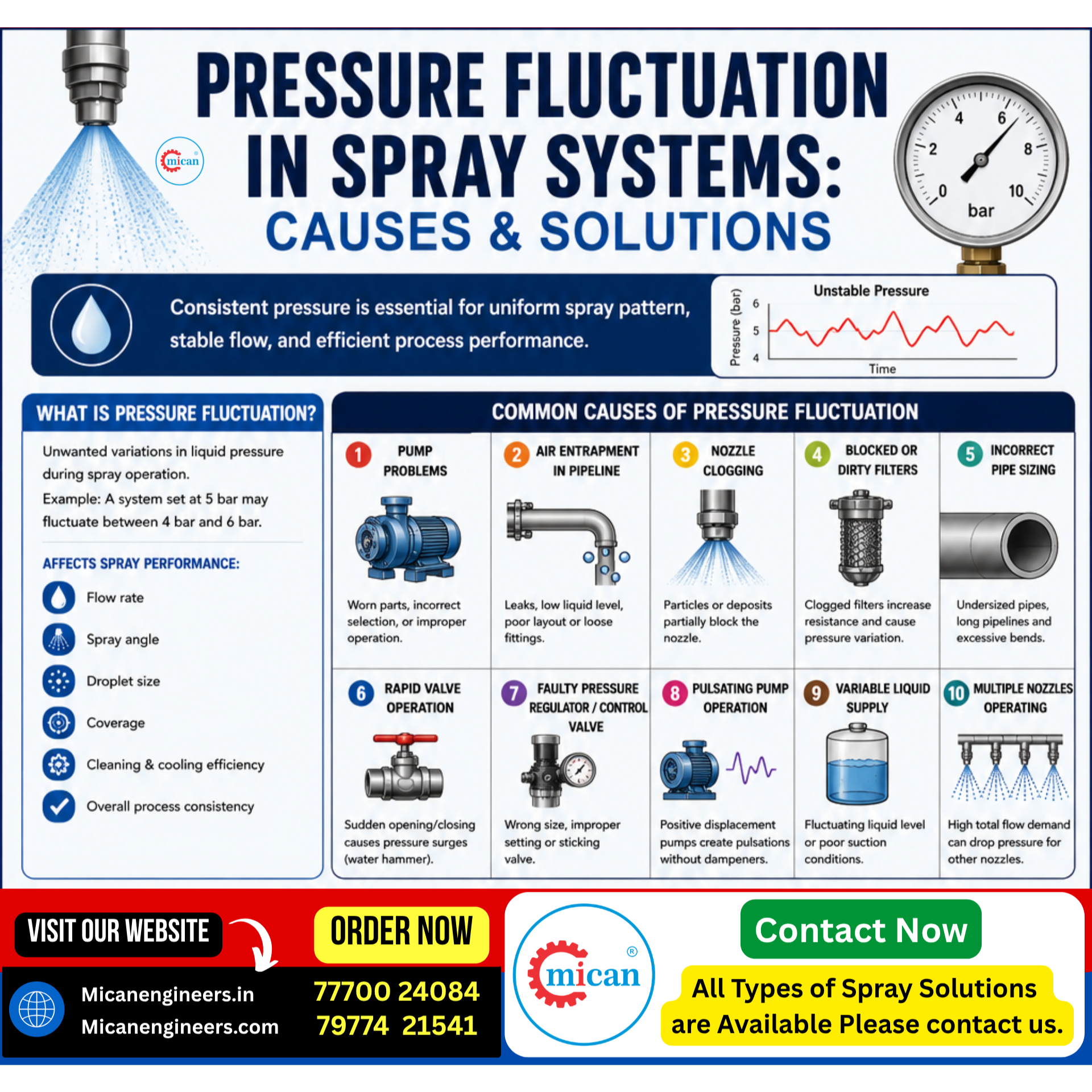
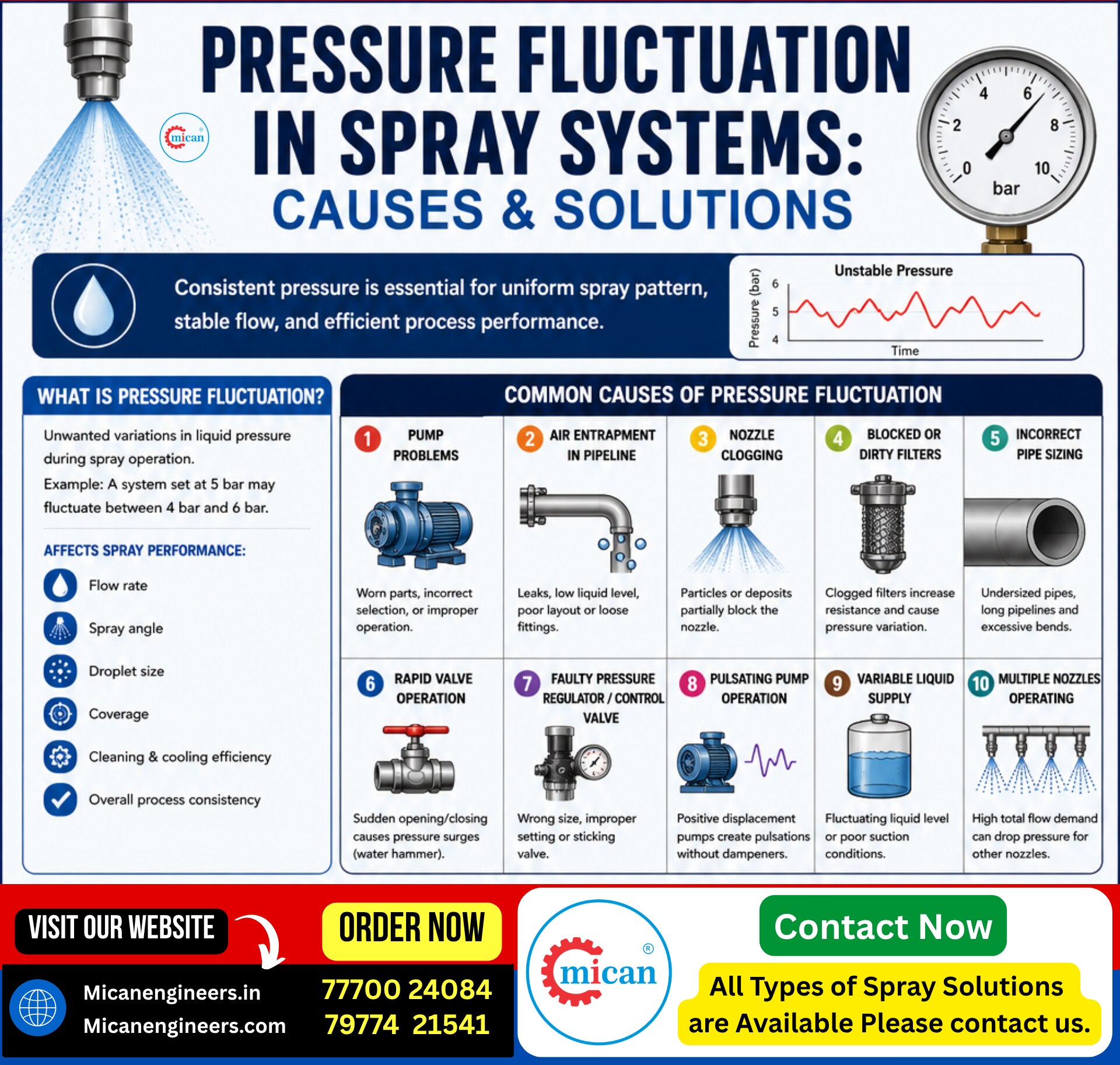
Pressure fluctuation refers to unwanted variations in liquid pressure during spray operation.
For example, a system designed to operate at 5 bar may repeatedly fluctuate between 4 bar and 6 bar. This variation can directly affect the nozzle's performance.
A spray nozzle does not simply depend on pressure alone. Changes in pressure can influence:
- Flow rate
- Spray angle
- Droplet size
- Spray coverage
- Impact force
- Atomization
- Cleaning performance
- Cooling efficiency
Therefore, maintaining relatively stable operating pressure is important for predictable spray performance.
Common Causes of Pressure Fluctuation :
1. Pump Problems
The pump is one of the first components to investigate when pressure is unstable.
Worn pump components, incorrect pump selection, insufficient pump capacity, or improper pump operation can cause pressure variations.
Possible solutions:
- Inspect the pump for wear.
- Check pump capacity against system requirements.
- Verify the pump is operating within its recommended range.
- Check for damaged or worn components.
- Ensure the pump is correctly sized for the required flow and pressure.
2. Air Entrapment in the Pipeline
Air trapped inside a liquid pipeline can compress and expand as the system operates. This can create unstable pressure and irregular spray output.
Air entrainment may occur because of :
- Low liquid level in the tank
- Leakage on the suction side
- Poor pipe layout
- Incorrect pump suction conditions
- Loose fittings
- Excessive turbulence
Possible solutions:
- Inspect the suction line for leaks.
- Maintain adequate liquid level in the tank.
- Minimize unnecessary bends and restrictions.
- Remove trapped air from the system.
- Check suction conditions and pump installation.
3. Nozzle Clogging
A partially blocked nozzle can restrict flow and increase upstream pressure. If particles periodically move through the system, the restriction may change, causing pressure to fluctuate.
This is particularly common when spraying liquids containing:
- Suspended solids
- Crystals
- Fibers
- Contaminants
- Precipitated chemicals
- Product residues
Possible solutions:
- Clean the nozzles regularly.
- Install appropriate filtration.
- Select a nozzle passage suitable for the liquid.
- Monitor filter and strainer condition.
- Replace damaged or heavily worn nozzles.
4. Blocked or Dirty Filters
A clogged filter gradually increases flow resistance. As the filter becomes more restricted, the pressure difference across it can increase and system performance can become unstable.
Possible solutions:
- Establish a filter cleaning schedule.
- Monitor differential pressure across the filter.
- Select the correct filter mesh size.
- Avoid using an unnecessarily fine filter that restricts flow.
- Clean or replace filters when required.
5. Incorrect Pipe Sizing
A pipeline that is too small for the required flow can create excessive pressure losses.
Sharp bends, long pipelines, undersized fittings, and unnecessary restrictions can further increase resistance.
Possible solutions:
- Review pipe diameter based on required flow.
- Minimize unnecessary bends.
- Avoid excessive restrictions.
- Check pressure loss throughout the piping system.
- Ensure valves and fittings are appropriately sized.
6. Rapid Valve Opening or Closing
Sudden changes in valve position can cause significant pressure changes. Rapidly closing a valve can create water hammer, while sudden opening can produce a temporary pressure drop.
Possible solutions:
- Open and close valves gradually.
- Use suitable control valves.
- Consider pressure-relief or surge-control arrangements where necessary.
- Avoid sudden changes in flow conditions.
7. Improper Pressure Regulator or Control Valve Operation
A faulty, incorrectly sized, or improperly adjusted regulator can cause the pressure to oscillate rather than remain stable.
Possible solutions:
- Inspect the regulator.
- Verify its pressure range.
- Check whether it is correctly sized for the required flow.
- Inspect the control valve for sticking or unstable operation.
- Check the pressure-setting mechanism.
8. Pulsating Pump Operation
Certain positive-displacement pumps can naturally produce pulsating flow. Without appropriate dampening, these pulsations can appear as pressure fluctuations throughout the spray system.
Possible solutions:
- Install a suitable pulsation dampener where required.
- Check pump operating conditions.
- Verify the pump is appropriate for the application.
- Inspect diaphragms, valves, and other pump components.
9. Variable Liquid Supply
If the liquid level, supply flow, or suction conditions continuously change, the pump may not receive a consistent liquid supply.
This can result in unstable discharge pressure.
Possible solutions:
- Maintain a consistent liquid level.
- Ensure adequate suction conditions.
- Check the supply tank and suction piping.
- Prevent vortex formation and excessive turbulence near the pump inlet.
10. Multiple Nozzles Operating Simultaneously
When several nozzles share the same header, changes in one part of the system can affect pressure available to other nozzles.
For example, opening additional nozzles can increase total flow demand and cause a pressure drop if the pump or pipeline cannot provide sufficient capacity.
Possible solutions:
- Calculate the total required flow.
- Verify pump capacity.
- Properly size the main header.
- Balance branches where necessary.
- Use suitable pressure-control arrangements.
How Pressure Fluctuation Affects Spray Nozzle Performance ?
Pressure variation can have a direct effect on spray characteristics.
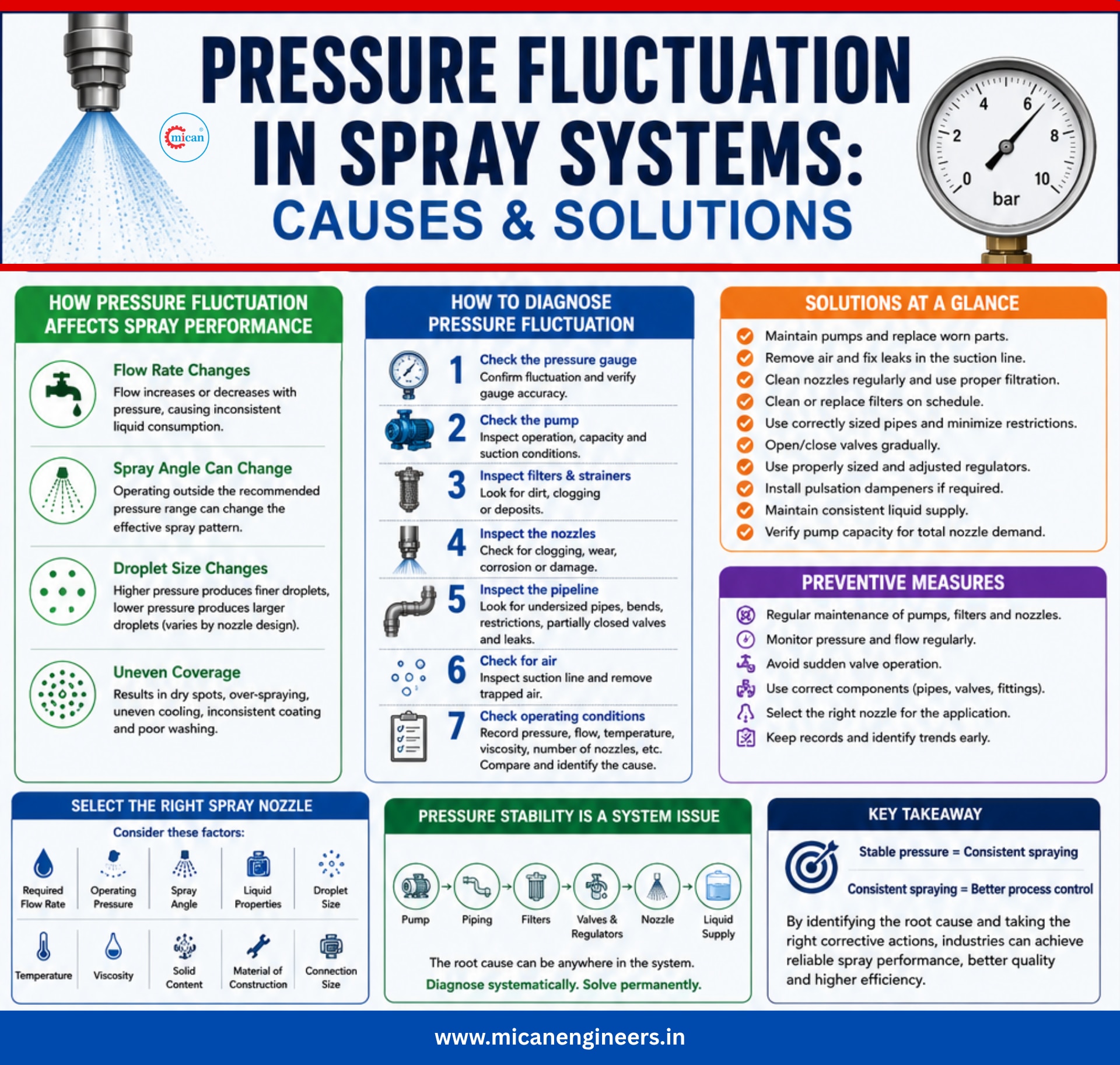
1. Flow Rate Changes
For many pressure-dependent spray nozzles, increasing pressure increases flow, while decreasing pressure reduces flow.
Therefore, fluctuating pressure can result in fluctuating liquid consumption.
2. Spray Angle Can Change
Some nozzle designs maintain their nominal spray angle only within a specified operating-pressure range. Operating outside that range can change the effective spray pattern.
3. Droplet Size Changes
In atomizing applications, pressure changes can affect droplet size and atomization quality.
Higher pressure may produce finer droplets, while lower pressure can produce comparatively larger droplets, depending on the nozzle design.
4. Uneven Coverage
In cooling, washing, coating, or chemical spraying applications, pressure fluctuations can create inconsistent coverage.
This can result in:
- Dry spots
- Over-spraying
- Uneven cooling
- Inconsistent coating
- Poor washing performance
- Variable chemical application
How to Diagnose Pressure Fluctuation
Instead of immediately replacing the nozzle or pump, troubleshoot the system systematically.
Step 1: Check the Pressure Gauge
Confirm whether the pressure fluctuation is actually occurring.
Also verify that the pressure gauge itself is functioning correctly.
Step 2: Check the Pump
Inspect pump operation, capacity, suction conditions, and mechanical condition.
Step 3: Inspect Filters and Strainers
Look for accumulated particles or deposits that could restrict flow.
Step 4: Inspect the Nozzles
Check for:
- Clogging
- Erosion
- Corrosion
- Incorrect nozzle size
- Physical damage
Step 5: Inspect the Pipeline
Look for undersized pipes, excessive bends, partially closed valves, restrictions, and leaks.
Step 6: Check for Air
Inspect the suction line and liquid supply for possible air ingress or trapped air.
Step 7: Check Operating Conditions
Record :
- Pressure
- Flow rate
- Liquid temperature
- Liquid viscosity
- Number of operating nozzles
- Pump operating condition
Comparing these parameters can help identify the source of the fluctuation.
Preventive Measures for Stable Spray Pressure
A preventive maintenance program can significantly reduce pressure-related spray problems.
Recommended practices include :
- Maintain pumps according to manufacturer recommendations.
- Clean filters and strainers regularly.
- Inspect spray nozzles for clogging and wear.
- Check piping and fittings for leaks.
- Monitor operating pressure and flow.
- Avoid sudden valve operation.
- Maintain adequate liquid supply to the pump.
- Use correctly sized pipes, valves, and fittings.
- Select nozzles according to the required pressure and flow.
- Keep records of pressure and flow trends to identify changes early.
Selecting the Right Spray Nozzle :
Not every nozzle performs the same way under changing pressure conditions.
When selecting a spray nozzle, consider :
- Required flow rate
- Operating pressure
- Spray angle
- Liquid properties
- Temperature
- Viscosity
- Solid content
- Required droplet size
- Spray coverage
- Material of construction
- Connection size
The nozzle should be selected based on the actual operating conditions, rather than simply choosing a nozzle based on connection size or nominal flow.
Pressure Stability Is a System Issue :
It is important to remember that pressure fluctuation is not always a nozzle problem.
The root cause may be located anywhere in the spray system—including the pump, suction line, filters, valves, piping, pressure controls, liquid supply, or nozzle itself.
A systematic approach is therefore more effective than simply replacing individual components.
Check this Most Common Problems and solutions Related to spray Nozzles :
Why One Nozzle Performs Differently From Another Identical Nozzle : Uneven Nozzle Performs
Why Does Spray Pattern Change During Production? 10 Common Causes & Solutions
Nozzle Vibration Problems : Causes, Effects & Solutions
Best High Quality Spray Nozzle Manufacturer In India
( Mican Engineers Pvt Ltd )
Conclusion :
Pressure fluctuation can negatively affect spray consistency, flow rate, coverage, atomization, cooling, cleaning, and overall process performance.
The most common causes include pump problems, air entrainment, clogged nozzles, blocked filters, undersized piping, valve operation, pressure-control issues, pulsating pumps, unstable liquid supply, and excessive flow demand from multiple nozzles.
By correctly diagnosing the source and selecting suitable pumps, piping, filtration, pressure-control components, and spray nozzles, industries can achieve more stable and predictable spray performance.
Consistent pressure leads to consistent spraying—and consistent spraying leads to better process control.
pressure fluctuation in spray systems, spray system pressure problems, spray nozzle pressure fluctuation, causes of pressure fluctuation, solutions for pressure fluctuation, spray nozzle performance, industrial spray systems, spray nozzle troubleshooting, spray pressure control, spray system troubleshooting, pump pressure fluctuation, nozzle clogging, spray system maintenance, industrial spray nozzles, spray pressure stability
#SprayNozzle #SpraySystem #PressureFluctuation #SprayTechnology #IndustrialSpraying #SprayNozzles #IndustrialNozzles #ProcessEngineering #FluidDynamics #PumpSystem #SpraySystemMaintenance #NozzleTroubleshooting #IndustrialAutomation #Manufacturing #ProcessOptimization
@mumbai @pune @ahmedabad @chennai