
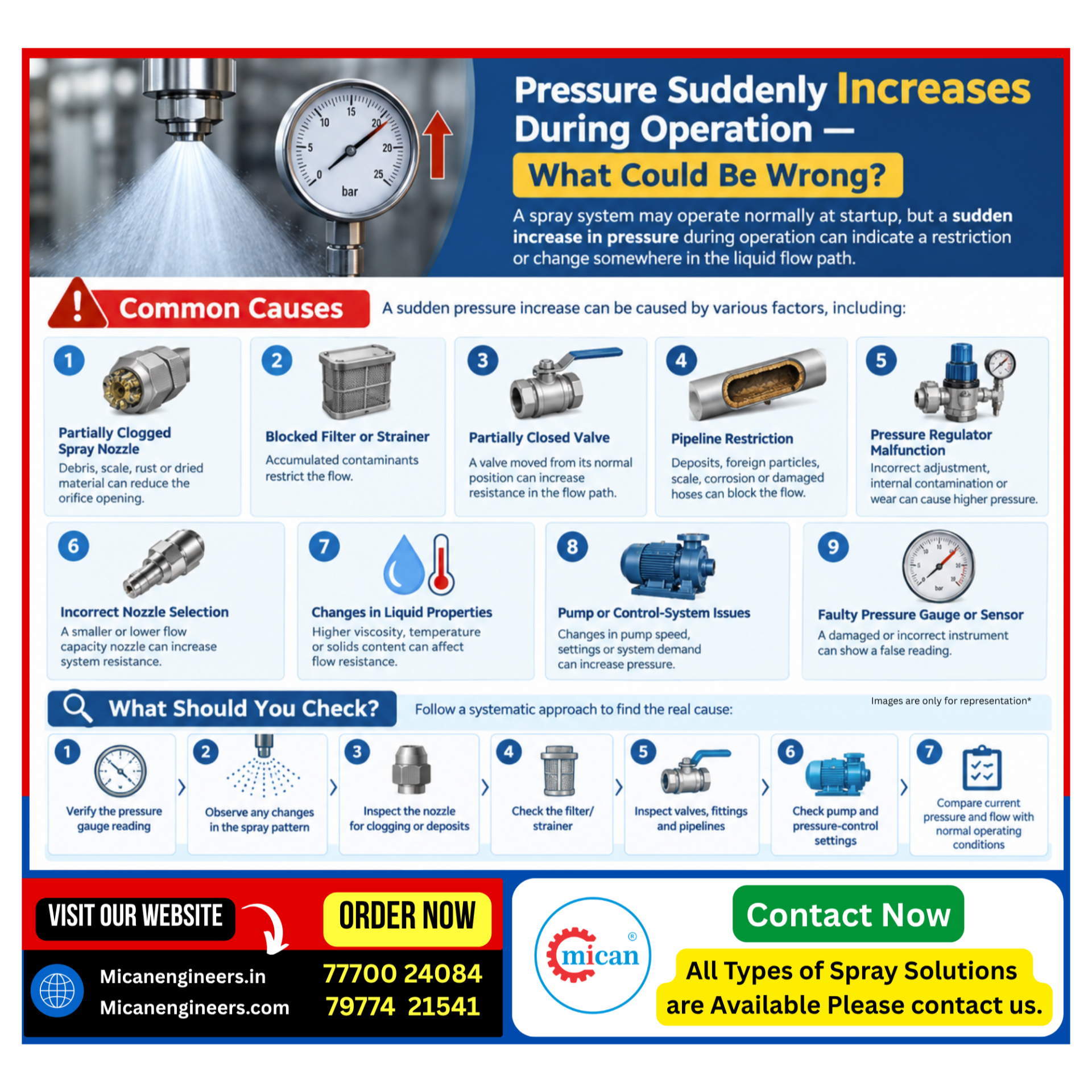
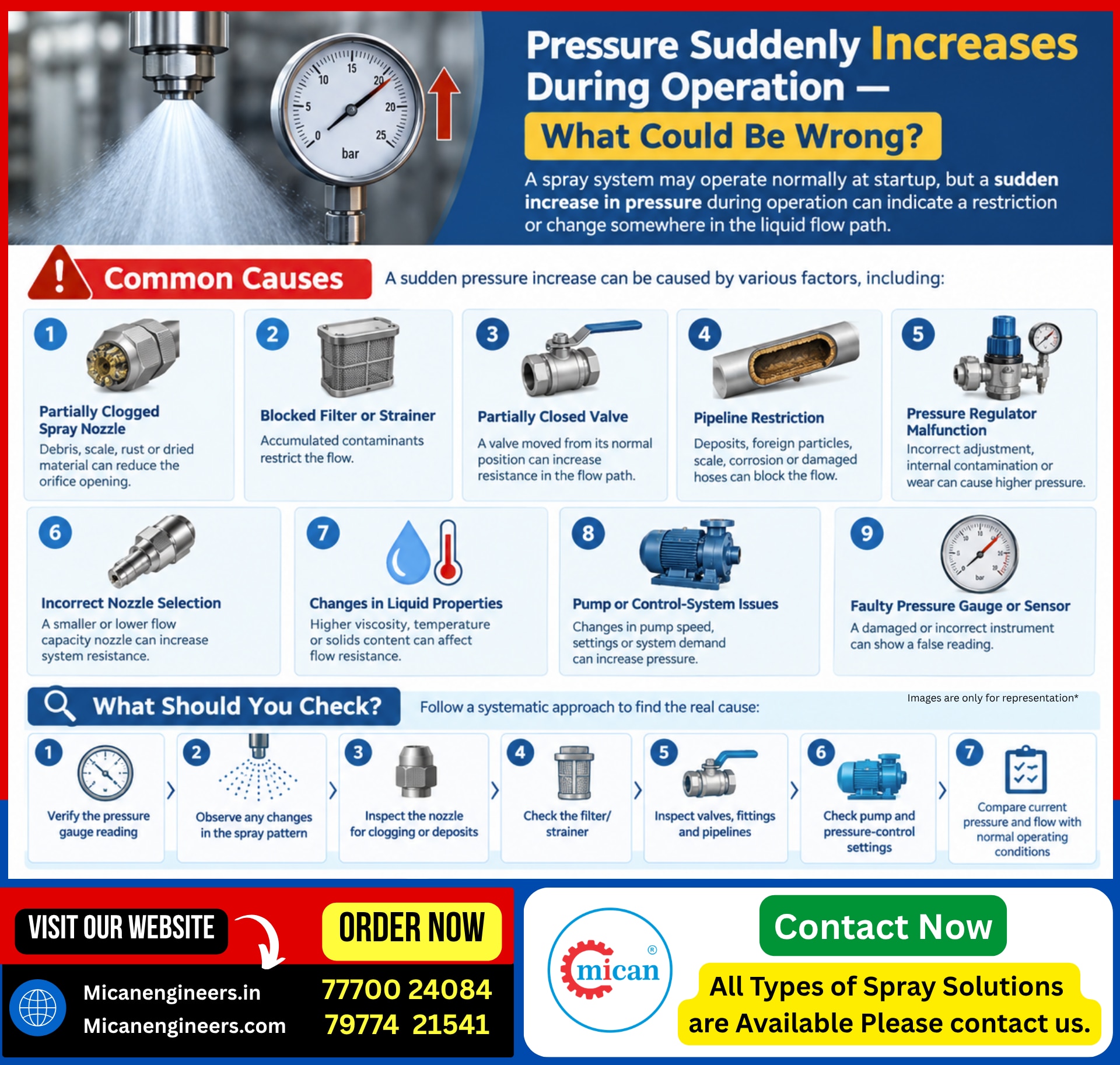
Pressure Suddenly Increases During Operation — What Could Be Wrong ?
In industrial spray systems, pressure is one of the most important operating parameters for achieving the required flow rate, spray pattern, droplet size, and coverage. A system may operate normally at startup, but sometimes the pressure suddenly increases during operation.
A sudden rise in pressure should not be ignored. It can indicate a restriction in the liquid flow path, a partially blocked spray nozzle, filter blockage, valve problems, or changes in operating conditions.
Understanding the possible causes can help identify the problem before it affects spray performance or damages system components.
What Does a Sudden Pressure Increase Mean ?
When a pump supplies liquid to a spray system, the liquid must flow through the pipeline, fittings, filters, valves, and finally the spray nozzle.
If the flow path becomes restricted, the system may require a higher pressure to maintain the same flow. Depending on where the pressure is measured, the pressure gauge may show a sudden increase.
For example, if a spray nozzle becomes partially clogged, its effective flow area decreases. The restriction can cause the pressure upstream of the nozzle to rise.
Therefore, a sudden increase in pressure can often be a sign that the system is experiencing increased resistance to flow.
Common Reasons for a Sudden Pressure Increase :
1. Spray Nozzle Partially Clogged
One of the most common causes is partial blockage of the spray nozzle orifice.
Particles, scale, rust, dried chemicals, or other contaminants can accumulate around the nozzle opening. As the effective opening becomes smaller, the nozzle restricts liquid flow.
This can result in :
- Increased upstream pressure
- Reduced flow rate
- Distorted spray pattern
- Uneven spray distribution
- Poor coverage
A partially blocked nozzle may not stop spraying completely. Instead, the spray may become narrower, irregular, or visibly different from the normal pattern.
2. Filter or Strainer Is Blocked
Filters and strainers protect spray nozzles from contaminants. However, if they collect too much debris, they can themselves become a restriction.
A clogged filter can cause :
Pump → Filter → Pressure rises upstream → Reduced flow downstream
If the system has pressure gauges before and after the filter, comparing the readings can help identify a developing restriction.
Regular inspection and cleaning of filters can help prevent this problem.
3. Pipeline Restriction
A sudden pressure increase may also originate from the piping system.
Possible causes include :
- Accumulation of deposits inside the pipe
- Foreign particles
- Scale formation
- Corrosion products
- Incorrectly installed components
- A partially blocked fitting
- A collapsed or damaged flexible hose
Even when the spray nozzle itself is clean, a restriction somewhere upstream or downstream can affect system pressure.
4. Valve Is Partially Closed
A valve that is accidentally moved from its normal position can restrict the liquid flow.
This can happen during :
- Maintenance
- System adjustment
- Equipment changeover
- Cleaning
- Startup procedures
A partially closed isolation valve or control valve can significantly increase resistance in the flow path.
Checking the position and condition of relevant valves should therefore be part of the troubleshooting process.
5. Pressure Regulator or Control Valve Problem
A pressure-regulating component may malfunction or become incorrectly adjusted.
For example, a regulator that is not controlling pressure correctly may cause the system pressure to rise above its normal operating range.
Possible causes include:
- Incorrect adjustment
- Internal contamination
- Mechanical wear
- Damaged components
- Control-system malfunction
The regulator should be checked against the manufacturer's specified operating conditions.
6. Incorrect Spray Nozzle Selection
The nozzle itself may be correctly manufactured and free from blockage but still be unsuitable for the required operating conditions.
For example, selecting a nozzle with a smaller orifice or lower flow capacity than required can increase system resistance and affect the operating pressure.
When selecting a spray nozzle, factors such as :
- Required flow rate
- Operating pressure
- Spray angle
- Liquid properties
- Nozzle material
- Required spray pattern
should be considered together.
7. Changes in Liquid Properties
The liquid being sprayed can affect system pressure.
Changes in :
- Viscosity
- Temperature
- Concentration
- Solids content
- Chemical composition
may change the resistance to flow.
For example, a liquid becoming more viscous can require different pumping conditions compared with a lower-viscosity liquid.
Therefore, if pressure changes occur only with a particular process material or temperature condition, the liquid properties should also be investigated.
8. Pump Operating Conditions Have Changed
The pump can also contribute to abnormal pressure behavior.
Possible causes include :
- Pump speed changes
- Incorrect pump control settings
- Changes in system demand
- Pump-control issues
- Changes in bypass or recirculation conditions
However, it is important not to assume that the pump is always the source of the problem.
The location of the pressure gauge matters.
A pressure increase at the pump discharge does not necessarily mean that the pump itself is faulty. A restriction farther downstream can also cause discharge pressure to increase.
Pressure Increase vs. Flow Rate Reduction
Pressure and flow rate are closely related in spray nozzle systems.
For a given nozzle, the approximate relationship is:
Q ∝ √P
Where :
- Q = flow rate
- P = pressure
This means that increasing pressure generally increases nozzle flow, but not in a directly proportional manner.
However, if a nozzle or filter becomes restricted, the actual system behavior can differ from the expected nozzle performance.
For this reason, pressure should be evaluated together with flow rate and spray pattern rather than considered by itself.
How to Troubleshoot a Sudden Pressure Increase ?
When pressure suddenly increases, follow a systematic approach instead of immediately replacing the nozzle or pump.
Step 1 — Check the Pressure Reading
First, confirm that the pressure gauge or pressure sensor is functioning correctly.
A faulty or damaged pressure instrument can produce an incorrect reading.
Step 2 — Check the Spray Pattern
Observe the spray pattern.
Look for :
- Narrower spray
- Missing sections
- Uneven distribution
- Reduced spray coverage
- Irregular spray
A change in spray pattern can provide an early indication of nozzle blockage or damage.
Step 3 — Inspect the Nozzle
Stop the system safely according to the applicable operating procedure and inspect the nozzle.
Check for :
- Clogging
- Deposits
- Scale
- Foreign particles
- Orifice damage
Do not automatically enlarge or modify the nozzle orifice to solve a blockage problem.
Step 4 — Check the Filter or Strainer
Inspect the filtration system for accumulated contaminants.
If a pressure differential is available across the filter, an increasing differential can indicate filter loading or blockage.
Step 5 — Check Valves and Piping
Verify that valves are in their correct positions and inspect the piping for possible restrictions.
Flexible hoses should also be checked for kinks, collapse, or damage.
Step 6 — Check Pump and Control Settings
If the nozzle, filter, valves, and piping appear normal, examine pump speed, control settings, regulators, and other system components.
Step 7 — Compare With Normal Operating Data
Compare the current :
- Pressure
- Flow rate
- Pump speed
- Liquid temperature
- Spray pattern
with the system's normal operating values.
This comparison can help identify when the abnormal condition started.
Why You Should Not Ignore a Pressure Increase ?
A sudden pressure increase can affect more than just spray performance.
Continued operation at an abnormal pressure may result in:
- Poor spray distribution
- Incorrect flow rate
- Reduced process efficiency
- Increased component stress
- Damage to seals or fittings
- Unstable spray performance
- Unplanned maintenance or downtime
The actual risk depends on the equipment, operating pressure, liquid, materials, and system design.
Always operate the system within the specified pressure limits of the pump, nozzle, piping, valves, and other components.
Preventive Measures :
Many pressure-related problems can be reduced through regular maintenance and monitoring.
Recommended practices include:
1. Regular nozzle inspection
Check spray nozzles for clogging, wear, and changes in spray pattern.
2. Proper filtration
Use appropriate filters or strainers to prevent contaminants from reaching the nozzle.
3. Monitor pressure and flow
Recording normal operating values makes it easier to identify abnormal changes.
4. Maintain valves and regulators
Ensure that control components operate correctly and remain properly adjusted.
5. Clean the system periodically
Remove deposits and contaminants before they become significant restrictions.
6. Use the correct nozzle specification
Select the nozzle based on the required flow, pressure, spray angle, liquid properties, and application requirements.
Quick Troubleshooting Checklist :
| Observation | Possible Cause |
|---|---|
| Pressure suddenly rises + spray becomes irregular | Nozzle partially clogged |
| Pressure rises across a filter | Filter/strainer blockage |
| Pressure rises after valve adjustment | Valve partially closed |
| Pressure rises but nozzle appears normal | Pipeline restriction |
| Pressure fluctuates abnormally | Pump/control/regulator issue |
| Pressure changes with liquid temperature | Change in liquid viscosity |
| Pressure is consistently higher than expected | Nozzle sizing or system design issue |
| Gauge reading changes without process change | Pressure gauge/sensor issue |
Conclusion :
A sudden increase in pressure during spray-system operation is often a warning that something has changed in the flow path or operating conditions.
The cause could be as simple as a partially clogged nozzle or filter, or it could involve piping restrictions, valves, pressure regulators, pump conditions, or changes in the liquid being sprayed.
Instead of looking at pressure alone, evaluate pressure, flow rate, spray pattern, and system conditions together. A systematic troubleshooting approach can help identify the cause and maintain consistent spray performance.
Regular inspection, proper filtration, correct nozzle selection, and monitoring of operating conditions are important for reliable industrial spray systems.
#SprayNozzle #IndustrialSprayNozzles #SprayTechnology #Pressure #PressureDrop #NozzleTroubleshooting #IndustrialSpraying #ProcessEngineering #FluidDynamics #IndustrialEquipment #Engineering #Manufacturing #MicanEngineers #flowrateissue #sprayissue #sprayproblem #spraynozzleissue #spraysolutions #commonsprayproblems
@mumbai @pune @ahmedabad @chennai