
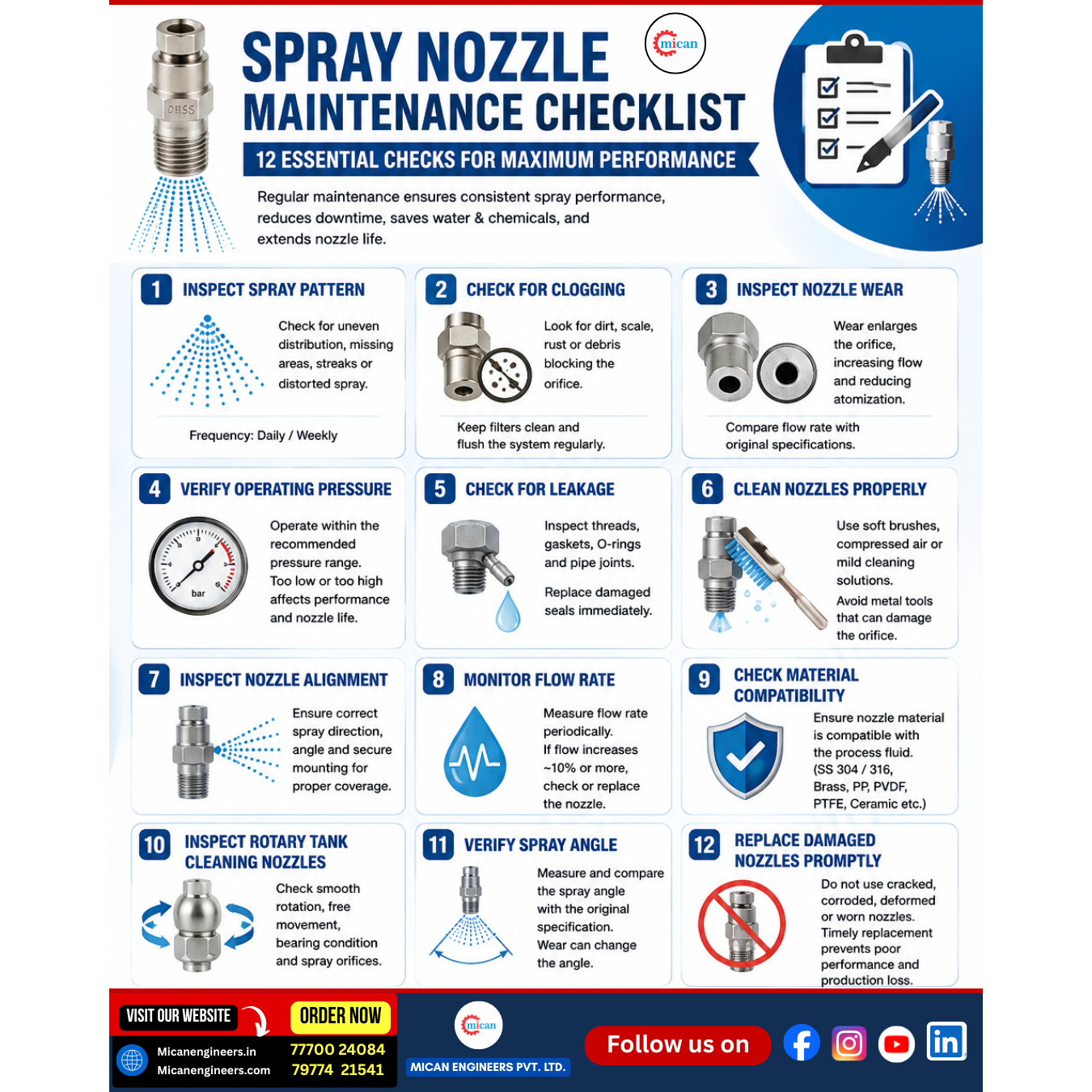
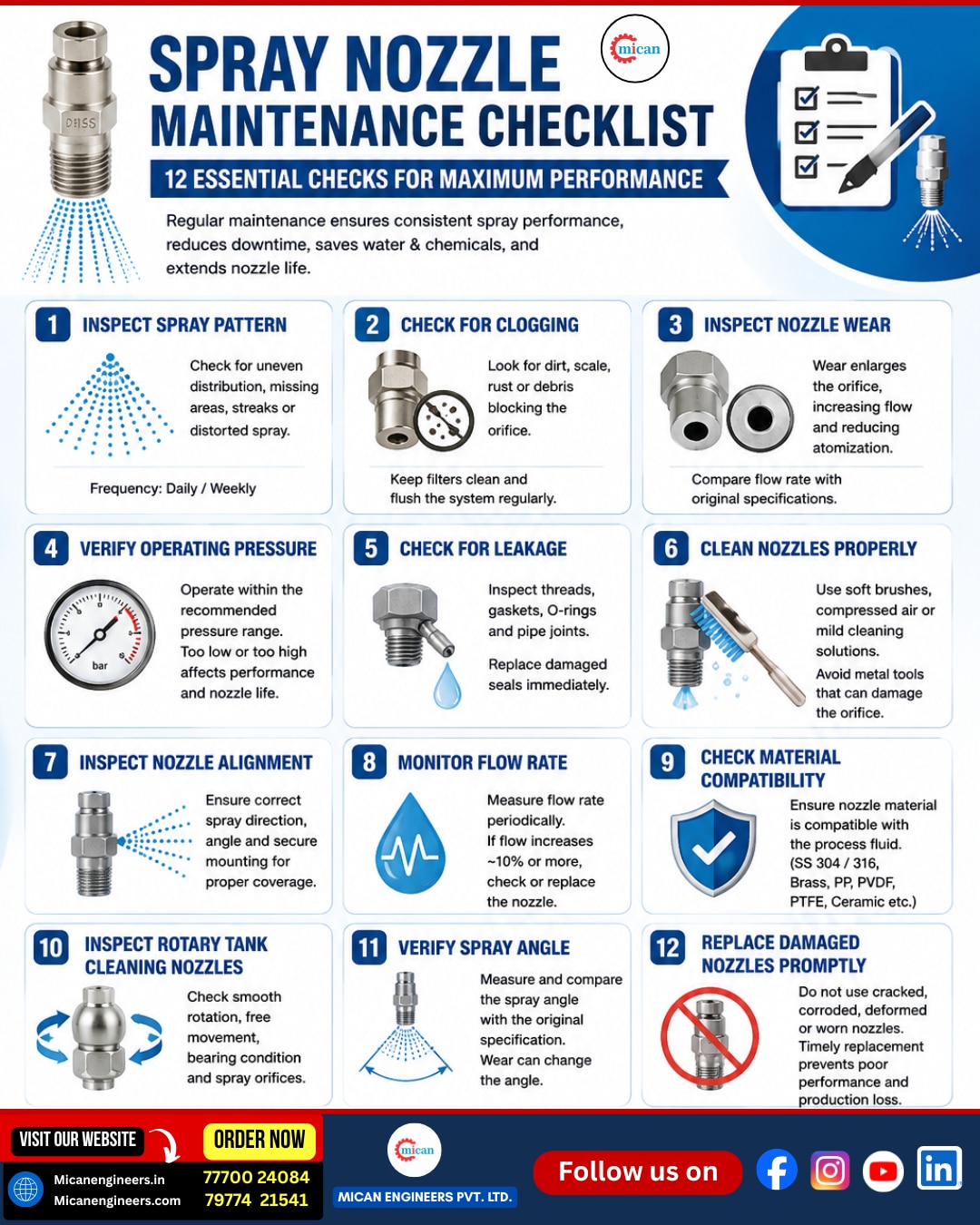
Spray Nozzle Maintenance Checklist : A Complete Guide to Improve Performance and Extend Nozzle Life
Spray nozzles play a critical role in numerous industrial processes, including cleaning, cooling, coating, humidification, dust suppression, chemical spraying, and tank washing. However, even the highest-quality spray nozzle can experience reduced performance if it is not maintained properly.
Regular maintenance not only extends the life of spray nozzles but also ensures consistent spray patterns, optimal flow rates, reduced water and chemical consumption, and improved production efficiency.
In this guide, we'll cover a practical spray nozzle maintenance checklist that every maintenance engineer and plant operator should follow.
Why Spray Nozzle Maintenance is Important ?
A neglected spray nozzle can lead to :
- Uneven spray coverage
- Increased water consumption
- Higher chemical usage
- Reduced cleaning efficiency
- Product quality issues
- Increased operating costs
- Unexpected production downtime
Preventive maintenance helps identify problems before they become costly failures.
Spray Nozzle Maintenance Checklist :
1. Inspect Spray Pattern Regularly
The spray pattern is one of the easiest indicators of nozzle condition.
Look for :
- Uneven distribution
- Missing spray sections
- Distorted spray angle
- Heavy streaks
- Dead zones
If the spray pattern changes from the original design, inspect the nozzle immediately.
Recommended Inspection Frequency :
- Daily for critical production lines
- Weekly for general industrial applications
2. Check for Clogging
Solid particles, dirt, rust, scale, and debris can partially or completely block the nozzle orifice.
Signs of clogging include :
- Reduced flow
- Uneven spray
- Pressure fluctuations
- Inconsistent cleaning
Prevention Tips
- Install proper line filters or strainers.
- Flush the system before operation.
- Clean filters regularly.
3. Inspect Nozzle Wear
Continuous exposure to abrasive liquids gradually enlarges the nozzle orifice.
Effects include:
- Increased flow rate
- Lower spray pressure
- Poor atomization
- Excess water usage
Compare the actual flow rate with the manufacturer's specifications.
Replace worn nozzles before process quality is affected.
4. Verify Operating Pressure
Incorrect pressure directly affects spray performance.
Too Low Pressure
- Weak spray
- Poor coverage
- Larger droplets
Too High Pressure
- Faster nozzle wear
- Excessive misting
- Increased water consumption
Always operate within the recommended pressure range.
5. Check for Leakage
Inspect:
- Thread connections
- Gaskets
- O-rings
- Pipe joints
Leaks reduce system efficiency and waste water and chemicals.
Replace damaged seals immediately.
6. Clean Nozzles Properly
Avoid cleaning nozzles with :
- Steel wire
- Nails
- Screwdrivers
- Hard metal tools
These tools can permanently damage the precision orifice.
Instead, use :
- Soft nylon brushes
- Compressed air
- Mild cleaning solutions
- Ultrasonic cleaning (when appropriate)
7. Inspect Nozzle Alignment
A properly functioning nozzle may still perform poorly if installed incorrectly.
Check for :
- Incorrect spray direction
- Improper angle
- Loose mounting
- Bent nozzle assemblies
Misalignment can cause incomplete coverage and wasted spray.
8. Monitor Flow Rate
Flow rate changes are often the first sign of nozzle wear.
Measure the actual flow periodically.
If the flow exceeds the original specification by approximately 10%, consider replacing the nozzle.
9. Check Material Compatibility
Ensure the nozzle material is compatible with the process fluid.
Common materials include :
- Stainless Steel 304
- Stainless Steel 316
- Brass
- Polypropylene (PP)
- PVDF
- PTFE
- Ceramic
Using the wrong material can lead to :
- Corrosion
- Premature wear
- Cracking
- Reduced service life
10. Inspect Rotary Tank Cleaning Nozzles
For rotary spray nozzles used in tanks :
Check for :
- Smooth rotation
- Free movement
- Bearing condition
- Blocked spray orifices
- Wear on rotating components
A nozzle that doesn't rotate correctly may leave uncleaned areas inside the tank.
11. Verify Spray Angle
Over time, wear can alter the spray angle.
Measure and compare it with the original specification.
Incorrect spray angles may result in:
- Overlapping spray
- Missed coverage
- Reduced process efficiency
12. Replace Damaged Nozzles Promptly
Do not continue operating with :
- Cracked nozzles
- Deformed tips
- Corroded components
- Damaged threads
Replacing a faulty nozzle is often far less expensive than dealing with production losses or product quality issues.
Recommended Maintenance Schedule
| Maintenance Activity | Frequency |
|---|---|
| Visual inspection | Daily |
| Check spray pattern | Daily / Weekly |
| Clean filters | Weekly |
| Clean nozzles | Weekly or as required |
| Measure pressure | Weekly |
| Inspect for leaks | Weekly |
| Measure flow rate | Monthly |
| Check nozzle wear | Monthly |
| Replace worn nozzles | As required |
| Complete system inspection | Quarterly |
Common Signs Your Spray Nozzle Needs Maintenance :
Watch for these warning signs :
- Uneven spray pattern
- Reduced cleaning performance
- Increased water consumption
- Low pressure
- Excessive misting
- Dripping after shutdown
- Clogging
- Vibration
- Corrosion
- Flow rate changes
Addressing these issues early can prevent costly downtime.
Best Practices for Longer Nozzle Life :
- Use filtered water or clean process fluids.
- Install strainers to prevent debris from entering the system.
- Operate within the recommended pressure range.
- Avoid abrasive cleaning tools.
- Store spare nozzles in a clean, dry environment.
- Replace worn nozzles before they affect production quality.
- Maintain a preventive maintenance schedule.
- Keep spare nozzles readily available to minimize downtime.
Benefits of Regular Spray Nozzle Maintenance
A consistent maintenance program provides several advantages :
- Improved spray performance
- Longer nozzle service life
- Reduced water consumption
- Lower chemical usage
- Better product quality
- Reduced maintenance costs
- Increased production efficiency
- Lower downtime
- Improved process reliability
- Higher return on investment
Conclusion :
Spray nozzles may be small components, but they have a significant impact on industrial process performance. A simple preventive maintenance routine can improve spray quality, reduce operating costs, and extend equipment life.
By following this maintenance checklist, industries can avoid common spray-related issues such as clogging, uneven coverage, excessive wear, leaks, and inefficient cleaning. Regular inspections and timely replacement of worn nozzles ensure reliable performance and help maintain consistent production quality.
FAQs :
1. How often should spray nozzles be inspected ?
Critical applications should be inspected daily, while general industrial applications can typically be checked weekly.
2. What is the most common cause of spray nozzle failure ?
Clogging, abrasive wear, corrosion, and operating at incorrect pressure are among the most common causes.
3. Can a worn spray nozzle increase water consumption ?
Yes. As the nozzle orifice wears, the flow rate increases, leading to higher water and chemical usage.
4. What tools should be used to clean spray nozzles ?
Use soft nylon brushes, compressed air, or suitable cleaning solutions. Avoid metal wires or sharp tools that can damage the orifice.
5. Why is nozzle alignment important ?
Proper alignment ensures complete spray coverage, improves process efficiency, and minimizes waste.
Keywords :
Spray Nozzle Maintenance Checklist, Spray Nozzle Maintenance, Industrial Spray Nozzle Maintenance, Nozzle Inspection Checklist, Spray Nozzle Cleaning Guide, Preventive Maintenance for Spray Nozzles, Industrial Nozzle Maintenance Tips, Spray Nozzle Troubleshooting, Nozzle Performance, Tank Cleaning Nozzle Maintenance.
#SprayNozzle #SprayNozzleMaintenance #IndustrialSprayNozzles #IndustrialMaintenance #PreventiveMaintenance #PlantMaintenance #Engineering #MechanicalEngineering #Manufacturing #ProcessIndustry #IndustrialCleaning #TankCleaning #CIPSystem #WaterSaving #ProductionEfficiency #ProcessEngineering #IndustrialSolutions #MaintenanceChecklist #MicanEngineers #PharmaSpraySolutions.
@mumbai @pune @ahmedabad @chennai