
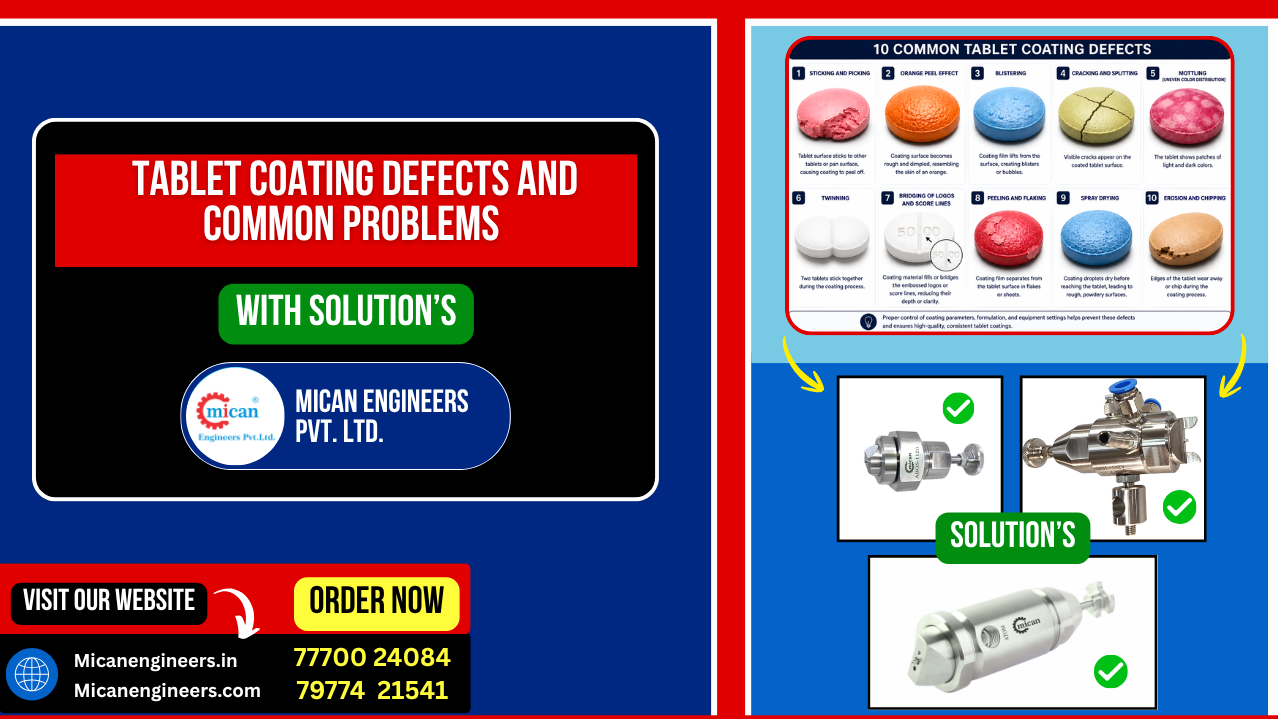
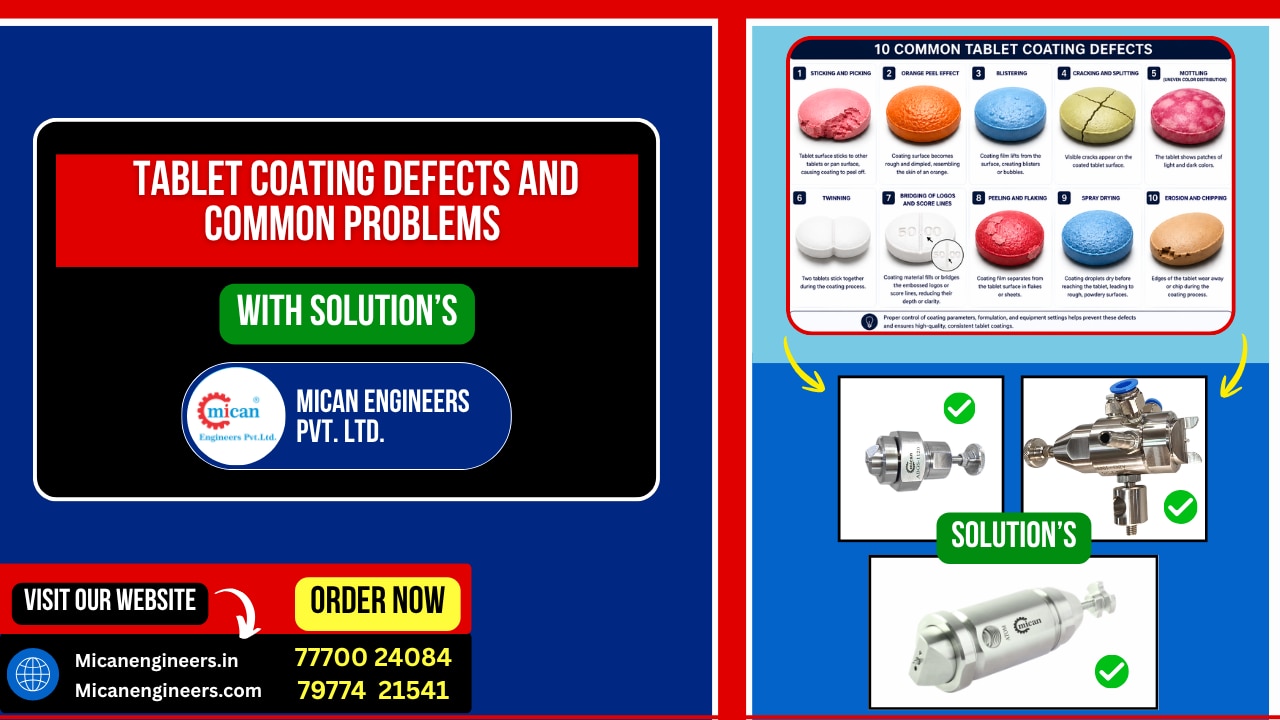
Tablet Coating Defects and Common Problems with Solutions
Tablet coating is a critical step in pharmaceutical manufacturing that enhances tablet appearance, improves stability, masks unpleasant taste and odor, protects active ingredients, and controls drug release characteristics. However, achieving a smooth, uniform, and defect-free coating requires precise control of coating parameters, spray technology, airflow, and drying conditions.
Even minor variations in the coating process can result in coating defects that affect product quality, appearance, and performance. Understanding these common defects and their causes is essential for maintaining consistent coating quality.
Why Tablet Coating Defects Occur
Most tablet coating defects arise due to:
Improper atomization
Excessive or insufficient spray rate
Incorrect inlet air temperature
Poor drying conditions
High coating solution viscosity
Inadequate tablet movement
Improper spray gun setup
Uneven coating distribution
Let's explore the most common tablet coating defects, their causes, and practical solutions.
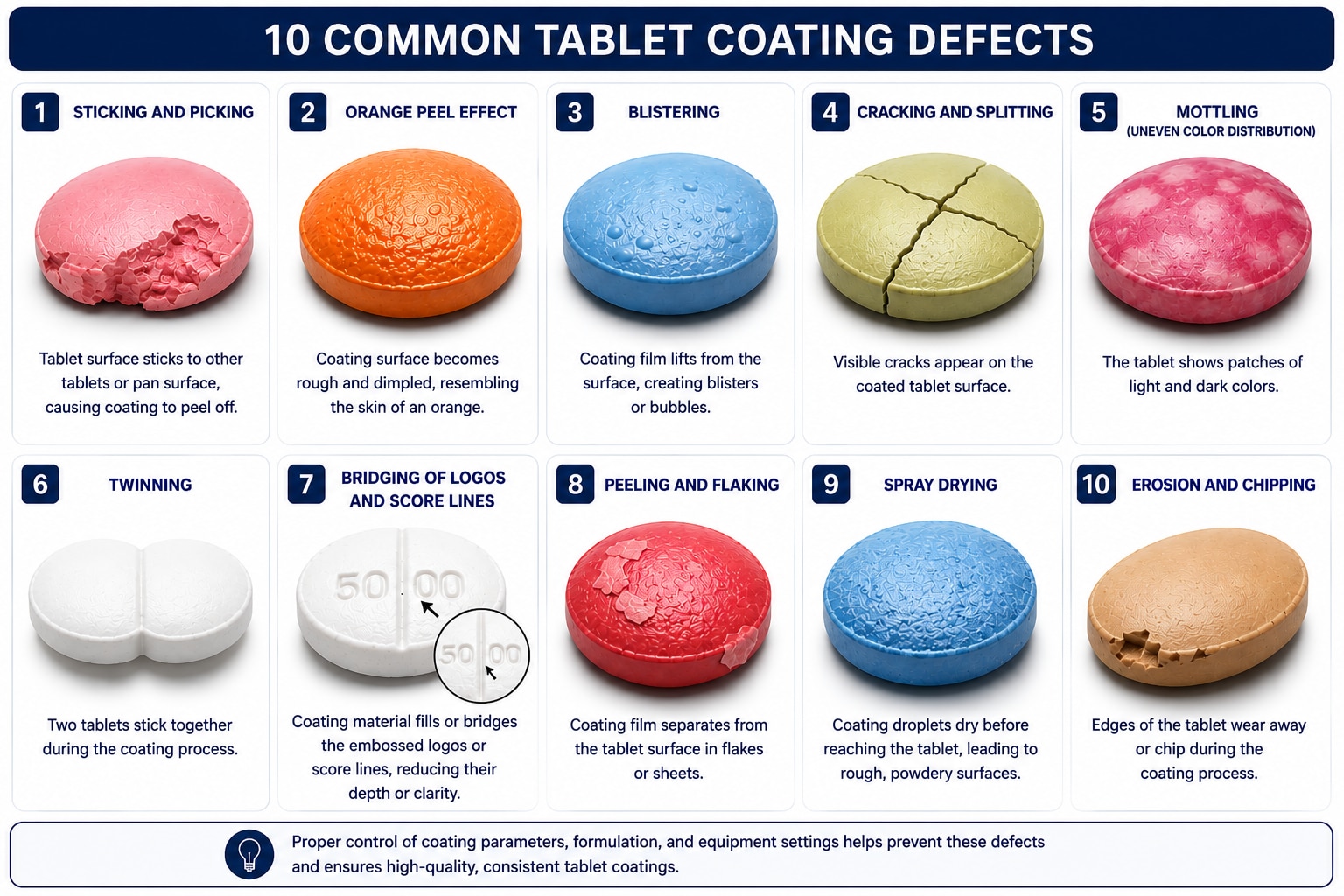
1. Sticking and Picking
What is it?
Sticking occurs when tablets adhere to each other or to the coating pan surface. Picking is the removal of a portion of the coating film from the tablet surface due to sticking.
Causes
Excessive spray rate
Overwetting of tablet bed
Inadequate drying
Poor atomization
Low inlet air temperature
Solutions
Reduce spray rate
Increase drying efficiency
Optimize inlet air temperature
Improve atomization quality
Ensure proper tablet bed movement
2. Orange Peel Effect
What is it?
The tablet surface develops a rough, textured appearance resembling the skin of an orange.
Causes
High coating solution viscosity
Poor atomization
Large droplet formation
Rapid solvent evaporation
Solutions
Reduce solution viscosity
Optimize spray air pressure
Use proper spray nozzles
Improve droplet size distribution
3. Blistering
What is it?
Blisters or bubbles form beneath the coating film due to trapped solvent or excessive drying temperatures.
Causes
High drying temperature
Rapid solvent evaporation
Excessive film formation
Solutions
Lower inlet air temperature
Apply coating gradually
Improve drying balance
Optimize coating formulation
4. Cracking and Splitting
What is it?
Visible cracks develop in the coating film, compromising appearance and protection.
Causes
Brittle coating formulation
Excessive coating thickness
Tablet expansion after coating
Insufficient plasticizer content
Solutions
Increase plasticizer concentration
Reduce coating thickness
Improve film flexibility
Optimize curing conditions
5. Mottling (Uneven Color Distribution)
What is it?
The tablet exhibits uneven color patterns with light and dark patches.
Causes
Poor pigment dispersion
Uneven spray distribution
Dye migration during drying
Inconsistent coating application
Solutions
Improve suspension mixing
Use suitable pigments
Optimize spray pattern
Ensure uniform coating application
6. Twinning
What is it?
Two tablets become stuck together during the coating process.
Causes
Excessive moisture on tablet surface
Overwetting
Deep concave tablet shapes
Inadequate drying
Solutions
Reduce spray rate
Increase drying efficiency
Optimize pan speed
Improve tablet movement within the coating pan
7. Bridging of Logos and Score Lines
What is it?
Coating material fills embossed logos, debossed markings, or score lines, reducing their visibility and functionality.
Causes
Excessive coating thickness
High solution viscosity
Large droplet size
Excessive solids content
Solutions
Apply thinner coating layers
Reduce coating viscosity
Improve atomization
Optimize spray parameters
8. Peeling and Flaking
What is it?
The coating film separates from the tablet surface in flakes or sheets.
Causes
Poor adhesion
Contaminated tablet cores
Improper formulation
Insufficient curing
Solutions
Improve tablet core quality
Optimize coating formulation
Ensure proper curing
Maintain clean tablet surfaces
9. Spray Drying
What is it?
Coating droplets dry before reaching the tablet surface, resulting in rough and powdery coatings.
Causes
High atomization air pressure
Excessive inlet air temperature
Long nozzle-to-bed distance
Small droplet size
Solutions
Reduce atomization pressure
Optimize spray gun position
Lower drying temperature
Balance spray and drying conditions
10. Erosion and Chipping
What is it?
Tablet edges wear away, chip, or become damaged during coating.
Causes
Excessive pan speed
Weak tablet cores
Excessive tablet movement
Mechanical impact
Solutions
Reduce pan speed
Improve tablet hardness
Minimize mechanical stress
Optimize coating process parameters
The Importance of Proper Spray Technology
Many tablet coating defects originate from poor atomization, inconsistent spray patterns, and uneven droplet distribution. Selecting the correct tablet coating spray gun plays a crucial role in achieving a smooth, uniform coating.
Benefits of Proper Spray Atomization:
Uniform coating thickness
Reduced overwetting
Improved drying efficiency
Consistent color distribution
Better logo and score line visibility
Reduced coating defects
Enhanced product quality
Achieve Consistent Tablet Coating Performance
For pharmaceutical coating applications, precision spray technology is essential to ensure optimal coating quality and process efficiency.
Achieve smoother coatings, improved efficiency, and consistent product quality with our ABG, ABGS, and ABH precision tablet coating spray guns, engineered for superior coating performance.
Whether you are operating a laboratory coater, pilot-scale system, or full-scale production coating machine, the right spray gun can help minimize coating defects and deliver reliable, repeatable results.
ABG | ABGS | ABH Tablet Coating Spray Guns – Precision Atomization for Pharmaceutical Coating Applications.
Tags :
#TabletCoating #TabletCoatingDefects #PharmaceuticalManufacturing #FilmCoating #TabletCoatingProcess #PharmaceuticalTechnology #CoatingDefects #PharmaIndustry #TabletProduction #DrugManufacturing #PharmaceuticalEquipment #TabletCoater #PharmaEngineering #CoatingSolutions #PharmaceuticalProcessing