
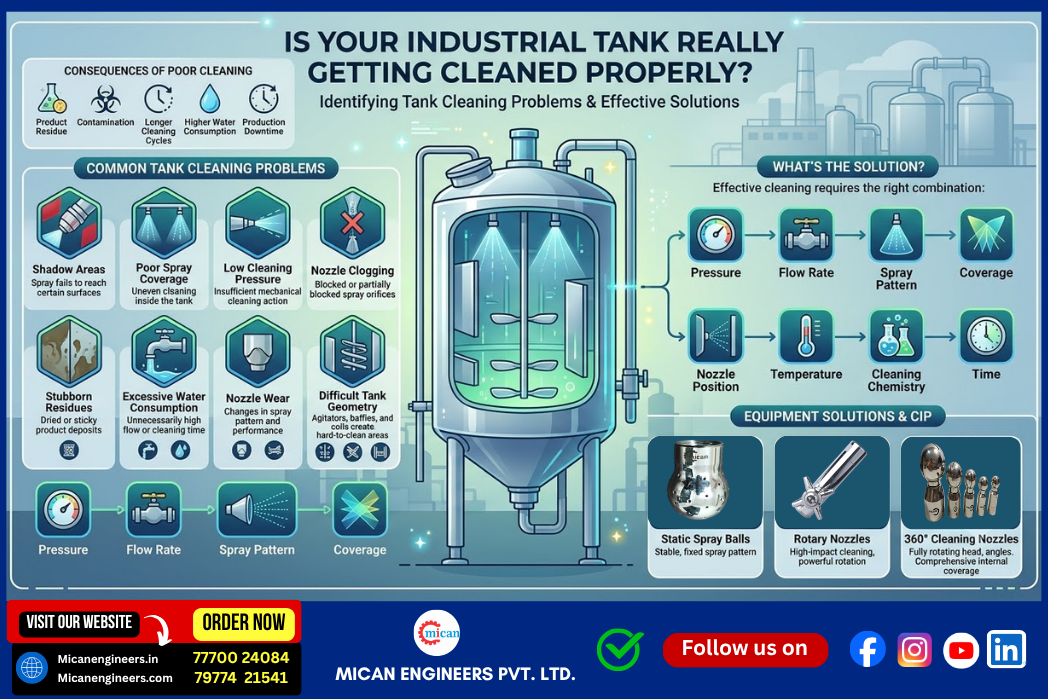
Common Industrial Tank Cleaning Problems & Solutions :
Industrial tanks are used extensively across pharmaceutical, food processing, chemical, beverage, dairy, nutraceutical, cosmetics, and other manufacturing industries. Keeping these tanks properly cleaned is essential for maintaining product quality, preventing contamination, improving hygiene, and ensuring efficient production.
However, industrial tank cleaning is not always as simple as spraying water or cleaning chemicals inside the tank. Poor nozzle selection, inadequate pressure, improper spray coverage, clogged nozzles, difficult tank geometry, and incorrect cleaning parameters can all reduce cleaning effectiveness.
In this article, we will discuss the most common industrial tank cleaning problems, their causes, and most practical solutions.
Why Effective Tank Cleaning Matters ?
Tank cleaning is an important part of maintaining a reliable production process. Residues left inside a tank can :
- Contaminate the next batch
- Encourage microbial growth
- Affect product quality
- Increase cleaning time
- Increase water and chemical consumption
- Cause production downtime
- Create cleaning-validation challenges
- Reduce equipment life
An effective cleaning system should provide sufficient coverage and cleaning action across the required internal surfaces of the tank.
1. Shadow Areas Inside the Tank :
Problem
One of the most common tank cleaning problems is the presence of shadow areas where the cleaning spray does not reach effectively.
These areas may occur behind :
- Agitator blades
- Baffles
- Heating coils
- Pipes
- Internal fittings
- Tank supports
Residue can accumulate in these areas even when the rest of the tank appears clean.
Causes
Common causes include :
- Incorrect nozzle positioning
- Limited spray coverage
- Obstructions inside the tank
- Incorrect spray angle
- Inadequate nozzle selection
Solution
Select a tank cleaning nozzle based on the tank's internal geometry and required coverage.
For applications requiring greater coverage, 360° rotary tank cleaning nozzles or rotary jet cleaning devices can provide dynamic spray coverage over internal surfaces.
For complex tanks, multiple cleaning nozzles may be required rather than relying on a single nozzle.
2. Poor Spray Coverage :
Problem
A nozzle may produce a spray pattern, but that does not necessarily mean that the entire tank surface is receiving effective cleaning action.
Poor coverage can result in:
- Uncleaned areas
- Uneven cleaning
- Residue accumulation
- Longer cleaning cycles
Causes
Poor coverage may be caused by:
- Incorrect spray angle
- Incorrect nozzle location
- Incorrect nozzle type
- Insufficient nozzle rotation
- Improper tank-to-nozzle positioning
Solution
Evaluate the complete tank geometry before selecting the nozzle.
Consider :
Tank diameter + tank height + nozzle location + spray angle + spray pattern + pressure + flow rate
The nozzle should be selected according to the actual cleaning requirement rather than simply choosing a nozzle based on connection size.
3. Insufficient Cleaning Pressure :
Problem
Low pressure can reduce the mechanical impact of the cleaning liquid on contaminated surfaces.
This becomes particularly important when removing :
- Dried product
- Sticky residues
- Oils
- Powders
- Process deposits
Causes
Low pressure at the nozzle can result from:
- Undersized pump
- Excessive pipe length
- Pressure losses in piping
- Blocked filters
- Partially clogged nozzles
- Incorrect system design
Solution
Measure the actual pressure at the nozzle, not only the pressure indicated at the pump.
Check :
- Pump capacity
- Piping diameter
- Filters
- Valves
- Nozzle condition
- Pressure losses
It is important to remember that pressure and flow are not the same thing. Effective cleaning requires an appropriate combination of both.
4. High Pump Pressure but Poor Cleaning
Problem
Sometimes the pump is operating at high pressure, but the tank is still not getting cleaned properly.
This can be confusing because operators may assume that higher pressure automatically means better cleaning.
Why It Happens
Cleaning effectiveness depends on more than pressure.
For example, a nozzle with an unsuitable spray pattern may fail to cover critical surfaces even when supplied with high pressure.
Similarly, insufficient flow may limit the amount of cleaning liquid reaching the surface.
Solution
Evaluate:
- Pressure
- Flow rate
- Spray pattern
- Nozzle design
- Coverage
- Nozzle position
- Cleaning time
- Cleaning chemistry
- Temperature
Higher pressure is not always the complete solution.
The entire cleaning system needs to be optimized.
5. Nozzle Clogging
Problem
Tank cleaning nozzles can become partially or completely clogged by:
- Product particles
- Solids
- Scale
- Chemical deposits
- Rust particles
- Contaminated cleaning fluid
A clogged nozzle can significantly alter the spray pattern and reduce cleaning performance.
Causes
Common causes include:
- Poor filtration
- Dirty cleaning fluid
- Small nozzle orifices
- Lack of inspection
- Product buildup
Solution
Use suitable filtration upstream of the cleaning nozzle.
Regularly inspect:
- Nozzle orifice
- Filters
- Piping
- Connections
If the spray pattern suddenly changes, nozzle blockage should be one of the first things checked.
6. Excessive Water Consumption
Problem
Some cleaning systems consume significantly more water than necessary.
This increases:
- Operating costs
- Wastewater generation
- Chemical consumption
- Cleaning time
Causes
Excessive consumption can result from:
- Oversized nozzles
- Excessive flow rate
- Long cleaning cycles
- Inefficient spray coverage
- Repeated cleaning due to poor initial cleaning
Solution
Optimize the cleaning process around the required:
Flow + Pressure + Time + Cleaning Chemistry
A properly selected nozzle can help deliver the required cleaning performance without unnecessarily increasing flow.
7. Stubborn Product Residue
Problem
Some products form difficult-to-remove deposits on tank walls and internal components.
Examples include:
- Sticky pharmaceutical formulations
- Oils and fats
- Dried food products
- Powders
- Resins
- Chemical deposits
Causes
Stubborn residue may result from :
- Product drying before cleaning
- Insufficient mechanical action
- Incorrect cleaning temperature
- Incorrect chemical concentration
- Insufficient cleaning time
Solution :
Optimize the complete cleaning process.
Depending on the application, evaluate :
- Cleaning temperature
- Chemical concentration
- Spray impact
- Flow rate
- Pressure
- Cleaning duration
The nozzle should provide sufficient mechanical action for the specific residue.
8. Uneven Cleaning of the Tank Surface
Problem
Some parts of the tank are cleaned effectively while other areas remain contaminated.
Causes
This may occur because of :
- Poor nozzle positioning
- Incorrect spray pattern
- Obstructions
- Insufficient spray overlap
- Incorrect nozzle selection
Solution
Perform a detailed assessment of the tank interior.
Identify :
- All internal surfaces requiring cleaning
- Potential shadow areas
- Equipment obstructions
- Nozzle mounting position
- Required spray coverage
For larger or complicated tanks, multiple cleaning points may provide better coverage than a single nozzle.
9. Slow Cleaning Cycles
Problem
A tank takes too long to clean, resulting in increased production downtime.
Causes
Common causes include :
- Poor spray coverage
- Insufficient mechanical action
- Low flow
- Incorrect pressure
- Inadequate cleaning chemistry
- Inefficient nozzle design
Solution :
Instead of simply increasing the cleaning time, identify why cleaning is taking longer.
Check whether the nozzle is delivering adequate:
- Flow
- Pressure
- Spray coverage
- Impact
A more efficient cleaning system may reduce the required cleaning cycle.
10. Tank Cleaning Nozzle Wear
Problem
Tank cleaning nozzles can wear over time, especially when exposed to abrasive particles or aggressive chemicals.
Wear can alter the original spray characteristics.
Causes
Potential causes include:
- Abrasive fluids
- High operating hours
- Chemical incompatibility
- High flow velocity
- Improper material selection
Solution :
Select the nozzle material according to the application.
Common materials may include :
- SS 304
- SS 316
- SS 316L
- Engineering plastics
- Other application-specific materials
Regularly inspect nozzles for changes in spray performance, leakage, wear, or damage.
11. Difficult Tank Geometry
Problem
Not all industrial tanks have simple cylindrical interiors.
Some tanks contain :
- Agitators
- Baffles
- Coils
- Spray pipes
- Sensors
- Manways
- Internal supports
These components can interfere with spray coverage.
Solution :
Tank cleaning should be designed around the actual internal configuration.
Before selecting a nozzle, consider:
Tank dimensions + internal obstructions + cleaning fluid + operating pressure + required flow + contamination type.
For complicated applications, specialized rotary cleaning equipment or multiple nozzles may be more appropriate.
12. Excessive Foam During Cleaning
Problem
Excessive foam can make the cleaning process difficult and may increase rinse requirements.
Causes
Foaming can be influenced by:
- Cleaning chemical formulation
- Chemical concentration
- Agitation
- Air entrainment
- Spray conditions
- Product residues
Solution
Review the cleaning chemistry and operating parameters.
Avoid assuming that increasing spray pressure alone will solve the cleaning problem.
The chemical concentration, temperature, flow and mechanical cleaning action should be optimized together.
13. Incomplete Rinsing
Problem
After the cleaning stage, chemical or product residues may remain inside the tank.
This can create contamination risks for the next production batch.
Causes
Possible causes include :
- Insufficient rinse time
- Poor spray coverage
- Inadequate flow
- Difficult tank geometry
- Poor nozzle positioning
Solution
Ensure the rinse stage provides sufficient coverage of all required internal surfaces.
The rinse process should be evaluated independently rather than assuming that a successful detergent-cleaning stage automatically means the tank is fully rinsed.
14. Cleaning Around Agitators and Internal Components
Problem
Agitators, shafts and other internal components can create difficult-to-clean areas.
Why It Happens ?
A fixed spray pattern may not adequately reach all surfaces around complicated equipment.
Solution :
Consider the movement and spray distribution of the cleaning device.
Depending on the application, rotary cleaning nozzles can provide changing spray paths that improve coverage.
For highly complex geometries, the cleaning system may require more than one strategically positioned nozzle.
15. Cleaning System Requires Frequent Manual Cleaning
Problem
Operators may need to enter the tank or manually clean internal surfaces after every production cycle.
This can increase :
- Labour requirements
- Cleaning time
- Safety risks
- Production downtime
Causes
Manual intervention may be required because of:
- Poor automated spray coverage
- Stubborn deposits
- Incorrect nozzle selection
- Dead zones
- Inadequate cleaning parameters
Solution
Review whether the automated cleaning system is correctly designed for the actual contamination and tank geometry.
An appropriately selected automated tank cleaning nozzle can reduce the need for manual intervention, although the exact result depends on the tank, residue, cleaning chemistry and operating conditions.
16. Cleaning Performance Changes Over Time
Problem
A tank cleaning system may initially perform well but gradually become less effective.
Causes
Possible reasons include:
- Nozzle wear
- Partial clogging
- Pump performance changes
- Filter blockage
- Scaling
- Changes in product formulation
- Changes in cleaning chemistry
Solution :
Establish a regular inspection and maintenance program.
Monitor :
- Nozzle spray pattern
- Operating pressure
- Flow rate
- Pump performance
- Filter condition
- Cleaning cycle duration
Changes in these parameters can provide early indications of cleaning-system problems.
Important Factors for Selecting a Tank Cleaning Nozzle :
Selecting a tank cleaning nozzle only by its connection size is not sufficient.
Consider the following parameters:
1. Tank Size
Tank diameter and height influence the required spray coverage.
2. Tank Geometry
Internal components can create shadow areas and affect nozzle positioning.
3. Cleaning Pressure
The available pressure determines the performance of the selected nozzle.
4. Flow Rate
The available flow must match the nozzle's operating requirements.
5. Spray Pattern
Different applications may require different spray patterns and coverage characteristics.
6. Cleaning Method
Determine whether the system uses:
- Water
- Detergent
- Caustic solution
- Acid solution
- Sanitizing solution
- Other cleaning fluids
7. Material Compatibility
The nozzle material should be compatible with the cleaning fluid and operating conditions.
8. Contamination Type
A light residue and a hardened product deposit may require completely different cleaning approaches.
9. Operating Temperature
Temperature can influence both cleaning chemistry and equipment material selection.
10. Required Cleaning Time
The cleaning system should achieve the required cleaning result within the desired production cycle.
Fixed Static Spray Ball vs Rotary Tank Cleaning Nozzle
Both fixed and rotary cleaning devices can be useful, depending on the application.
Fixed Static Spray Ball
A spray ball provides a fixed spray distribution and can be suitable for applications where the tank geometry and cleaning requirements are relatively straightforward.
Rotary Tank Cleaning Nozzle
A rotary cleaning nozzle changes the spray location as it rotates, allowing the cleaning liquid to reach different areas of the tank interior.
It can be particularly useful when greater dynamic coverage is required.
However, no single nozzle is automatically suitable for every tank. Selection should be based on tank geometry, contamination, pressure, flow, temperature and cleaning requirements.
A Simple Approach to Troubleshooting Tank Cleaning :
When a tank is not being cleaned effectively, follow a systematic approach.
Step 1: Check the Nozzle
Inspect the nozzle for:
- Clogging
- Wear
- Damage
- Incorrect installation
Step 2: Check Pressure
Measure pressure at the nozzle rather than relying only on pump pressure.
Step 3: Check Flow
Confirm that the actual flow rate matches the required operating conditions.
Step 4: Inspect Spray Coverage
Identify areas that are not receiving adequate cleaning spray.
Step 5: Check Tank Geometry
Look for:
- Baffles
- Agitators
- Coils
- Pipes
- Other obstructions
Step 6: Review Cleaning Parameters
Evaluate :
Time + Temperature + Chemical Concentration + Mechanical Action
Step 7: Inspect the Entire System
Check the:
- Pump
- Piping
- Filters
- Valves
- Nozzle
- Connections
A tank cleaning problem may not always originate from the nozzle itself.
Tank Cleaning Is a Complete System, Not Just a Nozzle
One of the most important points to understand is that effective tank cleaning depends on the entire cleaning system.
A high-quality nozzle cannot compensate for:
- Incorrect pump sizing
- Poor piping design
- Insufficient flow
- Inadequate cleaning chemistry
- Incorrect temperature
- Poor nozzle positioning
- Difficult tank geometry
Similarly, simply increasing pressure may not solve poor cleaning coverage.
The best results come from optimizing the complete cleaning process.
Conclusion :
Industrial tank cleaning problems can result in contamination, longer production cycles, increased water and chemical consumption, and unnecessary manual cleaning.
Common issues such as shadow areas, poor spray coverage, nozzle clogging, insufficient pressure, stubborn residues, excessive water consumption, nozzle wear, and difficult tank geometry can often be addressed through proper system design, nozzle selection, maintenance and process optimization.
When selecting a tank cleaning nozzle, consider the tank dimensions, internal geometry, contamination type, pressure, flow rate, temperature, cleaning chemistry and required cleaning time.
The goal should not simply be to use a higher-pressure spray. The goal is to achieve the required cleaning performance through the right combination of spray coverage, mechanical action, flow, pressure, chemistry, temperature and time.
Need help selecting the right tank cleaning nozzle?
Share your tank diameter, tank height, internal arrangement, available pressure and flow rate, and type of residue. These parameters can be used to determine a more suitable tank cleaning solution for the application.
Mican Engineers Pvt. Ltd. provides industrial spray nozzles and tank cleaning solutions for a range of industrial applications, with nozzle selection based on application requirements rather than a one-size-fits-all approach.
Industrial tank cleaning nozzle, Rotary tank cleaning nozzle, 360 degree tank cleaning nozzle, CIP tank cleaning system
Tank cleaning equipment, Industrial CIP cleaning
Hashtags :
#IndustrialTankCleaning
#TankCleaning
#TankCleaningNozzle
#IndustrialCleaning
#RotaryTankCleaning
#CIPSystem
#CIPCleaning
#TankCleaningSolutions
#SprayNozzles
#IndustrialSprayNozzles
#tankcleaningproblems #industrialtankcleaning #tankcleaning #industrialtankcleaning #tankcleaningsolutions #tankcleaningnozzle #industrialtankcleaning #tankcleaningfix #fixtankcleaning
#micanengineers #industrialtankcleaning #micanengineers