
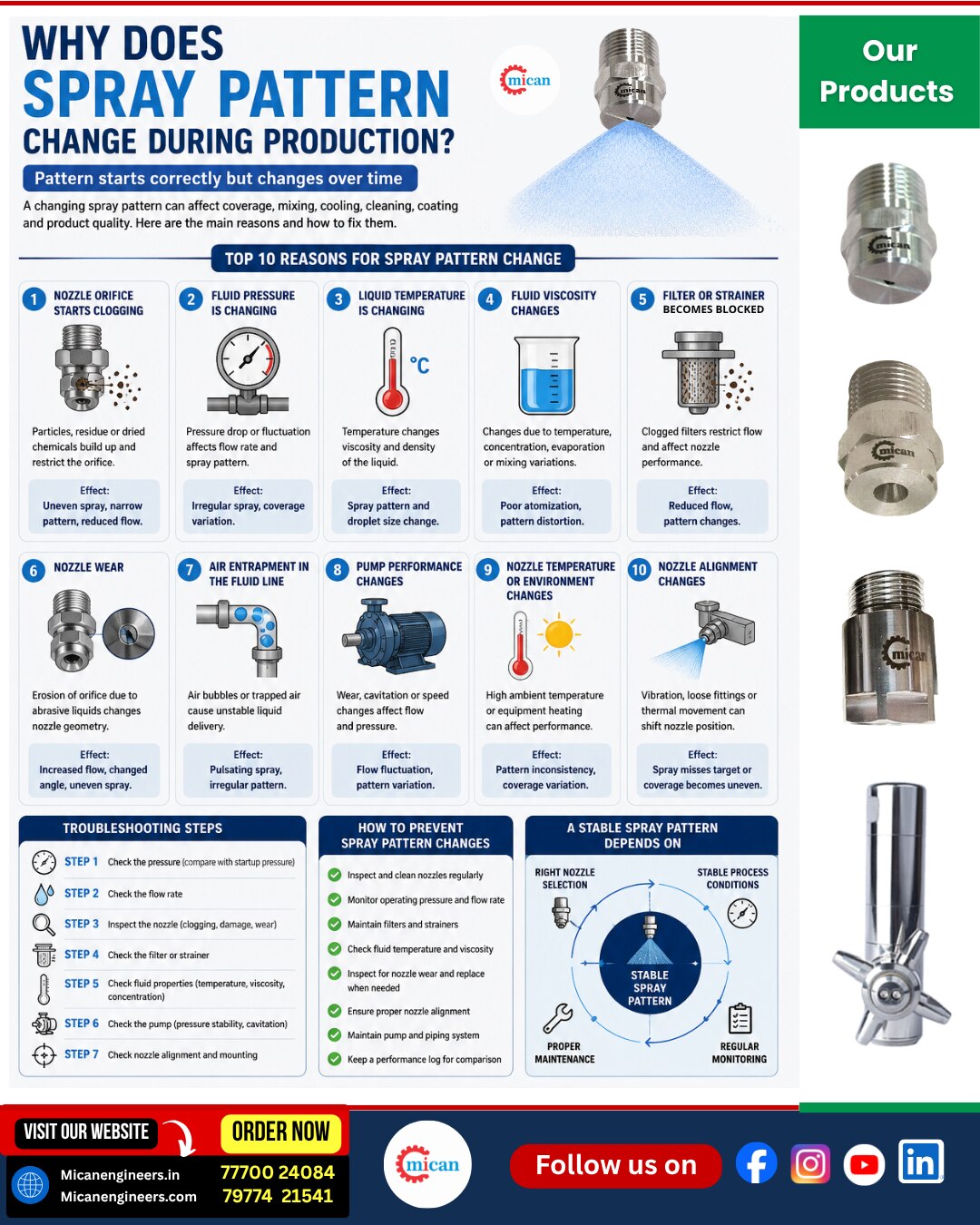
Why Does Spray Pattern Change During Production ?
A spray nozzle may produce the correct spray pattern when production starts, but after running for some time, the pattern can become uneven, narrow, distorted, or inconsistent.
This is a common industrial spraying problem. A changing spray pattern can affect coverage, cooling, washing, coating, cleaning, drying, and chemical application, ultimately reducing process consistency.
But why does the spray pattern change during production?
Let’s look at the most common causes and solutions.
What Is a Spray Pattern ?
A spray pattern is the shape and distribution of liquid produced by a spray nozzle.
Depending on the nozzle design, it may be:
- Flat fan
- Full cone
- Hollow cone
- Solid stream / straight jet
- Spiral
- Fine mist
A properly selected and maintained nozzle should provide a reasonably consistent pattern under stable operating conditions.
When the pattern changes during production, it usually indicates that something in the nozzle, fluid supply, or operating conditions has changed.
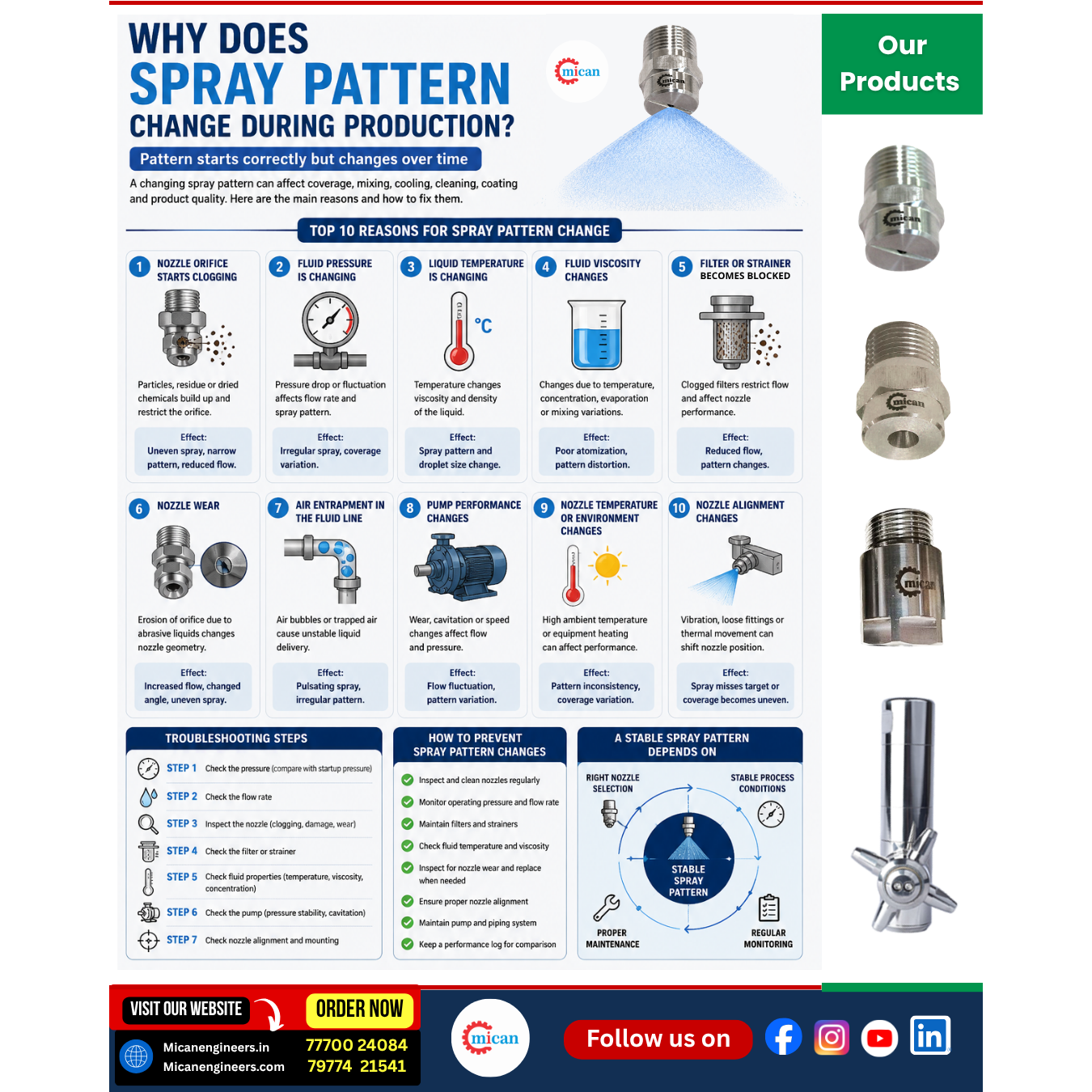
1. Nozzle Orifice Starts Clogging
One of the most common reasons for a changing spray pattern is partial blockage of the nozzle orifice.
During production, particles, solids, dried chemicals, product residue, or contaminants can gradually accumulate around the orifice.
What happens?
At the beginning:
Clean orifice → Correct flow → Correct spray pattern
After continuous operation:
Particle accumulation → Restricted flow → Distorted spray pattern
You may notice:
- Reduced spray coverage
- Uneven spray distribution
- Narrower spray pattern
- Irregular droplets
- Reduced flow rate
Solution :
Check the nozzle regularly and clean it using a suitable cleaning procedure.
For applications involving suspended solids or contaminants, consider appropriate filtration before the nozzle.
2. Fluid Pressure Is Changing
Spray pattern is strongly influenced by operating pressure.
If pump pressure gradually drops during production, the spray pattern may change.
For example:
Stable pressure → Stable spray pattern
But:
Pressure fluctuation → Flow fluctuation → Pattern variation
Pressure changes can occur because of:
- Pump performance
- Clogged filters
- Pressure regulator problems
- Valve position changes
- Pipeline restrictions
- Multiple nozzles operating simultaneously
Solution :
Monitor pressure near the nozzle rather than assuming the pump discharge pressure represents the actual nozzle pressure.
A pressure gauge or pressure sensor near the spray system can help identify fluctuations.
3. Liquid Temperature Is Changing
Temperature can affect the properties of the liquid being sprayed.
As temperature changes, viscosity, density, and other fluid properties can change.
For example, a liquid that becomes more viscous during production may not atomize or flow through the nozzle in the same way as it did at startup.
Solution :
Monitor process temperature and maintain it within the intended operating range.
If the process involves heating or cooling, evaluate the nozzle performance at the actual operating temperature, not only during initial testing.
4. Fluid Viscosity Changes During Production
Some industrial fluids change viscosity during processing.
This can happen due to:
- Temperature changes
- Concentration changes
- Mixing variations
- Chemical reactions
- Evaporation
- Addition of other ingredients
A nozzle that produces the desired pattern with one viscosity may produce a different pattern when the viscosity changes significantly.
Solution :
Check whether the fluid properties remain consistent throughout the production cycle.
If viscosity changes are unavoidable, the spray nozzle should be selected and tested based on the actual process conditions.
5. Filter or Strainer Becomes Partially Blocked
Sometimes the nozzle itself is not the problem.
A filter or strainer installed upstream can gradually become blocked.
As the filter gets clogged:
Filter restriction increases → Flow decreases → Nozzle performance changes
This can make the spray pattern appear to change during production.
Solution
Inspect:
- Suction filters
- Pipeline strainers
- Inline filters
- Pump filters
- Nozzle inlet filters
Establish a cleaning or replacement schedule based on actual operating conditions.
6. Nozzle Wear
A nozzle is a precision component, and continuous exposure to high-velocity fluid can cause wear.
This is particularly important when spraying :
- Abrasive liquids
- Suspensions
- Slurries
- Liquids containing particles
As the orifice wears, its geometry changes.
This can result in :
- Increased flow
- Changed spray angle
- Uneven distribution
- Larger droplets
- Reduced spray accuracy
Solution :
Compare the nozzle's current flow rate with its original or specified flow rate.
For critical applications, periodic nozzle inspection and replacement can prevent gradual performance deterioration.
7. Air Entrapment in the Fluid Line
Air bubbles or trapped air can cause unstable liquid delivery.
This may result in:
- Pulsating spray
- Intermittent spray
- Irregular pattern
- Flow fluctuations
The problem can become more noticeable when the pump or piping system introduces air into the liquid.
Solution
Check for:
- Air leaks on the suction side
- Improper tank levels
- Poor piping arrangements
- Pump cavitation
- Loose connections
The fluid supply should be as stable and consistent as possible.
8. Pump Performance Changes
The pump is responsible for supplying the nozzle with the required flow and pressure.
If pump performance changes during production, the nozzle may also show a changing spray pattern.
Possible causes include:
- Pump wear
- Cavitation
- Blocked suction line
- Changing pump speed
- Mechanical problems
- Insufficient fluid supply
Solution
Monitor pressure and flow together.
Looking only at pressure may not provide the complete picture.
9. Nozzle Temperature or Surrounding Conditions Change
In some industrial processes, the nozzle operates in a hot environment.
As the equipment heats up, the nozzle and surrounding components may experience thermal expansion.
In certain applications, this can influence alignment, fluid properties, or operating conditions.
Solution
Consider the complete operating environment when selecting and testing the nozzle.
The nozzle should be evaluated under actual production conditions whenever possible.
10. Nozzle Alignment Changes
Even when the nozzle itself is functioning correctly, a change in its position can affect the spray coverage.
Vibration, loose fittings, thermal movement, or mechanical impact can cause the nozzle to shift.
This is especially important in systems where multiple nozzles must provide overlapping coverage.
Solution :
Check :
- Nozzle orientation
- Mounting connection
- Pipe support
- Vibration
- Nozzle-to-target distance
A small positional change can sometimes create a noticeable difference in the overall spray coverage.
How to Troubleshoot a Changing Spray Pattern
When the spray pattern starts correctly but changes later, don't immediately replace the nozzle.
Follow a systematic approach.
Step 1: Check the pressure
Compare startup pressure with pressure during the problem.
Step 2: Check the flow rate
A change in flow can indicate clogging, wear, pump problems, or fluid-property changes.
Step 3: Inspect the nozzle
Look for:
- Partial blockage
- Residue
- Damage
- Wear
- Orifice deformation
Step 4: Check the filter
A gradually blocked filter can restrict flow to the nozzle.
Step 5: Check fluid properties
Compare temperature, viscosity, concentration, and other relevant process conditions.
Step 6: Check the pump
Look for pressure fluctuations, cavitation, unstable flow, or other pump-related issues.
Step 7: Check nozzle mounting
Make sure the nozzle has not moved, rotated, or become loose.
A Simple Way to Identify the Problem
A useful troubleshooting approach is to compare three conditions:
Parameter | At Startup | During Problem | Difference |
|---|---|---|---|
| Pressure | Normal | ? | Check |
| Flow Rate | Normal | ? | Check |
| Temperature | Normal | ? | Check |
| Viscosity | Normal | ? | Check |
| Filter Condition | Clean | ? | Inspect |
| Nozzle Condition | Clean | ? | Inspect |
This helps determine whether the problem is actually caused by the nozzle or by a change elsewhere in the system.
How to Prevent Spray Pattern Changes
Preventive maintenance can significantly reduce unexpected spray variation.
Recommended practices :
- Inspect nozzles periodically
- Clean nozzles using the correct procedure
- Monitor operating pressure
- Monitor flow rate
- Maintain filters and strainers
- Check fluid temperature
- Monitor viscosity where applicable
- Inspect for nozzle wear
- Check nozzle alignment
- Maintain the pump properly
- Keep records of nozzle performance
For critical applications, establish a baseline spray pattern and flow rate when the nozzle is new. Future measurements can then be compared against this baseline.
Final Takeaway :
If a spray pattern is correct at the beginning of production but changes over time, the problem is often related to clogging, pressure variation, filter restriction, fluid-property changes, nozzle wear, pump instability, or nozzle movement.
The key is to identify what changed between startup and the point where the spray pattern became abnormal.
Instead of simply replacing the nozzle, check the complete spraying system—from the fluid supply and pump to the filter, piping, nozzle, and operating conditions.
A stable spray pattern starts with the right nozzle, but maintaining that pattern requires stable process conditions and proper nozzle maintenance.
( Mican Engineers Pvt Ltd )
Tags :
#SprayNozzle #SprayPattern #SprayNozzleTroubleshooting #IndustrialSpraying #SprayTechnology #NozzleMaintenance #IndustrialNozzles #SpraySystem #SprayNozzleProblems #ProcessEngineering #IndustrialAutomation #Manufacturing #EngineeringSolutions #IndustrialEquipment #SprayTechnology
Common Keywords Covered :
spray pattern changes during production, spray pattern problems ,spray nozzle troubleshooting
changing spray pattern, inconsistent spray pattern, spray nozzle problems and solutionsspray nozzle performance issues, spray pattern troubleshooting, industrial spray nozzle problems
spray nozzle clogging, spray nozzle pressure problems, uneven spray pattern
spray nozzle maintenance, industrial spray nozzle troubleshooting, spray nozzle flow problems