
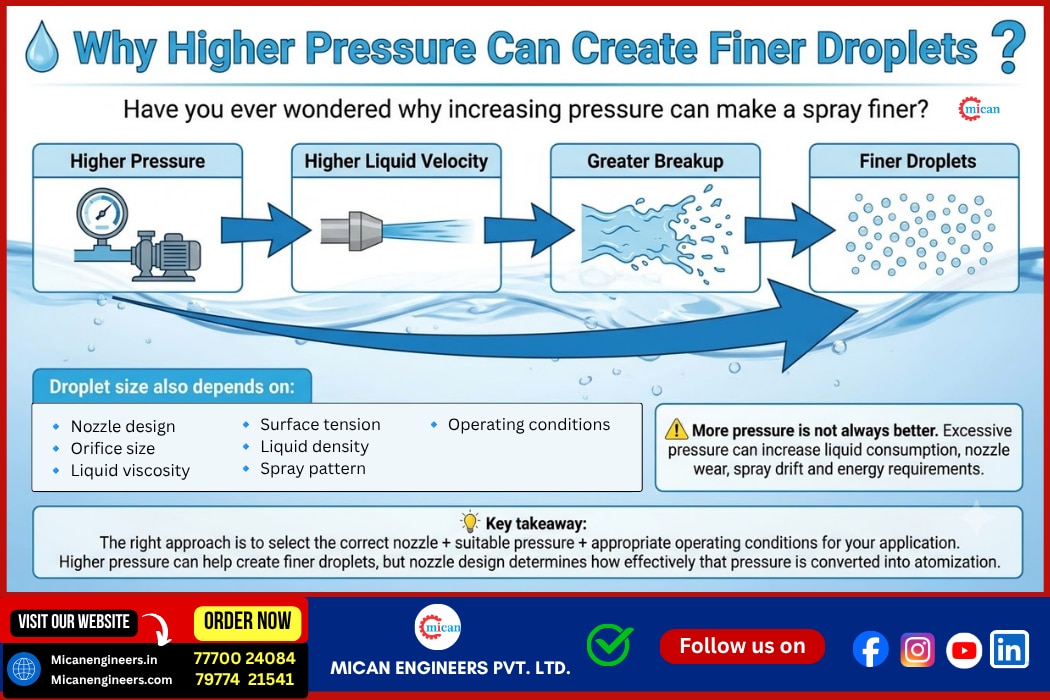
Why Higher Pressure Can Create Finer Droplets ?
Spray nozzle performance depends on several factors, but pressure is one of the most important variables affecting droplet size. In many spray applications, increasing the liquid pressure at the nozzle can produce a finer spray with smaller droplets.
But why does this happen ?
The answer lies in how pressure is converted into liquid velocity, turbulence, and atomization energy as the liquid passes through the nozzle orifice.
What Happens When Pressure Increases ?
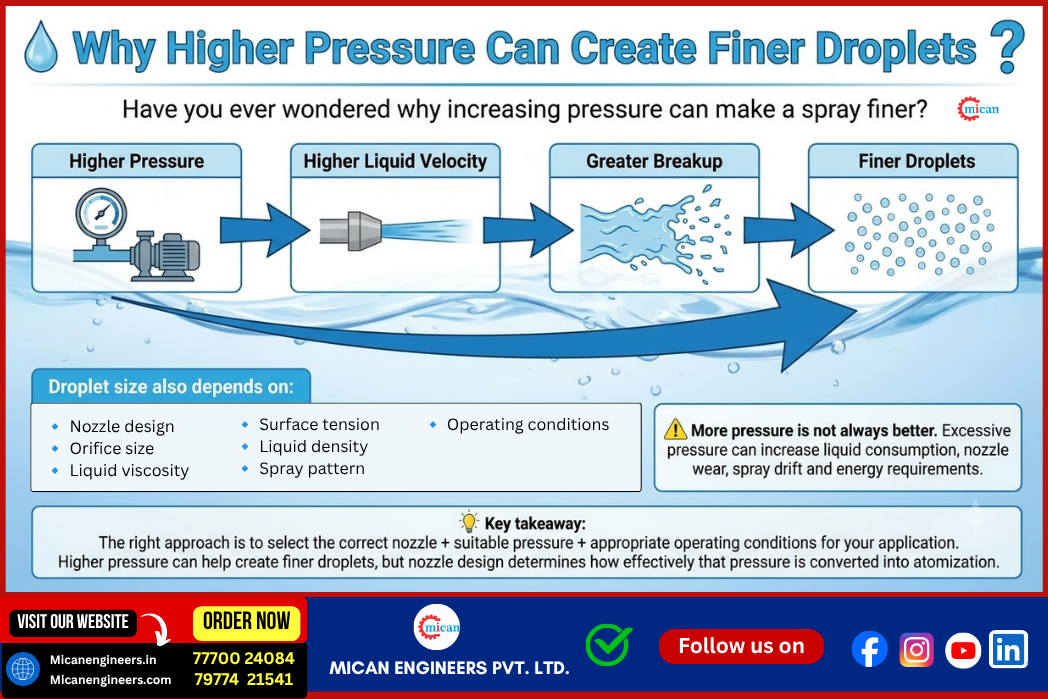
When liquid enters a spray nozzle under pressure, the nozzle converts pressure energy into velocity. As the pressure increases, the liquid exits the nozzle at a higher velocity.
Higher velocity creates stronger forces that work to break the liquid stream into smaller droplets.
In simple terms :
Higher Pressure → Higher Exit Velocity → Greater Liquid Breakup → Finer Droplets
However, the exact effect depends strongly on the type and design of the spray nozzle.
How Pressure Helps Break Liquid Into Smaller Droplets ?
When liquid leaves a nozzle, it does not always remain as one continuous stream. The liquid can become unstable and break apart into ligaments, sheets, or droplets.
At higher pressure, several effects become more significant.
1. Higher Liquid Velocity
Increasing pressure increases the velocity of liquid through the nozzle.
Higher velocity means the liquid has greater kinetic energy when it exits the nozzle. This makes it easier for the liquid to break apart into smaller droplets.
For many nozzle designs, flow approximately follows :
Q ∝ √P
Where :
- Q = flow rate
- P = pressure
This means that increasing pressure increases flow, but not proportionally.
For example,
if pressure increases from 2 bar to 8 bar, pressure becomes 4 times higher.
The theoretical flow increase is :
√(8/2) = 2
So the flow rate approximately doubles.
At the same time, the higher pressure can significantly influence atomization and droplet breakup.
2. Increased Turbulence
Inside many spray nozzles, the liquid experiences changes in direction, velocity and flow conditions.
Higher pressure can increase turbulence and instability in the liquid.
When the liquid exits the nozzle, these instabilities help overcome the forces holding the liquid together, causing the spray to break into smaller droplets.
This is particularly important in atomizing and fine-spray applications.
3. Greater Shear Forces
A liquid surface naturally resists being broken apart because of surface tension.
When liquid moves rapidly through a nozzle and interacts with surrounding air, aerodynamic forces act on the liquid surface.
At higher velocity, these forces become stronger.
The result can be:
Liquid Sheet/Jet → Instability → Breakup → Smaller Droplets
This is one reason higher operating pressure is commonly used when finer atomization is required.
Pressure vs Droplet Size
In general, for a given nozzle design and liquid:
Higher Pressure → Smaller Average Droplet Size
and
Lower Pressure → Larger Average Droplet Size
However, this should not be interpreted as an unlimited relationship.
For example :
Pressure | Typical Effect |
|---|---|
| Low | Larger droplets, less atomization |
| Medium | Improved breakup and spray quality |
| High | Finer droplets and greater atomization |
| Very High | May provide limited additional benefit depending on nozzle design |
The actual droplet size depends on much more than pressure.
Why Higher Pressure Does Not Always Mean Much Finer Droplets ?
This is an important point.
Increasing pressure does not automatically produce an unlimited reduction in droplet size.
The relationship depends on :
- Nozzle design
- Orifice size
- Spray pattern
- Liquid viscosity
- Surface tension
- Liquid density
- Nozzle geometry
- Airflow around the spray
- Operating pressure range
A nozzle designed for a coarse spray may not produce extremely fine droplets simply because its pressure is increased.
Therefore, pressure should always be considered together with nozzle design and liquid properties.
The Role of Nozzle Type :
Different spray nozzle designs respond differently to pressure.
Flat Spray Nozzles
Flat spray nozzles produce a fan-shaped spray pattern.
Increasing pressure can increase liquid velocity and improve breakup, potentially producing finer droplets.
They are commonly used for :
- Washing
- Cleaning
- Coating
- Cooling
- Surface treatment
Full cone nozzles produce a round spray pattern with droplets distributed across the spray area.
Increasing pressure can improve atomization, but these nozzles are often selected primarily for coverage and flow distribution, rather than extremely fine atomization.
Common applications include :
- Cooling
- Scrubbing
- Dust suppression
- Chemical spraying
- Washing
Hollow cone nozzles create a ring-shaped spray pattern and can produce relatively fine droplets compared with many conventional hydraulic nozzles.
Higher pressure can further improve atomization within the nozzle's operating range.
They are commonly used for:
- Gas cooling
- Humidification
- Dust control
- Chemical processing
- Air pollution control
Hydraulic Nozzles vs Air Atomizing Nozzle :
It is also important to distinguish between hydraulic spray nozzles and air-atomizing nozzles.
A hydraulic nozzle primarily uses liquid pressure to generate the spray.
An air-atomizing nozzle uses compressed air or another gas to assist in breaking the liquid into very fine droplets.
Therefore, if an application requires extremely fine atomization, simply increasing liquid pressure may not be the most effective solution. An appropriately designed air-atomizing nozzle may be more suitable.
Does Higher Pressure Increase Flow Rate Too ?
Yes.
For a given nozzle, flow rate generally follows the relationship:
Q₂ = Q₁ × √(P₂/P₁)
For example, suppose a nozzle produces:
10 LPM at 2 bar
If the pressure is increased to 8 bar :
Q₂ = 10 × √(8/2)
Q₂ = 10 × 2
Q₂ ≈ 20 LPM
So increasing pressure from 2 bar to 8 bar approximately doubles the flow rate.
At the same time, the higher exit velocity can produce a finer spray.
This is why pressure affects both flow rate and spray characteristics.
Higher Pressure Also Changes Spray Impact
Higher pressure does not only influence droplet size.
It can also increase :
- Spray velocity
- Impact force
- Spray penetration
- Coverage behavior
- Turbulence
- Liquid consumption
For applications such as tank cleaning or surface washing, higher pressure may be desirable because impact force is important.
For applications such as cooling, humidification or coating, droplet size may be more important.
Therefore, the correct pressure depends on the objective of the spraying process.
What Happens If Pressure Is Too High ?
More pressure is not always better.
Operating a nozzle above its recommended pressure range can cause problems such as:
Excessive Liquid Consumption
Because flow increases approximately with the square root of pressure, higher pressure results in higher liquid consumption.
Excessive Atomization
Very fine droplets may not always be desirable. They can increase drift or evaporate before reaching the target.
Uneven Application
If the spray becomes too fine or the spray pattern changes significantly, the application may become less uniform.
Nozzle Wear
Higher velocity through the orifice can increase wear, particularly when the liquid contains abrasive particles.
Pump Energy Consumption
Higher pressure requires the pump to provide greater pressure, which can increase energy consumption.
Droplet Size Is Not Determined by Pressure Alone
One of the most common mistakes is assuming:
"Higher pressure = smaller droplets in every situation."
The correct understanding is:
Higher pressure can promote finer droplets, but the final droplet size depends on the complete spraying system.
Important factors include:
Pressure + Nozzle Design + Liquid Properties + Operating Conditions
For example, a high-viscosity liquid may resist breakup more strongly than water. Similarly, a nozzle specifically designed for coarse droplets may continue producing relatively coarse spray even when pressure is increased.
Practical Example
Imagine two operating conditions using the same hydraulic spray nozzle:
Condition A
- Pressure: 2 bar
- Lower exit velocity
- Lower atomization energy
- Relatively larger droplets
Condition B
- Pressure: 6 bar
- Higher exit velocity
- Greater breakup forces
- Potentially finer droplets
The spray may therefore change from a relatively coarse spray to a finer spray as pressure increases.
However, the exact droplet-size change must be determined from the manufacturer's spray characterization data, because there is no universal pressure-to-droplet-size formula that applies to every nozzle
How to Select the Right Pressure ?
Instead of simply increasing pressure to obtain finer droplets, consider the application's actual requirements.
Step 1: Identify the Required Droplet Size
Determine whether you need :
- Coarse droplets
- Medium droplets
- Fine droplets
- Very fine atomization
Step 2: Select the Appropriate Nozzle
Choose a nozzle designed to produce the required spray characteristics.
Step 3: Check the Recommended Pressure Range
Operate the nozzle within the manufacturer's specified pressure range.
Step 4: Check Flow Rate
Increasing pressure also increases flow, so make sure the pump and system can handle the required flow.
Step 5: Consider Liquid Properties
Viscosity, surface tension and density can significantly influence atomization.
Conclusion :
Higher pressure can create finer droplets because it increases the velocity and energy of the liquid leaving the nozzle, making the liquid more susceptible to breakup.
The basic concept is:
Higher Pressure → Higher Velocity → Greater Breakup Forces → Potentially Finer Droplets
But pressure is only one part of the equation.
The nozzle design, liquid properties and operating conditions ultimately determine the spray quality and droplet size.
Therefore, the goal should not simply be to operate at the highest possible pressure, but to find the right pressure for the selected nozzle and application.
#SprayNozzle #IndustrialSprayNozzles #SprayTechnology #NozzleTechnology #SprayEngineering #Atomization #DropletSize #SprayPattern #SpraySystem #IndustrialSpraying #ProcessEngineering #FluidDynamics #SprayApplications #EngineeringSolutions #IndustrialEquipment #Manufacturing #IndustrialAutomation #ProcessIndustry #ChemicalIndustry #PharmaceuticalIndustry #CoolingSystems #TankCleaning #MicanEngineers
@mumbai @pune @ahmedabad @chennai