

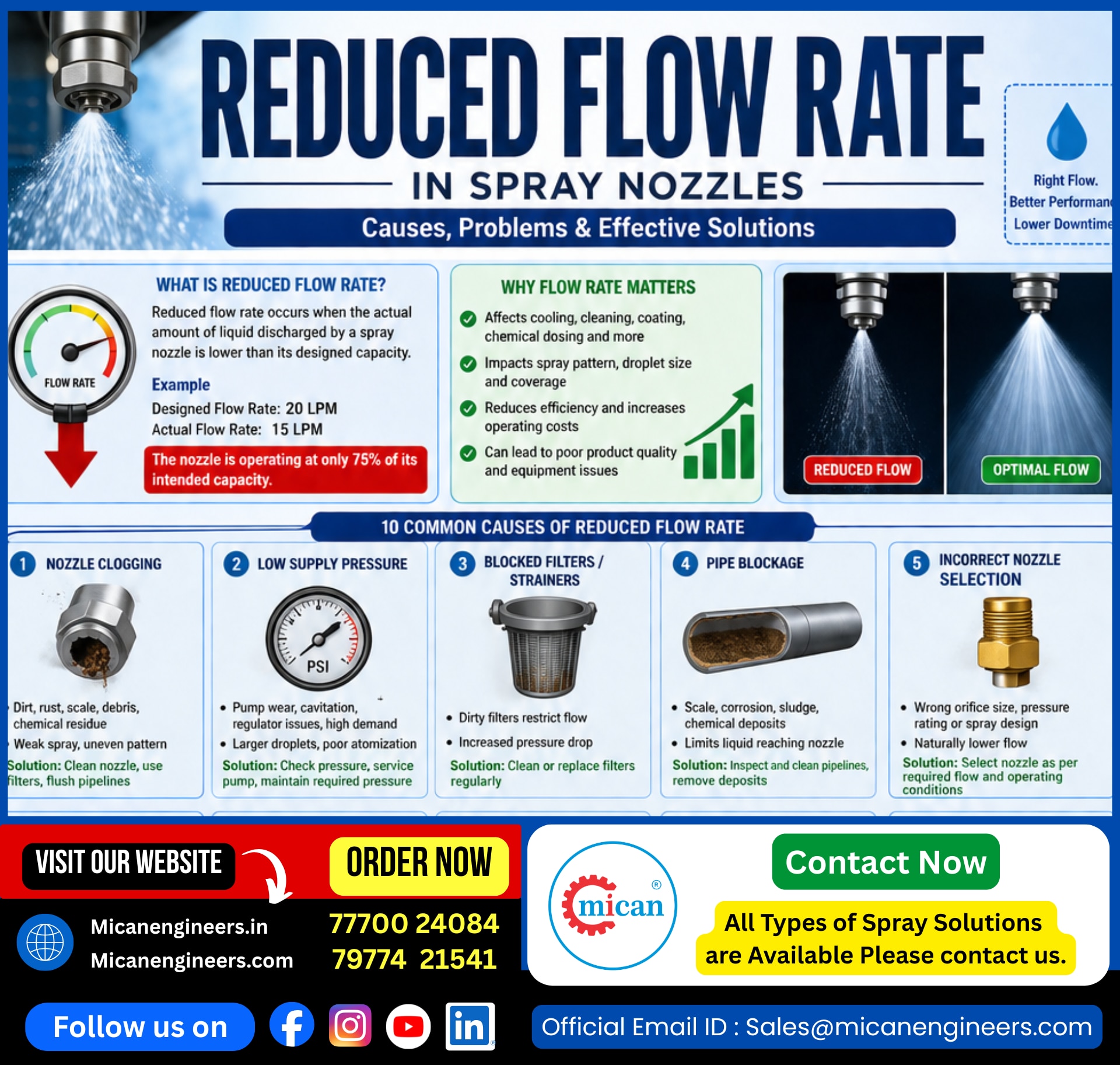
Reduced Flow Rate in Spray Nozzles : Causes, Problems, and Effective Solutions
Spray nozzles are designed to deliver a specific flow rate at a given pressure to ensure consistent performance in industrial applications such as cooling, cleaning, coating, dust suppression, humidification, lubrication, gas conditioning, and chemical processing.
When a spray nozzle delivers less liquid than its rated flow, it is known as Reduced Flow Rate. Even a small reduction in flow can significantly affect process efficiency, product quality, and operating costs.
Understanding the causes of reduced flow rate and implementing the right corrective actions can prevent costly downtime and maintain optimal spray performance.
What is Reduced Flow Rate ?
Reduced flow rate occurs when the actual amount of liquid discharged by a spray nozzle is lower than its designed capacity.
For example:
- Designed Flow Rate: 20 LPM
- Actual Flow Rate: 15 LPM
This means the nozzle is operating at only 75% of its intended capacity, leading to insufficient spray coverage and poor process performance.
Why Flow Rate Matters ?
Every spray nozzle is engineered to provide :
- Specific flow rate
- Correct spray angle
- Proper droplet size
- Uniform distribution
- Required impact force
When flow decreases, all these characteristics are affected simultaneously.
As a result :
- Cooling efficiency decreases
- Cleaning becomes ineffective
- Chemical dosing becomes inaccurate
- Coating quality deteriorates
- Production efficiency drops
Common Causes of Reduced Flow Rate
1. Nozzle Clogging
The most common reason for reduced flow is blockage inside the nozzle orifice.
Particles such as:
- Rust
- Sand
- Scale
- Welding debris
- Pipe deposits
- Undissolved chemicals
- Product residues
can partially block the nozzle opening.
Even a small obstruction significantly reduces the flow.
Symptoms
- Weak spray
- Uneven spray pattern
- Missing sections in spray
- Low pressure at the outlet
Solution
- Clean the nozzle properly.
- Install suitable inline filters or strainers.
- Flush the pipeline before installing new nozzles.
- Follow regular maintenance schedules.
2. Low Supply Pressure
Spray nozzles require sufficient inlet pressure to achieve their rated flow.
When system pressure drops, the flow rate automatically decreases.
Possible reasons include:
- Pump wear
- Pump cavitation
- Incorrect pump sizing
- Pressure regulator malfunction
- Excessive demand from multiple nozzles
Problems
- Larger droplets
- Poor atomization
- Reduced spray reach
- Incomplete coverage
Solution
- Measure pressure near the nozzle.
- Inspect pumps regularly.
- Maintain recommended operating pressure.
- Replace worn pump components.
3. Blocked Filters or Strainers
A dirty filter creates excessive pressure loss before the nozzle.
Although the pump may be running normally, the nozzle receives less liquid.
Common Reasons
- Dirty water
- Scale buildup
- Rust particles
- Process contamination
Solution
- Clean strainers regularly.
- Use filters with appropriate mesh size.
- Replace damaged filter elements.
4. Pipe Blockage
Deposits inside pipelines gradually reduce the available flow.
Common deposits include:
- Calcium scale
- Corrosion
- Chemical precipitation
- Sludge
- Product buildup
This restriction limits the amount of liquid reaching the spray nozzle.
Solution
- Inspect pipelines periodically.
- Perform chemical cleaning when required.
- Replace severely corroded piping.
5. Incorrect Nozzle Selection
Sometimes the nozzle itself is unsuitable for the application.
Examples include:
- Orifice too small
- Wrong pressure rating
- Incorrect flow capacity
- Improper spray design
Using a smaller-capacity nozzle than required naturally results in insufficient flow.
Solution
Select the nozzle based on:
- Required flow rate
- Operating pressure
- Spray angle
- Liquid properties
- Application requirements
6. High Liquid Viscosity
Liquids with higher viscosity flow more slowly through a nozzle.
Examples include:
- Syrups
- Oils
- Adhesives
- Paints
- Polymer solutions
Higher viscosity creates greater resistance inside the nozzle.
Solution
- Select nozzles designed for viscous fluids.
- Heat the liquid if the process allows.
- Increase operating pressure within safe limits.
7. Air Entrapment
Air trapped inside the pipeline interrupts liquid flow.
This often occurs:
- After maintenance
- During startup
- Due to suction leaks
- When tanks run empty
Symptoms
- Pulsating spray
- Intermittent flow
- Unstable spray pattern
Solution
- Bleed air from the system.
- Repair suction leaks.
- Maintain proper tank levels.
8. Valve Restrictions
Partially closed valves reduce the flow supplied to the spray nozzle.
This is often overlooked during maintenance or system adjustments.
Solution
- Verify all valves are fully open.
- Inspect control valves for proper operation.
- Replace faulty valves.
9. Pump Wear
Pump components gradually wear with time.
Common issues include:
- Worn impellers
- Damaged seals
- Internal leakage
- Reduced pumping efficiency
The pump can no longer supply the required flow.
Solution
- Perform periodic pump inspections.
- Replace worn components.
- Monitor pump performance regularly.
10. Liquid Supply Problems
Insufficient liquid entering the pump also reduces nozzle flow.
Possible causes:
- Low tank level
- Blocked suction line
- Suction air leaks
- Undersized suction piping
Solution
Maintain proper suction conditions and ensure uninterrupted liquid supply.
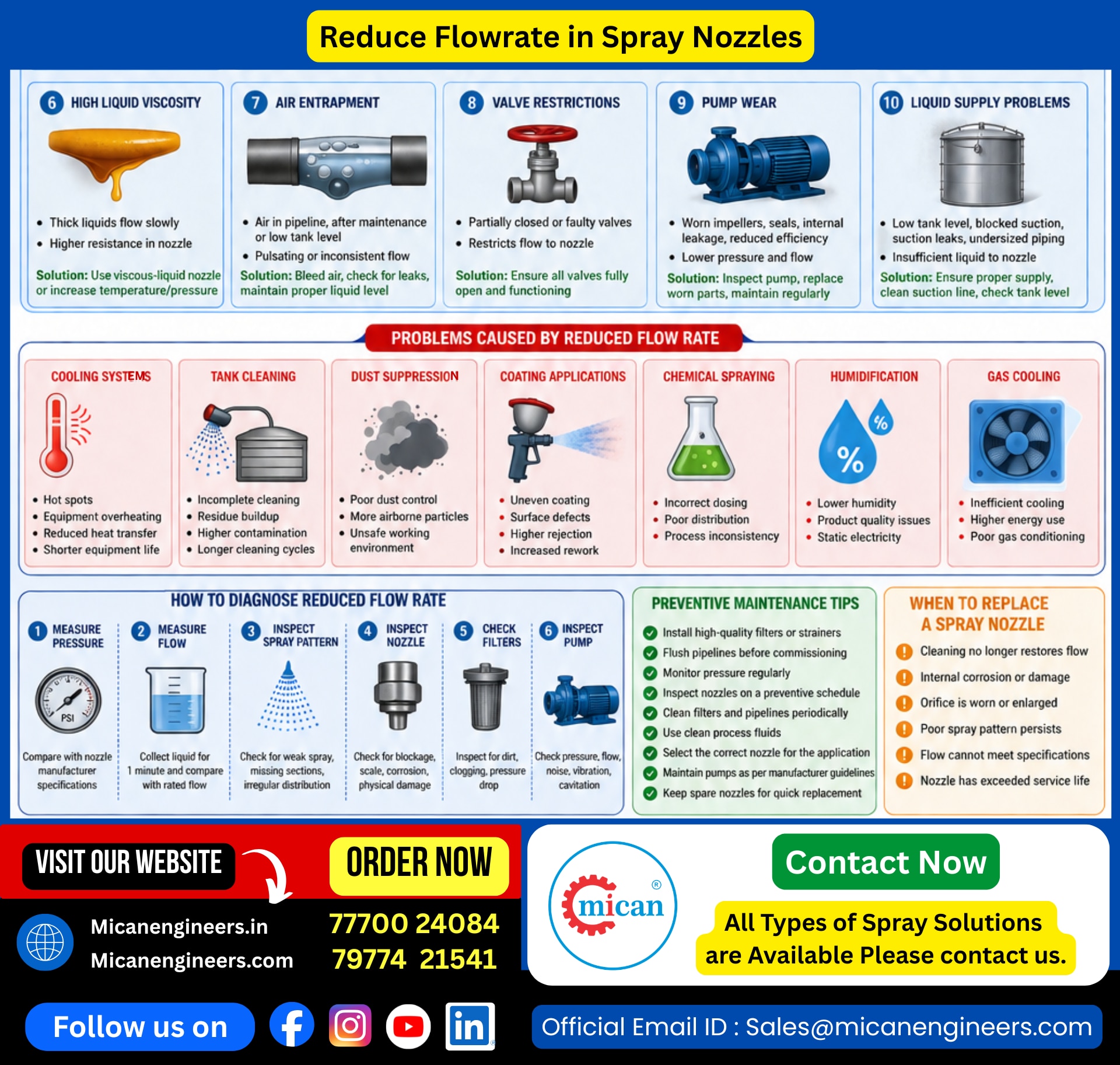
Problems Caused by Reduced Flow Rate
Reduced flow affects numerous industrial processes.
Cooling Systems
- Hot spots
- Equipment overheating
- Reduced heat transfer
- Shortened equipment life
Tank Cleaning
- Incomplete cleaning
- Residue buildup
- Higher contamination risk
- Longer cleaning cycles
Dust Suppression
- Poor dust control
- Increased airborne particles
- Unsafe working environment
Coating Applications
- Uneven coating thickness
- Surface defects
- Higher rejection rates
- Increased rework
Chemical Spraying
- Incorrect dosing
- Poor chemical distribution
- Process inconsistency
Humidification
- Lower humidity levels
- Product quality issues
- Static electricity buildup
Gas Cooling
- Inefficient temperature reduction
- Higher energy consumption
- Poor gas conditioning
How to Diagnose Reduced Flow Rate ?
Maintenance personnel should check the following:
1. Measure Operating Pressure
Compare the measured pressure with the nozzle manufacturer's specifications.
2. Measure Actual Flow
Collect liquid for one minute and compare the measured flow with the nozzle rating.
3. Inspect Spray Pattern
Look for:
- Weak spray
- Missing spray sections
- Irregular distribution
- Large droplets
4. Inspect Nozzle
Check for:
- Internal blockage
- Scale
- Corrosion
- Physical damage
5. Check Filters
Inspect all strainers for blockage.
6. Inspect Pump
Verify:
- Pump pressure
- Flow output
- Noise
- Vibration
- Cavitation
Preventive Maintenance Tips
To avoid reduced flow rate:
- Install high-quality filters or strainers.
- Flush pipelines before commissioning.
- Monitor pressure regularly.
- Inspect nozzles on a preventive maintenance schedule.
- Replace worn or damaged nozzles promptly.
- Clean filters and pipelines periodically.
- Use clean process fluids whenever possible.
- Select the correct nozzle for the application.
- Maintain pumps according to manufacturer recommendations.
- Keep spare nozzles available for quick replacement.
When Should You Replace a Spray Nozzle ?
Replacement is recommended when:
- Cleaning no longer restores flow.
- The nozzle has internal corrosion.
- The orifice is damaged.
- Spray pattern remains poor after cleaning.
- Flow cannot be restored to specification.
- The nozzle has exceeded its recommended service life.
Conclusion :
Reduced flow rate is one of the most common spray nozzle performance issues, but it is also one of the easiest to prevent through proper system design and regular maintenance.
Factors such as clogged nozzles, blocked filters, low operating pressure, worn pumps, pipeline restrictions, and incorrect nozzle selection can all reduce flow and compromise spray performance.
Routine inspection of the entire spray system—not just the nozzle—helps ensure consistent flow, reliable operation, and optimal process efficiency. Selecting the right nozzle and maintaining it properly can improve product quality, reduce downtime, lower maintenance costs, and extend equipment life.
At Mican Engineers, we offer a wide range of high-performance industrial spray nozzles along with expert technical guidance to help industries achieve precise flow control, uniform spray distribution, and dependable performance across demanding applications.
Also Read : Spray Failing to cover entire surface area
@mumbai @pune @chennai @ahmedabad
not enough Humanizer words left. Upgrade your Surfer plan.
