
How Pressure, Orifice Size and Flow Rate Work Together in Spray Nozzles ?
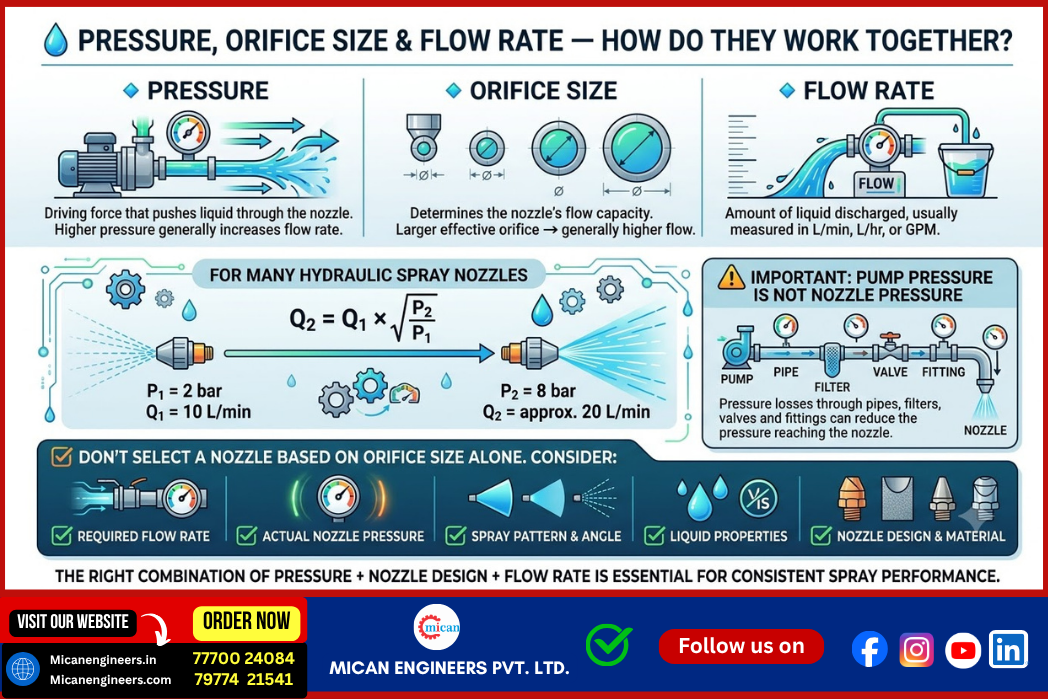
In any industrial spray system, three parameters play a major role in determining spray performance: pressure, orifice size, and flow rate.
These parameters are closely connected. Changing one can significantly affect the others, influencing the amount of liquid discharged, spray coverage, droplet size, and overall process performance.
Understanding this relationship is important when selecting the right industrial spray nozzle for applications such as cooling, washing, cleaning, coating, lubrication, dust suppression, chemical spraying, and surface treatment.
1. What Is Spray Pressure ?
Spray pressure is the pressure available at the nozzle inlet that forces liquid through the nozzle orifice.
Pressure is generally measured in :
- bar
- PSI
- kPa
- MPa
For example, a nozzle may be specified to operate at 2 bar, 5 bar, 10 bar, or higher pressure, depending on its design and application.
Pressure affects several aspects of spraying, including :
- Flow rate
- Spray pattern
- Droplet size
- Spray velocity
- Coverage
- Atomization
However, it is important to remember that pump pressure and actual nozzle pressure are not necessarily the same.
Pressure can be lost through pipes, valves, filters, fittings, bends, and other components before the liquid reaches the nozzle.
2. What Is Orifice Size ?
The orifice is the opening through which liquid exits the spray nozzle.
Its size has a direct influence on how much liquid the nozzle can discharge.
Generally :
Larger orifice → Higher potential flow rate
Smaller orifice → Lower potential flow rate
For example, consider two otherwise similar nozzles operating at the same pressure:
- Nozzle A: Small orifice
- Nozzle B: Large orifice
The larger-orifice nozzle will generally discharge more liquid at the same pressure.
Orifice geometry also matters. Two nozzles with similar nominal orifice dimensions may not have exactly the same flow characteristics because their internal designs can differ.
3. What Is Flow Rate ?
Flow rate is the quantity of liquid discharged by the nozzle over a specific period.
It is commonly expressed as:
- L/min
- L/hr
- m³/hr
- GPM
For industrial spray nozzles, flow rate is one of the most important selection parameters.
For example :
A nozzle with a flow rate of 10 L/min delivers approximately 10 litres of liquid every minute under its specified operating conditions.
Flow rate determines how much liquid is being applied to a surface, product, process, or equipment.
4. The Relationship Between Pressure and Flow Rate
For many hydraulic spray nozzles, flow rate is approximately related to pressure according to:
Q₂ = Q₁ × √(P₂ / P₁)
Where :
- Q₁ = flow rate at known pressure
- Q₂ = flow rate at new pressure
- P₁ = original pressure
- P₂ = new pressure
This means that flow rate does not increase proportionally with pressure.
Example
Suppose a nozzle delivers:
10 L/min at 2 bar
If the pressure is increased to 8 bar:
Q₂ = 10 × √(8/2)
Q₂ = 10 × √4
Q₂ = 20 L/min
So, increasing pressure from 2 bar to 8 bar—a fourfold increase—results in approximately double the flow rate, assuming the nozzle and liquid conditions remain comparable.
This is an important concept because simply increasing pump pressure does not produce a proportional increase in nozzle flow.
5. How Orifice Size Affects Flow Rate
Orifice size also has a major influence on flow.
A simplified relationship for hydraulic nozzles can be represented as:
Q ∝ A × √P
Where :
- Q = flow rate
- A = effective orifice area
- P = pressure
Because the area of a circular opening depends on its diameter squared:
A ∝ d²
where d is the orifice diameter.
Therefore, even a relatively small increase in orifice diameter can significantly increase the available flow area.
However, real-world nozzle performance depends on the complete internal nozzle geometry, discharge coefficient, liquid properties, and manufacturer-specific design.
6. Pressure vs Orifice Size: Two Ways to Change Flow
Suppose you need to increase the flow rate of an industrial spray nozzle.
You may consider two options :
Option 1: Increase Pressure
Increasing pressure can increase flow through the existing nozzle.
However, higher pressure may also :
- Increase energy consumption
- Increase wear
- Change droplet characteristics
- Affect spray pattern
- Increase overspray in some applications
Option 2: Increase Orifice Size
A larger orifice can provide higher flow without necessarily requiring the same increase in operating pressure.
This can be useful when the system needs a higher liquid delivery rate while maintaining a particular pressure range.
Therefore, higher flow does not always mean higher pressure.
Sometimes the correct solution is selecting a nozzle with a different orifice/flow capacity.
7. Pressure, Orifice Size and Flow Rate Work Together
These three parameters should not be considered independently.
A simplified way to understand the relationship is :
Pressure provides the driving force → Orifice controls the discharge capacity → Flow rate is the resulting liquid delivery.
For a given nozzle :
a) Increase pressure → Flow increases
b) Decrease pressure → Flow decreases
c) Increase orifice size → Flow capacity increases
d) Decrease orifice size → Flow capacity decreases
But the actual relationship depends on nozzle design and operating conditions.
8. Example: Selecting a Spray Nozzle
Suppose an industrial process requires :
Required flow: 20 L/min
Available pressure: 4 bar
You cannot simply select a nozzle based only on its physical orifice diameter.
Instead, check the manufacturer's flow-performance data.
A nozzle may be rated, for example, at:
Pressure | Flow Rate |
|---|---|
| 2 bar | 14 L/min |
| 4 bar | 20 L/min |
| 6 bar | 24.5 L/min |
| 8 bar | 28 L/min |
This tells you that the nozzle delivers approximately 20 L/min at 4 bar.
The correct nozzle should therefore be selected according to the required flow rate at the actual operating pressure, rather than by orifice size alone.
9. Why You Should Not Select a Nozzle Only by Orifice Diameter
A common mistake is to say :
"I need a 3 mm orifice nozzle."
But orifice diameter alone does not provide enough information.
Two nozzles with similar orifice dimensions can have different :
- Flow rates
- Spray angles
- Spray patterns
- Internal geometries
- Pressure ranges
- Droplet characteristics
- Spray distributions
For proper nozzle selection, consider the complete specification.
Important parameters include:
Flow rate + pressure + spray angle + spray pattern + liquid properties + material + connection size + application requirements
10. What Happens When Pressure Is Too Low ?
Operating a nozzle below its recommended pressure can affect spray performance.
Depending on the nozzle type, you may experience :
- Reduced flow rate
- Poor spray coverage
- Reduced spray velocity
- An altered spray pattern
- Larger droplets
- Uneven distribution
For example, a flat spray nozzle designed to produce a specific pattern at 3 bar may not produce the same pattern at a significantly lower pressure.
Therefore, nozzle performance should always be evaluated at the intended operating pressure.
11. What Happens When Pressure Is Too High ?
Increasing pressure is not always the solution to improve spraying.
Excessive pressure can result in :
- Higher flow than required
- Increased energy consumption
- Greater wear
- Excessive atomization
- Increased overspray
- Unwanted mist generation
- Changes in spray distribution
In some applications, excessive pressure can also accelerate nozzle wear, particularly when abrasive liquids are being sprayed.
The nozzle should therefore be operated within the manufacturer's recommended pressure range.
12. Pressure and Droplet Size
Pressure can also influence droplet size.
In many hydraulic spraying applications:
Higher pressure → Generally finer droplets
Lower pressure → Generally larger droplets
However, the exact droplet-size distribution depends on the nozzle design, liquid properties, spray type, and operating conditions.
For applications such as :
- Cooling
- Dust suppression
- Humidification
- Chemical spraying
- Combustion
- Surface coating
droplet characteristics can be just as important as flow rate.
Therefore, selecting a nozzle only based on L/min may not provide the desired process result.
13. Why Actual Nozzle Pressure Matters
One of the most important considerations in a spray system is the difference between pump pressure and nozzle pressure.
For example :
Pump → Pipe → Filter → Valve → Fittings → Nozzle
Pressure losses occur throughout the system.
If the pump produces 8 bar but there is a pressure loss of 2 bar before the nozzle, the nozzle may receive approximately:
8 − 2 = 6 bar
Therefore, when selecting a nozzle, the relevant pressure is the actual pressure available at the nozzle inlet.
This is why measuring or estimating pressure at the nozzle location is important for accurate flow selection.
14. How to Troubleshoot Flow Problems
If a nozzle is not delivering the expected flow rate, don't immediately assume that the nozzle is defective.
Check :
1. Actual nozzle pressure
Is the pressure at the nozzle inlet what you expect?
2. Filter condition
A clogged filter can restrict liquid flow.
3. Pipe size
Undersized piping can increase pressure losses.
4. Valves and fittings
Partially closed valves or restrictive fittings can reduce flow.
5. Nozzle blockage
Particles or deposits inside the orifice can reduce discharge.
6. Nozzle wear
With abrasive liquids, the orifice can become enlarged over time, increasing flow and potentially changing the spray pattern.
7. Liquid properties
Viscosity, density, and temperature can affect actual nozzle performance.
15. A Simple Way to Remember the Relationship
Think of a spray nozzle like a controlled opening in a pressurized liquid system.
Pressure = Driving force
Orifice = Discharge opening
Flow rate = Amount of liquid delivered
Changing one can influence the final spray performance.
For a given nozzle:
More pressure generally increases flow.
A larger effective orifice generally increases flow capacity.
The final flow rate depends on the combination of nozzle design, pressure, orifice characteristics, and liquid properties.
16. Practical Nozzle Selection Formula
For many hydraulic spray nozzles, manufacturers use a relationship similar to:
Q = K × √P
Where :
- Q = flow rate
- K = nozzle flow coefficient
- P = pressure
The exact coefficient depends on the nozzle design.
This is why manufacturers normally provide flow-rate tables for different pressures rather than asking customers to calculate flow solely from physical orifice diameter.
For engineering applications, always refer to the manufacturer's nozzle performance data.
17. What Information Should You Provide When Selecting a Spray Nozzle ?
When requesting a nozzle from a manufacturer, providing the following information can make nozzle selection much easier:
a. Application
What is the nozzle being used for?
b. Liquid
What liquid will be sprayed?
c. Required flow rate
How many L/min are required?
d. Operating pressure
What pressure is available at the nozzle?
e. Spray angle
What coverage angle is required?
f. Spray pattern
For example:
- Flat spray
- Full cone
- Hollow cone
- Straight jet
- Spiral
e. Material
For example :
- SS 304
- SS 316/316L
- Brass
- PP
- PVDF
- Other application-specific materials
g. Connection
For example :
- BSP
- NPT
- Flange
- Quick connection
Providing these details allows the nozzle to be selected based on the actual process requirement, rather than simply choosing a nozzle based on its orifice size.
Conclusion :
Pressure, orifice size, and flow rate are closely interconnected in industrial spray nozzles.
Pressure provides the driving force that pushes liquid through the nozzle. The nozzle's orifice and internal geometry determine its discharge characteristics, while flow rate represents the quantity of liquid delivered.
Increasing pressure generally increases flow, but the increase follows approximately a square-root relationship, not a one-to-one relationship. Similarly, selecting a larger orifice can increase flow capacity without simply relying on higher pressure.
For accurate nozzle selection, it is therefore important to consider :
Required Flow Rate + Actual Nozzle Pressure + Spray Pattern + Spray Angle + Liquid Properties + Nozzle Design
The goal should not be to select the largest orifice or operate at the highest pressure. The goal is to find the combination that delivers the required flow and spray performance efficiently and consistently.
About Mican Engineers
Mican Engineers Pvt. Ltd. manufactures and supplies industrial spray nozzles for a wide range of applications, including cooling, washing, cleaning, coating, dust suppression, chemical processing, and other industrial processes.
For proper nozzle selection, provide your required flow rate, operating pressure, spray pattern, spray angle, liquid, and application details to identify a suitable nozzle configuration.
Read This Topic Related to Pressure :
Pump Pressure Vs Nozzle Pressure
How to Maintain Consistent Pressure Across Multiple Spray Nozzles
@mumbai @pune @chennai @ahmedabad